
News Source: Ministry of Women and Child Development, Government of India | Press Release: September 7, 2026
Rashtriya Poshan Maah 2026 is about to get its official launch — and the details announced today have direct relevance for every Indian parent with a young child.
The Ministry of Women and Child Development announced on September 7, 2026 that Union Minister Annpurna Devi will formally launch the 9th Rashtriya Poshan Maah on September 9, 2026 at the Rudraksh International Cooperation and Convention Centre in Varanasi, Uttar Pradesh — in the presence of Chief Minister Yogi Adityanath and other senior officials.
This year’s theme — “Hamari Anganwadi Hamari Jimmedari” (Our Anganwadi, Our Responsibility) — places community ownership of Anganwadi Centres at the heart of the month-long campaign.
What Is Rashtriya Poshan Maah?
Observed every September under the Poshan Abhiyaan framework, Rashtriya Poshan Maah is India’s largest annual nutrition awareness campaign. It mobilises communities, Anganwadi workers, ASHA workers, Panchayats, and families across every state and union territory to strengthen nutrition, health, and caregiving practices among women, children, and adolescents.
This year is the 9th edition — and it carries significant additions that directly affect what Indian parents can expect at their local Anganwadi centre this month.
5 Key Themes of Rashtriya Poshan Maah 2026 — What Parents Need to Know
Theme 1 — Dietary Diversity and Protein
This year’s campaign specifically targets protein deficiency in young children — one of the most common and consequential nutritional gaps in India.
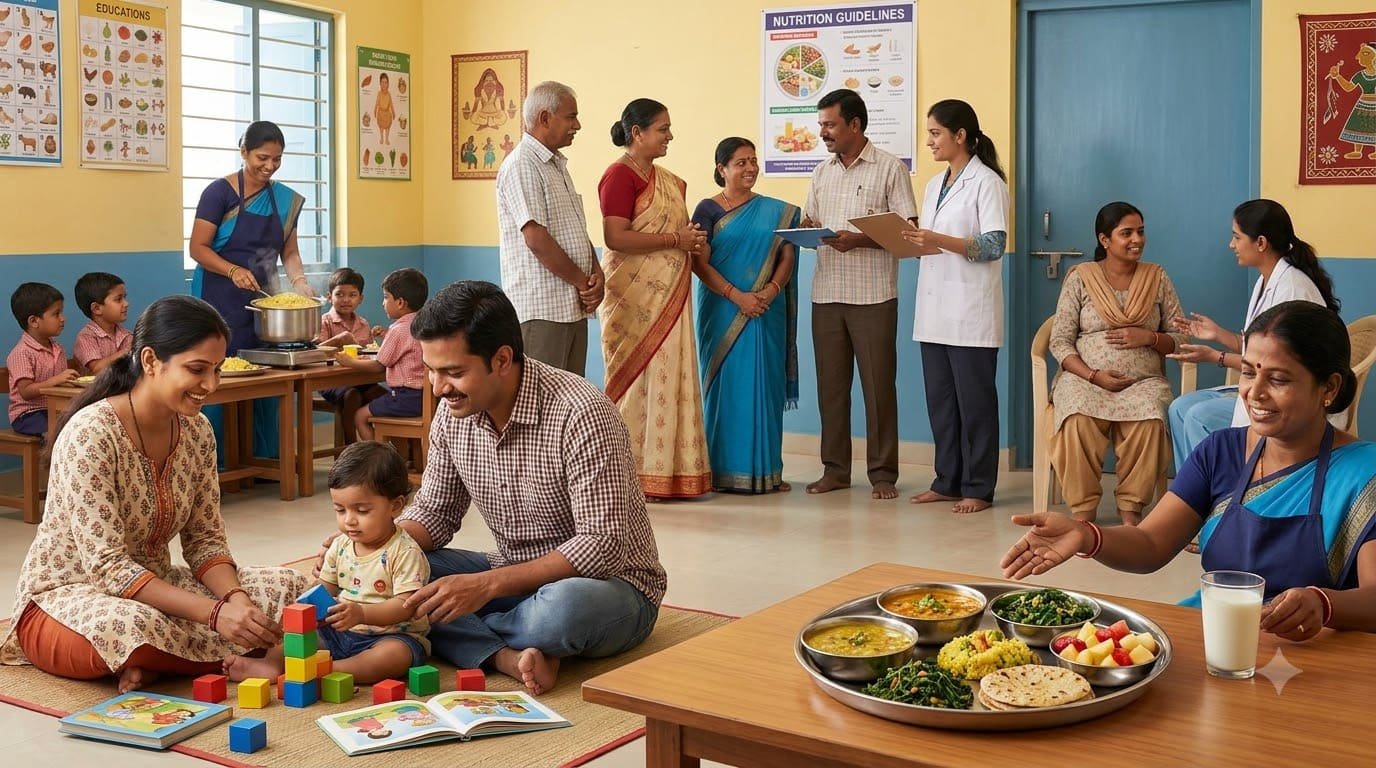
Anganwadi Centres across India will hold live demonstrations of healthy, affordable recipes using ingredients from all food groups — with a specific focus on plant-based and animal-based protein sources accessible to families at all income levels.
What this means for you: Visit your local Anganwadi centre this September. The recipe demonstrations and Poshan Melas happening throughout the month are practical, community-level nutrition education that’s genuinely useful for Indian families.
For Indian parents wondering which protein-rich foods to prioritise for their toddlers, our healthy snacks for toddlers India guide covers the best protein sources available in Indian kitchens.
Theme 2 — Fresh Hot Cooked Meals at Anganwadi Centres
A significant development this year: revised Supplementary Nutrition Programme (SNP) guidelines now, for the first time, formally define and mandate Hot Cooked Meals at Anganwadi Centres — with weekly menu rotation using millets, pulses, and seasonal vegetables.
SNP Menu Boards will be displayed at every Anganwadi Centre, making daily menus and entitlements visible to parents. Anganwadi Management Committees — community-level oversight bodies — will monitor meal quality and menu adherence.
What this means for you: If your child attends an Anganwadi centre, you can now check the SNP Menu Board to see what your child is being fed. The Anganwadi Management Committee in your area is a legitimate channel to raise concerns about food quality.
Theme 3 — Community Ownership and Accountability
“Hamari Anganwadi Hamari Jimmedari” is not just a slogan — it reflects a structural shift. At least one Anganwadi Management Committee meeting will be held at every centre during Poshan Maah, with community members, parents, SHG members, and Panchayat representatives all invited to participate.
What this means for you: This September, Indian parents have a formal mechanism to engage with their local Anganwadi centre. If you have a child under 6 — attend the AMC meeting at your nearest Anganwadi. Your presence and voice matter.
Theme 4 — Nutrition, Early Stimulation and Education
For children aged 0–3 years, Anganwadi Workers will conduct dedicated home visits during Poshan Maah, providing counselling on responsive caregiving and early stimulation through age-appropriate activities. A dedicated drive will record the developmental milestones of all enrolled children aged 0–3 years, with fast-track referrals for children requiring intervention.
For children aged 3–6 years, every Anganwadi Centre will celebrate an Early Childhood Care and Education (ECCE) Day — with parent-child activities showcasing early learning.
What this means for you: If your child’s developmental milestones haven’t been formally assessed recently — request an assessment from your ASHA worker or Anganwadi worker this month. The system is specifically set up for this during Poshan Maah.
Theme 5 — 10 Years of PMMVY
Poshan Maah 2026 marks the 10th anniversary of the Pradhan Mantri Matru Vandana Yojana — the government’s flagship maternity benefit scheme that provides direct cash support to pregnant and lactating women.
A 100% saturation drive will enrol all eligible pregnant and lactating women during Poshan Maah, and Direct Benefit Transfers will be expedited.
What this means for you: If you are pregnant or have recently delivered and have not yet claimed PMMVY benefits — September 2026 is the time to register. Contact your ASHA worker, Anganwadi worker, or nearest government health centre.
What Happens at Anganwadi Centres This Month
Throughout September, every Anganwadi Centre in India will be running specific activities:
For families with children aged 0–3: Home visits from Anganwadi Workers for developmental milestone recording and early stimulation guidance.
For children aged 3–6: ECCE Day celebrations with parent-child activities. Exposure visits to nearby government primary schools.
Community events: Nutrition quiz competitions. Community viewings of IEC videos on newborn care, traditional childcare practices, and parent-infant interaction.
Practical nutrition support: Recipe demonstrations, Poshan Melas, protein-rich food campaigns.
MumPappaHub’s Take
The 9th Rashtriya Poshan Maah’s theme — “Hamari Anganwadi Hamari Jimmedari” — marks a meaningful shift in how India’s nutrition programme is being framed. For the first eight editions, Poshan Maah was primarily a government-run awareness campaign. This year’s edition explicitly asks communities and parents to take ownership.
The Anganwadi Management Committee structure, the SNP Menu Boards, and the community-level accountability mechanisms are all designed to make the Anganwadi system more transparent and more responsive to the families it serves.
For Indian parents of young children — this is the month to engage with your local Anganwadi. Not just as a beneficiary, but as a participant. Visit. Ask questions. Attend the AMC meeting. The system works better when parents are present.
Related Reading on MumPappaHub:
- Iron Rich Foods Babies Toddlers India
- Healthy Snacks for Toddlers India
- Superfoods for Toddler Brain Development
- Starting Baby on Solid Foods India
- How to Increase Breast Milk Supply
- Baby Development Month by Month
- Baby Vaccination Schedule India 2026
Source: Ministry of Women and Child Development, Government of India. Press release dated September 7, 2026. “Union Minister Annpurna Devi to launch 9th Rashtriya Poshan Maah 2026 at Varanasi on 9th September.”
MumPappaHub — Real talk for real parents. mumpappahub.com
