
Medical Disclaimer: This article is for informational purposes only and reviewed against WHO and IAP guidelines. Newborn jaundice can be serious — always consult your paediatrician if you notice yellowing in your baby.
Newborn jaundice India is something every new parent needs to understand — because it is the most common condition requiring medical attention in the first week of a baby’s life, affecting 60% of full-term babies and 80% of premature babies.
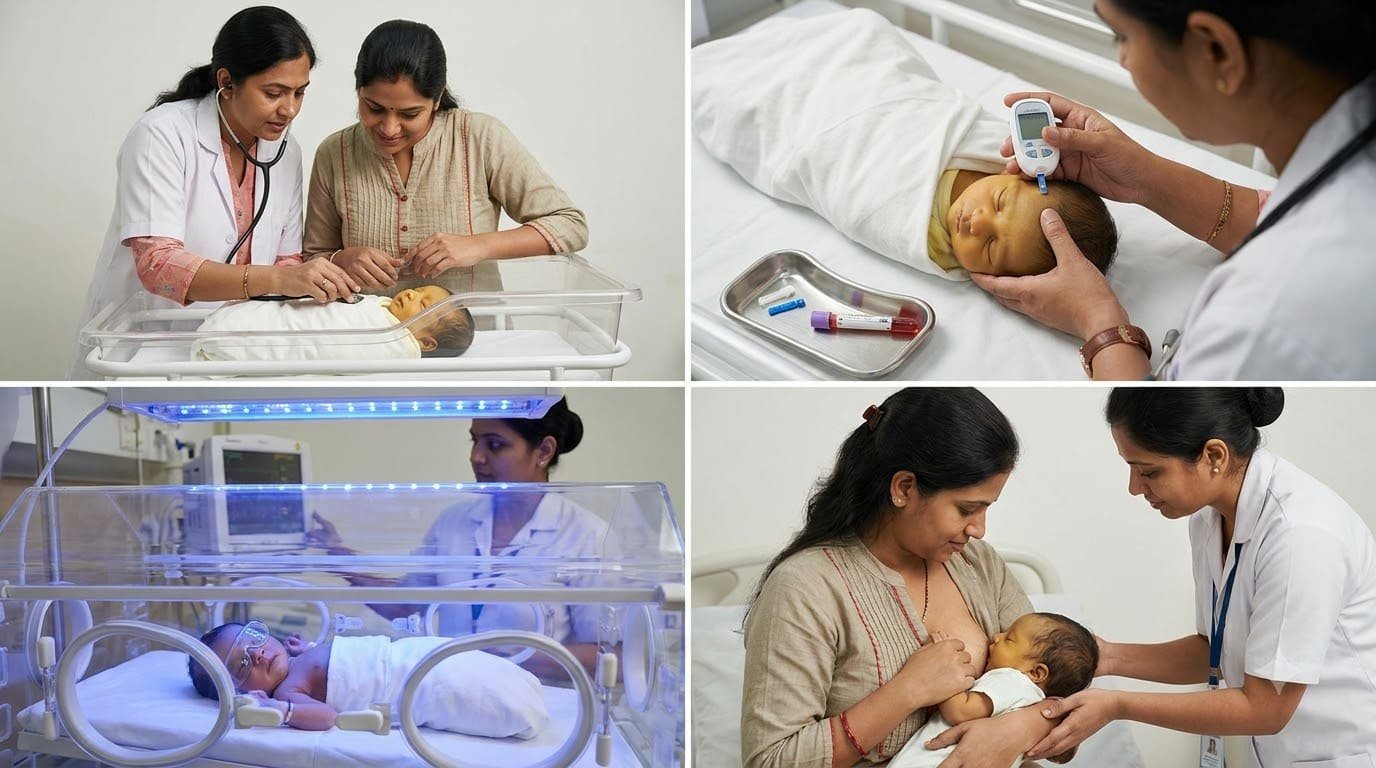
My son was born on a Tuesday. By Thursday, the nurse at the hospital looked at him carefully under the window light and said, “He’s looking a little yellow. Let’s check his bilirubin.” By Friday morning, he was under a phototherapy lamp — a glowing blue light that he lay under for eighteen hours, eyes covered with tiny eye patches, while I sat beside him trying to understand what was happening and why.
He was absolutely fine by Saturday. Bilirubin came down, phototherapy was stopped, he fed well, and we went home on Sunday. The whole episode lasted three days and caused no lasting harm.
But those three days were among the most anxious of my life — because I didn’t understand what jaundice was, why it happens to so many babies, what the warning signs of serious jaundice look like, and at what point home management stops being appropriate.
This guide is what I needed that Friday morning.
What Is Newborn Jaundice India — Understanding Bilirubin
Newborn jaundice India must begin with understanding bilirubin — because jaundice is not a disease in itself. It is a visible sign of elevated bilirubin in the blood.
Bilirubin is a yellow pigment produced when red blood cells are broken down. In adults, the liver processes bilirubin efficiently and excretes it through bile and urine. In newborns, the liver is immature and cannot process bilirubin as quickly as it is produced — because newborns break down red blood cells at a much faster rate than adults (fetal red blood cells have a shorter lifespan) and the newborn liver hasn’t yet reached full processing capacity.
The result: bilirubin accumulates in the blood and deposits in the skin and whites of the eyes — producing the yellow colour called jaundice (in Hindi: peelia or halka peela rang).
According to the World Health Organization’s guidelines on newborn care, physiological jaundice in newborns is expected and normal — it is a consequence of the transition from fetal to newborn physiology, not a sign that something has gone wrong. The Indian Academy of Pediatrics provides specific bilirubin thresholds for Indian newborns and clear guidance on when phototherapy is required.
The critical distinction: Most newborn jaundice is physiological — normal, self-limiting, and requiring only monitoring. A smaller proportion is pathological — caused by underlying conditions, requiring prompt treatment. The parent’s role is to recognise the warning signs that distinguish one from the other.
Types of Newborn Jaundice
Physiological Jaundice — Normal and Expected
Physiological jaundice appears on Day 2 or 3 of life, peaks around Day 4-5, and resolves on its own by Day 10-14 in full-term babies.
This is the most common type. In Indian babies, slightly higher bilirubin levels are considered normal compared to some Western populations — the IAP guidelines specifically account for this.
Why it happens: Fetal red blood cells (which carry fetal haemoglobin) are broken down rapidly after birth as they are replaced by adult red blood cells. The immature liver cannot process the resulting bilirubin quickly enough.
Breastfeeding Jaundice — Days 2-5
Breastfeeding jaundice occurs in the first days of life in babies who are not feeding frequently enough. Inadequate breast milk intake means inadequate bowel movements — and bilirubin is excreted through stool. Less stool = more bilirubin recirculated.
Solution: More frequent breastfeeding — 8-12 times per 24 hours in the first days. This is the single most effective prevention for breastfeeding jaundice. This is why colostrum and frequent early feeds matter so much.
Breast Milk Jaundice — Week 2-3
A different condition from breastfeeding jaundice — breast milk jaundice occurs later, from around Day 5-7, and can persist for several weeks. It is caused by substances in some mothers’ breast milk that affect bilirubin processing.
It is not a reason to stop breastfeeding. The bilirubin level is typically not high enough to cause harm, and continuing breastfeeding is the correct approach in almost all cases.
Pathological Jaundice — Requires Urgent Assessment
Pathological jaundice appears within the first 24 hours of life — before Day 2. This timing is the key warning sign. Early-onset jaundice indicates an underlying cause that needs investigation.
Causes include: blood group incompatibility (Rh or ABO), G6PD deficiency (very common in Indian male babies), infection, or other conditions.
Jaundice within the first 24 hours is always a medical emergency. Go to the hospital.
10 Best Warning Signs — Newborn Jaundice India
Warning Sign 1 — Jaundice Before 24 Hours of Age
This is the most important warning sign. Physiological jaundice never appears in the first 24 hours — the liver takes time to become overwhelmed. Any yellowing of the skin or eyes before 24 hours of age indicates pathological jaundice requiring immediate medical assessment.
Action: Go to the hospital the same day. Do not wait and see.
Warning Sign 2 — Yellow Colour Spreading to Arms, Legs, and Palms
Jaundice typically spreads from head downward — starting in the face, progressing to the chest, then abdomen, then arms and legs. The further down the body the yellowing has spread, the higher the bilirubin level is likely to be.
The blanch test: Press gently on the baby’s skin — forehead, nose, chest — and release. If the skin looks yellow after releasing the pressure, jaundice is present. This works on all skin tones.
Action: If yellow colour has reached the arms, legs, or the soles of the feet and palms — this indicates a higher bilirubin level. See your paediatrician same day.
Warning Sign 3 — Yellow Sclera (Whites of the Eyes)
The whites of the eyes (sclera) turning yellow is a reliable sign that bilirubin levels are elevated. It is visible in all skin tones — making it particularly useful for identifying jaundice in babies with darker skin where skin yellowing can be harder to see.
How to check: Gently pull down the lower eyelid in natural light. The sclera — the white area — should be white. If it looks yellow, jaundice is present.
Warning Sign 4 — Baby Very Difficult to Wake for Feeds
Bilirubin in high concentrations is toxic to the brain. One of the earliest signs of bilirubin affecting the brain (called kernicterus or acute bilirubin encephalopathy) is unusual sleepiness — a baby who is very difficult to wake for feeds, who feeds weakly, or who seems generally limp.
Normal sleepiness: Baby wakes for feeds every 2-3 hours, feeds vigorously, settles after feeding.
Concerning sleepiness: Baby cannot be roused for feeds, feeds weakly when finally latched, falls asleep at the breast after just a few minutes without transferring adequate milk.
Action: This requires same-day paediatrician assessment.
Warning Sign 5 — Jaundice Not Improving After Day 5
In physiological jaundice, bilirubin typically peaks at Day 4-5 and then begins to decline. If jaundice is visibly worse after Day 5 or still significant at Day 10, this warrants assessment — it may not be resolving as expected, or may be breast milk jaundice.
Warning Sign 6 — Jaundice Persisting Beyond 2 Weeks
Physiological jaundice in full-term babies resolves by Day 10-14. Jaundice that persists beyond 2 weeks in a full-term baby — called prolonged jaundice — requires investigation. The most important cause to rule out in Indian babies is hypothyroidism and, in some communities, biliary atresia.
Action: Any jaundice still present at 2 weeks warrants a paediatrician visit and assessment.
Warning Sign 7 — Dark Yellow/Orange Urine
Newborn urine should be pale yellow or nearly colourless. Dark yellow or orange urine indicates that bilirubin is being excreted through the kidneys — a sign that bilirubin levels are elevated. This is often more reliably noticeable in a nappy than visual skin assessment.
Note: The pink/orange “brick dust” staining sometimes seen in nappies in the first 2-3 days is uric acid crystals — normal and different from bilirubin staining.
Warning Sign 8 — Pale/White or Chalky Stools
Normal newborn stools transition from black meconium (first 1-2 days) to green-yellow and then to yellow-orange milk stools. Pale, white, or chalky/clay-coloured stools are abnormal and may indicate biliary atresia — a serious condition where bile ducts are absent or blocked.
Action: Pale or white stools in any newborn require immediate medical assessment.
Warning Sign 9 — Baby Who Is G6PD Deficient
G6PD deficiency (glucose-6-phosphate dehydrogenase deficiency) is extremely common in India — particularly in South Indian, North-Eastern, and many tribal communities — and in male babies specifically (it is X-linked). G6PD-deficient babies are at significantly higher risk of severe jaundice that can escalate rapidly.
If your family has known G6PD deficiency, if your community has high G6PD prevalence, or if your baby is male and the family is from a high-prevalence community: inform your paediatrician before discharge from the hospital. G6PD deficiency can be tested with a blood test.
Warning Sign 10 — High-Pitched Cry or Arching of the Back
These are late signs of bilirubin toxicity affecting the brain — they indicate kernicterus, a medical emergency. A high-pitched, unusual cry (different from a baby’s normal cry) and arching of the back (opisthotonus) in a jaundiced baby require emergency hospital treatment immediately.
Action: If a jaundiced baby develops a high-pitched cry or arching — call an ambulance or go to the emergency department immediately.
Treatment of Newborn Jaundice India
Frequent Breastfeeding — The Most Important Home Action
For mild jaundice, frequent breastfeeding — 8-12 feeds per 24 hours — is the most important management. Breast milk stimulates bowel movements, and bilirubin is excreted through stool. Frequent feeding prevents and treats mild jaundice.
This is why colostrum matters so much: The laxative effect of colostrum helps clear bilirubin-rich meconium from the intestines, reducing bilirubin reabsorption.
Sunlight — The Traditional Remedy With Limits
The traditional Indian practice of placing a jaundiced baby in indirect sunlight has scientific basis — natural light breaks down bilirubin in the skin. However, there are important limits:
Safe: Indirect morning sunlight — filtered through a window, not direct. 15-20 minutes once or twice daily.
Not safe: Direct sunlight on a newborn’s delicate skin — sunburn risk.
Not effective for significant jaundice: If bilirubin is above the phototherapy threshold, sunlight is not a substitute for medical phototherapy.
Phototherapy — Medical Blue Light Treatment
When bilirubin reaches a level that the IAP considers requiring treatment (based on the baby’s age in hours and birth weight), phototherapy is prescribed. This involves placing the baby under specific blue-spectrum fluorescent lights that break down bilirubin in the skin.
What it looks like: Baby lies under the blue light with only a nappy on and small eye patches to protect the eyes. Parents can take the baby out for feeds and brief holds. Phototherapy is very effective — bilirubin typically falls significantly within 24 hours.
In India: Phototherapy is available at most government hospitals free of charge. Home phototherapy devices are available for mild cases — your paediatrician will advise if this is appropriate.
Exchange Transfusion — For Severe Cases
In very high bilirubin levels that don’t respond to phototherapy, or in cases of kernicterus, exchange transfusion — replacing the baby’s blood with donor blood — may be required. This is rare with appropriate monitoring and timely treatment.
Checking Bilirubin — India Options
Serum bilirubin: A blood test (heel prick) giving an exact bilirubin number. Standard in hospitals.
Transcutaneous bilirubinometer (TcB): A non-invasive device placed on the skin that estimates bilirubin without a blood test. Available at many hospitals and some private paediatric clinics. Useful for screening and monitoring.
Visual assessment: Done by paediatricians and trained nurses — assessing the spread of yellowing from head downward. Less precise but useful for initial assessment.
What Causes Jaundice to Be More Severe — India-Specific Risks
G6PD deficiency: As discussed — common in India, increases jaundice severity significantly.
Blood group incompatibility: Rh incompatibility (Rh-negative mother, Rh-positive baby) or ABO incompatibility causes significant early jaundice. Rh incompatibility is preventable with anti-D injection to the mother during pregnancy.
Prematurity: Premature babies have even more immature livers — jaundice is more common and more severe.
Inadequate feeding: Particularly in the first days. This is why frequent breastfeeding is so critical.
Bruising from delivery: Instrumental deliveries (forceps, vacuum) cause bruising which increases red blood cell breakdown and bilirubin load.
FAQ — Newborn Jaundice India
Q: My baby looks slightly yellow on Day 3. Should I go to the hospital?
Day 3 yellowing is within the expected window for physiological jaundice. The key questions are: How far has the yellowing spread? Is the baby feeding well and waking for feeds? Is the baby alert when awake? If the yellow is confined to the face and chest, the baby is feeding 8+ times per 24 hours, and the baby seems well — monitor at home and call your paediatrician to report and get guidance. If yellowing has spread to the arms and legs, or the baby is difficult to wake — see the paediatrician same day.
Q: Can I treat jaundice at home with sunlight?
Filtered indirect morning sunlight — through a window — can help with mild physiological jaundice. It is not a replacement for phototherapy when bilirubin is above the treatment threshold. Never put a newborn in direct sunlight — the skin is too delicate. If your paediatrician has recommended phototherapy — this is not something sunlight can substitute for.
Q: Should I stop breastfeeding if the baby has jaundice?
Almost certainly not. The vast majority of newborn jaundice — including breast milk jaundice — does not require stopping breastfeeding. Frequent breastfeeding is actually the most important treatment for mild jaundice. If your paediatrician is recommending stopping breastfeeding, ask them to explain specifically why and for how long — this is rarely necessary.
Q: My baby is under the phototherapy light. Can I hold him?
Yes — absolutely. Take the baby out of the phototherapy light for feeds and brief holds. Breastfeeding must continue during phototherapy — the nutrition and fluid from breast milk supports bilirubin excretion. Your paediatrician will advise on how long the baby needs to be under the light versus time out.
Q: What is G6PD deficiency and should I get my baby tested?
G6PD deficiency is a genetic enzyme deficiency that makes red blood cells more vulnerable to breaking down — which increases bilirubin production and jaundice severity. It is very common in India — particularly in South Indian, North-Eastern, and some other communities, and more commonly in male babies. If your family is from a community with known high prevalence, or if there is a family history — ask your paediatrician about testing your baby before discharge. It is a simple blood test.
Q: My 3-week-old still looks yellow. Is this a problem?
Jaundice persisting beyond 2 weeks in a full-term baby — called prolonged jaundice — requires investigation. Most commonly it is breast milk jaundice which is benign. But prolonged jaundice can sometimes indicate thyroid problems or, rarely, biliary atresia. The most important immediate check: look at the colour of the baby’s stools. Normal yellow/mustard stools with prolonged jaundice — likely breast milk jaundice, see paediatrician for assessment. Pale, white, or chalky stools with prolonged jaundice — go to hospital urgently.
More from MumPappaHub — Read These Next:
- Newborn Care Tips: Complete Guide
- Baby Fever Guide: When to Worry
- Baby Vaccination Schedule India 2026
- Newborn Sleep Tips
- How to Increase Breast Milk Supply
- Baby Development Month by Month
- Indian Baby Weight Chart 0-12 Months
- Baby Blues vs Postpartum Depression
- Diaper Rash Treatment India
- Baby Gas & Colic Relief India
- Baby First Year Milestones
- Baby Massage Maalish India
About This Article
Written by the MumPappaHub editorial team — including a mother whose son was under a phototherapy lamp at two days old, with tiny eye patches, while she sat beside him trying to understand what was happening. He was home by Sunday. The anxiety of those three days was real — and entirely preventable with the right information.
Reviewed for accuracy against WHO guidelines on newborn care, Indian Academy of Pediatrics neonatal jaundice management guidelines, and IAP bilirubin thresholds for Indian newborns. This content is for general informational purposes only and does not constitute medical advice. Always consult your paediatrician about jaundice in your newborn.
MumPappaHub — Real talk for real parents. mumpappahub.com
