
Medical Disclaimer: This article is for informational purposes only. Always consult your paediatrician before starting massage if your baby was premature, has a skin condition, or has any medical concerns.
Baby massage maalish India is one of those rare topics where the traditional Indian practice and modern science are in complete agreement.
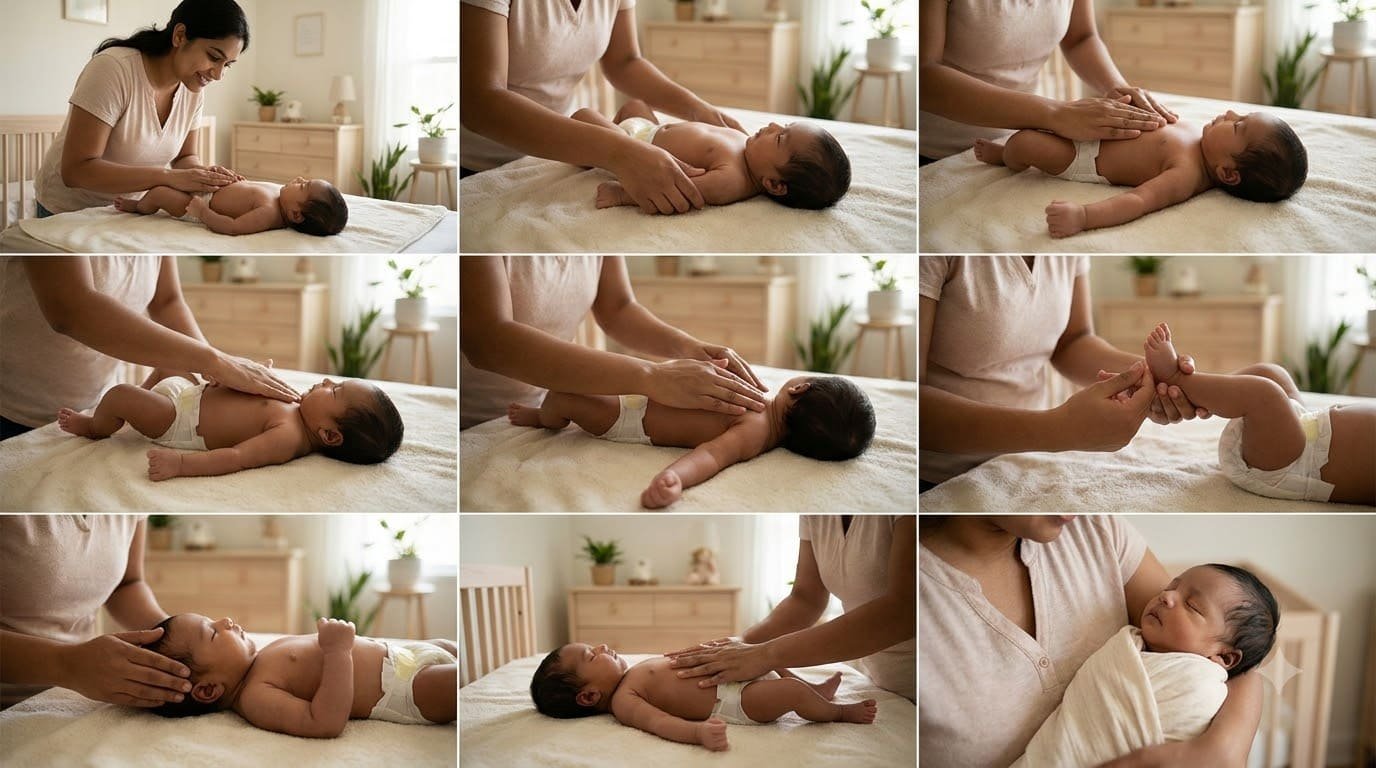
My mother began massaging my son on day three of his life. She arrived with a small bottle of sarson ka tel — the same mustard oil she had used on my husband as a baby, and on her own children before that. She sat cross-legged on the floor, laid him on her outstretched legs, and began with a slow, confident rhythm that told me immediately she had done this thousands of times.
I watched, feeling simultaneously grateful and slightly superfluous. She sang softly while she worked. He was, for the first time since birth, completely still and completely relaxed.
“Roz karna hai,” she said. Every day.
She was right — not just culturally, but scientifically. The research on infant massage is genuinely impressive. This guide covers what the science shows, the right technique for Indian maalish, which oils are appropriate at which ages, and what mistakes to avoid.
Baby Massage Maalish India — What the Science Says
Baby massage maalish India is supported by a significant body of research that validates what Indian families have known for generations.
According to the World Health Organization’s guidelines on newborn care, infant massage is a recommended practice for promoting healthy growth and development in newborns. Studies cited by the WHO show that regular massage in preterm and term infants produces measurable improvements in weight gain, sleep, and neurological development. The Indian Academy of Pediatrics recognises traditional Indian infant massage as a beneficial practice and recommends it as part of routine newborn care.
What research shows baby massage does:
Weight gain: Multiple studies — including Indian research published in Indian Pediatrics — show that massaged babies gain weight faster than non-massaged babies. The mechanism involves improved gastric motility and insulin secretion triggered by the tactile stimulation.
Sleep improvement: Cortisol (the stress hormone) decreases and melatonin increases following massage. Massaged babies fall asleep faster and sleep longer.
Neurological development: Touch stimulation directly supports myelination — the formation of myelin sheaths around nerve fibres that determines how efficiently nerve signals travel. Early tactile stimulation supports brain connectivity.
Bonding: Skin-to-skin touch during massage triggers oxytocin release in both parent and baby — the bonding hormone. Regular massage is one of the most evidence-based ways to deepen the parent-infant bond.
Reduced colic and gas: The abdominal massage component specifically helps move trapped gas through the intestine, reducing the discomfort of colic. Our baby gas colic relief India guide covers this in detail.
Immune function: Some research suggests massage supports immune function by reducing stress hormones that suppress immunity.
Which Oil to Use — The Indian Context
The choice of massage oil is one of the most debated aspects of traditional Indian maalish — with strong opinions across regions and generations. Here is an honest assessment:
Mustard Oil (Sarson Ka Tel) — North India Standard
Mustard oil is the most traditional massage oil in North and Central India. It has genuine antifungal and antibacterial properties, is warming (beneficial in cooler weather), and has been used for infant massage for centuries.
However — recent research raises a concern: Studies suggest that mustard oil applied to infant skin may compromise the skin barrier over time due to its high erucic acid content. A 2017 study in the journal Pediatric Dermatology found that mustard oil increased skin permeability in neonates compared to sunflower oil.
Practical position: If your family has used mustard oil for generations without problems, and your baby’s skin is healthy — it is not harmful in the short term. For babies with dry or sensitive skin, or any family history of eczema, a lighter oil may be preferable.
Coconut Oil — South India Standard and Research-Supported
Virgin coconut oil is the traditional choice in South India and has the strongest research support for infant massage. It has documented anti-inflammatory and antimicrobial properties, is easily absorbed, and — importantly — strengthens rather than compromises the skin barrier.
A study in the Indian Journal of Dermatology found coconut oil superior to mineral oil for moisturising premature infant skin. For most Indian babies, virgin coconut oil is the most evidence-supported choice.
Use: Virgin coconut oil (cold-pressed) — not refined or processed coconut oil.
Sesame Oil (Til Ka Tel) — Ayurvedic Recommendation
Sesame oil is the oil of choice in Ayurvedic infant care. It is warming, rich in antioxidants, and has mild antimicrobial properties. Well-tolerated by most babies.
Best for: Cooler weather and winter months. The warming quality is particularly appropriate in cold seasons.
Sunflower Oil — Research-Supported, Practical
Refined sunflower oil has good research support for infant skin — it maintains the skin barrier without the concerns associated with mustard oil. For parents who want a research-validated, widely available option: sunflower oil is appropriate.
What to Avoid:
❌ Olive oil — despite being natural, research shows it may worsen dry skin and eczema in babies due to its oleic acid content. ❌ Fragrant or perfumed oils — can cause skin irritation and contact dermatitis.
❌ Baby powder alongside massage — inhalation risk.
❌ Any oil on broken or irritated skin.
10 Best Baby Massage Maalish India Techniques
1. Preparation — Set the Stage Correctly
Before touching the baby, prepare the environment:
Room temperature: Warm — 26–28°C. Cold air on an undressed baby causes stress rather than relaxation. Close windows, turn off fans or AC.
Oil temperature: Warm the oil by placing the bottle in a bowl of warm water for a few minutes. Cold oil on a baby’s skin triggers a startle response. Test on your inner wrist — should feel comfortably warm.
Timing: At least 45 minutes after a feed — never on a full stomach (can cause vomiting) and never when the baby is very hungry. The ideal time is when the baby is alert and calm — not already sleepy, not hungry.
Your hands: Wash thoroughly. Remove any jewellery that could scratch. Rub palms together with oil to warm further.
Ask permission: This sounds unusual for a newborn — but look for the baby’s cues. An alert, engaged baby is ready. A fussy, crying, or turning-away baby is telling you this is not the moment.
2. The Opening Strokes — Legs First
Traditional Indian maalish typically begins with the legs — the least sensitive area, which allows the baby to adjust to being touched and undressed without the more vulnerable areas (chest, tummy) being exposed first.
Technique: Hold the baby’s ankle gently. Using your thumb and fingers, make a gentle wringing motion from hip to ankle — like wringing a cloth, but softly. Alternate hands in a continuous motion. Cover both sides of the leg.
Then use the sole of your palm to stroke from hip to ankle in long, smooth strokes.
Pressure: Firm enough to feel — not so light it tickles. A gentle but definite contact.
Duration: 1–2 minutes per leg.
3. Feet — Reflex Points
The soles of the feet have significant nerve endings and respond strongly to touch. Foot massage is calming and has documented benefits for digestion and sleep.
Technique: Use your thumb to trace small circles across the entire sole — from heel to toe. Then gently rotate each toe. Press gently on the ball of the foot — this reflex point is associated with digestion in infant reflexology.
Duration: 1 minute per foot.
4. Arms and Hands
Technique: Same wringing motion as the legs — from shoulder to wrist. Then open the palm and massage gently across the palm and each finger.
Many babies resist having their arms massaged initially because the arms are used for self-soothing — hands near the mouth, clasped together. If the baby resists, skip and return later.
Duration: 1 minute per arm.
5. Chest — The Heart Connection
Chest massage is one of the most bonding aspects of the maalish — the parent’s hands directly over the baby’s heart.
Technique: Place both palms flat on the baby’s chest. With very gentle pressure, stroke outward from the centre toward the shoulders — as if smoothing open a book. Then stroke from the centre downward toward the hips.
Key: Keep pressure very light on the chest. The ribs are delicate.
Duration: 1–2 minutes.
6. Tummy — The Colic Relief Step
Abdominal massage is one of the most medically significant parts of the maalish — it directly helps with gas, digestion, and constipation.
Technique: Always clockwise — this follows the direction of the large intestine and helps move gas toward the exit. Anti-clockwise massage works against natural bowel movement direction.
Place fingertips just below the navel. Make slow, gentle clockwise circles — start small, gradually increase. Then use the side of your hand to make gentle I-L-U strokes (these spell “I Love You” and follow the colon): vertical stroke on the baby’s left side (your right), L-shape across the tummy, U-shape up the right, across, and down the left.
Skip this step: If the baby has just eaten, has an umbilical cord stump that hasn’t fallen off, or shows signs of discomfort.
Duration: 2–3 minutes.
7. Back — The Long Stroke
Turning the baby onto their tummy (supervised, awake — this is also tummy time) for back massage:
Technique: Both hands on either side of the spine. Make long, smooth strokes from the neck down to the bottom — never pressing on the spine itself. Then use fingertips to make small circles on either side of the spine.
The spine rule: Never apply direct pressure to the spine. Work alongside it.
Duration: 2–3 minutes.
8. Face and Head — Gentle and Brief
Face and head massage requires particularly light touch.
Face: Use fingertips to make tiny circles on the temples. Stroke from the centre of the forehead outward toward the ears. Gently stroke from the nose outward across the cheeks.
Head: Very gently, use fingertips to make small circles across the scalp — avoiding the fontanelle (soft spot) on young babies.
Duration: 1 minute.
9. The Integration Stroke — Connecting It All
After individual areas, finish with long strokes that connect the body from head to toe — helping the baby’s nervous system integrate the whole experience.
Technique: One long, smooth stroke from the top of the head, down the back, to the feet. Alternate hands. Slow and continuous.
Duration: 1 minute.
10. The Ending — Warm Wrap and Feed
End by wrapping the baby in a warm, soft cotton cloth. If the timing is right, a feed immediately after massage deepens the relaxation and helps the baby settle for sleep.
Many Indian families follow the traditional sequence: maalish → warm bath → feed → sleep. This sequence produces reliable settling particularly in the evening as part of a bedtime routine. Our bedtime routine for baby India guide covers how to integrate maalish into your sleep routine.
Age-Wise Guide to Baby Maalish India
| Age | Duration | Pressure | Notes |
|---|---|---|---|
| 0–4 weeks | 5–10 min | Very light | Avoid face, avoid navel area until cord falls |
| 1–3 months | 10–15 min | Light-medium | Full body — follow baby’s cues |
| 3–6 months | 15–20 min | Medium | Baby more interactive — make it playful |
| 6–12 months | 15–20 min | Medium | May resist — follow their lead |
| 12 months+ | 10–15 min | Medium | Toddlers often enjoy massage before bed |
Common Mistakes to Avoid
Massaging on a full stomach: Wait at least 45 minutes after a feed. Massage immediately after feeding can cause vomiting.
Cold oil: Always warm the oil first. Cold oil triggers stress rather than relaxation.
Too much pressure: Particularly on the chest, abdomen, and head. Baby bones are soft and easily compressed. Keep pressure firm but never forceful.
Anti-clockwise abdominal massage: This works against the natural direction of bowel movement and can worsen gas rather than relieve it. Always clockwise.
Continuing when the baby signals stop: Turning the head away, crying, arching the back, pushing your hands away — these are all “stop” signals. A forced massage is not beneficial. End, soothe, and try again later.
Massaging an unwell baby: Fever, rash, active infection, or any illness — skip massage until recovered.
FAQ — Baby Massage Maalish India
Q: When should I start massaging my newborn?
You can begin from day one if the baby is full-term and healthy — with very light touch and avoiding the umbilical cord area. Many families wait until the cord falls off (usually 7–14 days) before beginning full massage. Premature babies benefit greatly from massage but should only be massaged under guidance from their neonatal team.
Q: Should I use sarson ka tel or coconut oil?
Both are used traditionally and safely across India. For most babies, virgin coconut oil has better research support and is less likely to affect the skin barrier. Mustard oil is warming and appropriate in cool weather, but there is some research suggesting it may increase skin permeability in newborns — for babies with dry or sensitive skin, coconut or sunflower oil may be preferable. Your family tradition and your baby’s skin response are both valid guides.
Q: My baby cries during massage. Should I continue?
No — stop and soothe the baby. Massage is beneficial only when the baby is receptive. Try at a different time — when the baby is alert and calm rather than tired or hungry. Some babies take 2–3 weeks to enjoy massage consistently. Persistence over time, not forcing in the moment, is the approach.
Q: How long should each massage session be?
For newborns: 5–10 minutes. For babies 1–3 months: 10–15 minutes. For older babies: 15–20 minutes. Follow the baby’s cues — end when the baby signals they’ve had enough, regardless of how long has passed.
Q: Is baby massage safe in summer in India?
Yes — with adjustments. Use a lighter oil (coconut oil works well in summer). Keep the room ventilated but not with cold air directly on the baby. The duration can be slightly shorter in hot weather. In very hot weather, a massage before a bath (rather than before sleep) works well.
More from MumPappaHub — Read These Next:
- Newborn Care Tips
- Bedtime Routine for Baby India
- Baby Gas & Colic Relief India
- Baby Fever Guide
- Newborn Sleep Tips
- 4 Month Sleep Regression
- Baby Development Month by Month
- Indian Baby Weight Chart
- Baby Vaccination Schedule India 2026
- Baby Teething Signs & Remedies India
- Baby Blues vs Postpartum Depression
- How to Increase Breast Milk Supply
About This Article
Written by the MumPappaHub editorial team — including a mother who watched her mother-in-law begin massaging her son on day three with a confidence that came from decades of practice. She sat cross-legged on the floor, sang softly, and he was — for the first time — completely still. “Roz karna hai,” she said. Every day. She was right.
Reviewed for accuracy against WHO newborn care guidelines and Indian Academy of Pediatrics recommendations on infant massage. This content is for general informational purposes only and does not constitute medical advice. Always consult your paediatrician for guidance specific to your baby.
MumPappaHub — Real talk for real parents. mumpappahub.com

3 Comments