
Medical Disclaimer: This article is for informational purposes only. If your baby has persistent sleep difficulties, consult your paediatrician to rule out underlying causes.
Bedtime routine for baby India is what I wish someone had explained to me in the first week home from the hospital — instead of month three, when I was surviving on three-hour sleep fragments and had begun to genuinely believe that the concept of a full night’s sleep was something I had invented in a delusional past life.
My son had no bedtime. He had no routine. He slept when he couldn’t stay awake anymore, which was sometimes at 7 PM and sometimes at 11 PM and once memorably at 2 AM after a particularly stimulating evening of relatives visiting and being passed around like a cricket trophy.
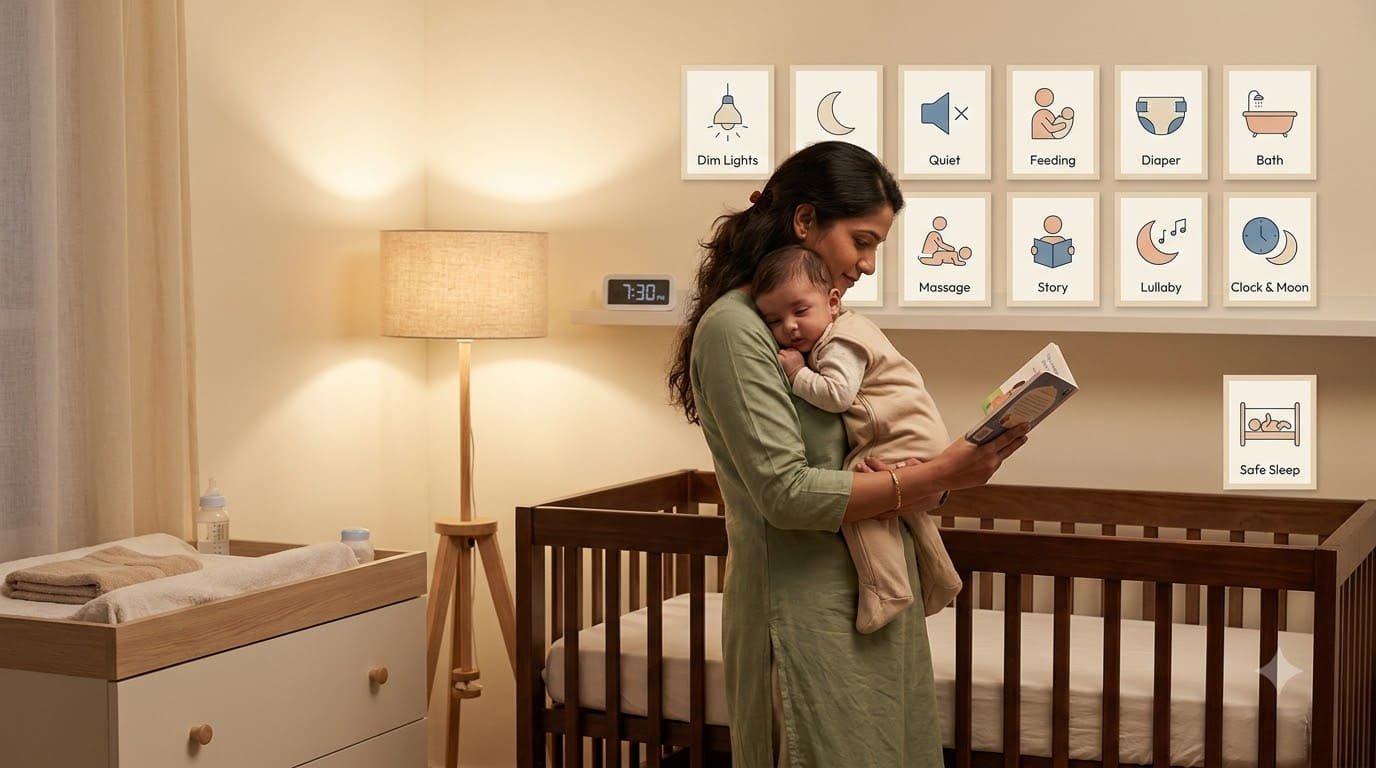
The chaos ended — slowly, imperfectly, but genuinely — when we introduced a consistent bedtime routine at around ten weeks. Not a complicated one. Four steps, the same order, every evening. Within two weeks, he was falling asleep faster. Within a month, he was sleeping in a longer first stretch. The routine itself had become the signal his brain needed.
This guide covers the bedtime routine for baby India — the science behind why routines work, the specific steps that matter most, how to make it work in Indian households where evenings are often social and chaotic, and the age-by-age adjustments that keep the routine relevant as the baby grows.
Why Bedtime Routine for Baby India Works — The Science
Bedtime routine for baby India is not just a nice habit. It is a neurological intervention — and understanding why it works makes it easier to implement consistently.
Babies and young children do not have a fully developed circadian rhythm — the internal biological clock that regulates sleep and wakefulness — at birth. The circadian rhythm calibrates over the first three to four months of life, using light, temperature, feeding patterns, and consistent routines as cues.
A consistent bedtime routine works by creating a predictable sequence of events that the brain associates with sleep. After several weeks of repetition, the routine itself triggers the release of melatonin — the hormone that initiates sleep. The baby begins to get drowsy during the routine, not just after it ends.
According to the World Health Organization’s guidelines on infant sleep and development, consistent sleep routines are associated with better sleep duration, fewer night wakings, and improved developmental outcomes in infants and toddlers. The Indian Academy of Pediatrics recommends establishing a consistent, calming bedtime routine from as early as six to eight weeks as a primary strategy for supporting healthy infant sleep.
The key word is consistent — the same steps, in the same order, at roughly the same time, every night. Variation significantly reduces effectiveness.
When to Start — Age Guide
| Age | Routine Complexity | Expected Effect |
|---|---|---|
| 0–6 weeks | 1–2 steps: dim lights, feed, sleep | Minimal — too early for circadian rhythm |
| 6–12 weeks | 3–4 steps: bath/massage, feed, dark room | First effects begin — 2–3 weeks in |
| 3–6 months | 4–5 consistent steps | Clear effect on sleep onset |
| 6–12 months | 5–6 steps with song or book | Strong conditioned response |
| 1–3 years | 6–8 steps with story, song | Toddlers often initiate routine themselves |
Start as early as 6 weeks — not because you’ll see dramatic results immediately, but because establishing the habit early means you’re not trying to introduce a new routine to a baby who has already developed different expectations.
10 Best Steps for Bedtime Routine for Baby India
Step 1 — Consistent Timing — The Foundation of Everything
Before any specific routine step, the most important decision is: what time will bedtime be? And can you maintain it consistently?
Recommended bedtime by age:
| Age | Ideal Bedtime |
|---|---|
| 0–3 months | 7:30–9:00 PM |
| 3–6 months | 7:00–8:00 PM |
| 6–12 months | 6:30–7:30 PM |
| 1–3 years | 7:00–8:00 PM |
Earlier is usually better. This is counterintuitive but well-supported by sleep research. Earlier bedtimes produce longer total sleep, not earlier morning waking. Overtired babies kept up late to “make them sleep more” consistently sleep worse — more night wakings, earlier morning rising, shorter total sleep.
The Indian family challenge: Evenings are often the most social time — relatives visit, fathers return from work, grandparents want time with the baby. A 7:30 PM bedtime feels disruptive to family life.
The practical solution: Move family interaction to 5–6 PM. Give relatives and returning parents their time with the baby before the routine begins. Then the 7:30 PM routine is a clear signal: baby time is done, sleep time is starting.
Step 2 — Wind Down the Environment — 30 Minutes Before
Thirty minutes before the routine begins, start dimming the environment:
Lights: Dim or turn off bright overhead lights. Use a bedside lamp or dim setting. The brain reads bright light as “daytime” and suppresses melatonin. Dim light signals that night is coming.
Sound: Reduce noise levels. If television is on in adjacent rooms — turn it down or off. The contrast between a noisy household and a quiet bedroom is jarring for babies.
Screen ban: No screens for anyone in the baby’s vicinity for thirty minutes before bedtime. Blue light from screens suppresses melatonin significantly.
Activity level: Stop exciting play, tickling, and stimulating interactions. Shift to calm — gentle talking, quiet holding, slow movement.
Step 3 — Warm Bath — The Sleep Temperature Trigger
A warm bath is one of the most physiologically effective pre-sleep tools available. It works through a specific mechanism: when the body is warmed by the bath and then exposed to cooler air, core body temperature drops — and this drop in core temperature triggers sleepiness.
This is not just comfort. It is thermoregulation activating the sleep drive.
How to give a pre-sleep bath: Comfortably warm water — test on your inner wrist. 5–10 minutes is sufficient. Keep the room warm afterward so the baby doesn’t get chilled during drying. Keep it calm and quiet — this is not play bath time. Soft lighting, low voice, slow movements.
If daily baths aren’t practical: Alternate days is fine. On no-bath nights, substitute a warm sponge wipe of face, hands, and neck — which provides a similar (if smaller) thermoregulatory cue.
Indian summer note: In peak summer heat, a slightly cooler bath actually works well — the body temperature drop effect still occurs as the baby comes out of the water into a room-temperature environment.
Step 4 — Baby Massage (Maalish) — The Indian Sleep Superpower
Baby massage — the traditional Indian maalish — has documented sleep benefits alongside its well-known developmental advantages. Studies on infant massage show reduced cortisol (stress hormone), increased melatonin, and improved sleep duration and quality in massaged babies.
This traditional Indian practice is not just cultural — it is physiologically sound pre-sleep preparation.
How to do pre-sleep maalish: Warm oil — coconut oil in summer, sesame or mustard oil in cooler months. Gentle, slow, firm strokes — not stimulating or playful. Arms, legs, back, tummy in a consistent sequence. 5–7 minutes. Keep the environment dim and quiet.
Age: From birth — adjust pressure appropriately for age.
The dual benefit: The maalish itself is a powerful sleep cue after weeks of repetition — the smell of the oil, the warmth, the touch sequence all become part of the conditioned sleep signal.
Step 5 — Fresh Nappy and Sleep Clothes
A fresh nappy and comfortable sleep clothing are practical steps that also function as part of the conditioned routine signal.
Sleep clothes for Indian conditions: Summer — a single layer of thin cotton. Many babies sleep comfortably in just a cotton vest or nappy in hot weather. Do not overdress a baby for sleep.
Monsoon — a light cotton outfit. Humidity makes bundling unnecessary in most of India.
Winter — an additional layer as needed. Footie pyjamas or a sleep sack are useful when temperatures drop — they eliminate the need for loose blankets which pose a suffocation risk for babies under 12 months.
Never cover a baby’s face or head for sleep — even in cold weather. Overheating during sleep is a SIDS risk factor.
Step 6 — Feed — Timing Matters
For breastfed and formula-fed babies, a feed is an essential part of the bedtime routine. It provides satiety that supports longer sleep, and the warmth and closeness of feeding are themselves calming.
The drowsy-but-awake distinction (from 3 months): A baby who falls fully asleep during the feed and is placed in the cot already asleep learns to associate falling asleep with feeding. When they rouse between sleep cycles at night, they look for the same conditions to return to sleep — which means feeding again.
A baby who finishes the feed, is kept slightly awake during winding, and is placed in the cot drowsy but not fully asleep, has the opportunity to practice falling asleep independently.
Practically: Finish the feed before the final settling step. Wind, then place in cot when drowsy but awake from around 10–12 weeks.
Step 7 — White Noise — Optional but Powerful
White noise — a consistent, non-startling background sound — serves two purposes in a bedtime routine: it masks household noise that might wake a light-sleeping baby, and it becomes a powerful sleep cue through association.
What works: A fan (very effective in Indian summers — doubles as cooling). A white noise machine. A phone app at low-to-moderate volume — approximately 50–60 decibels, no louder than a shower. Rain sounds, static, or “brown noise” all work.
Age: From birth Important: Keep the volume at a safe level. Do not place a speaker directly next to the baby’s head.
Step 8 — Book or Lullaby — The Language and Bonding Step
From around 3–4 months, adding a book or a consistent lullaby (or both) to the routine adds a powerful additional cue and provides significant developmental benefits alongside the sleep function.
Books: Even before the baby can understand the words, the rhythm of reading, the sound of the parent’s voice, and the physical closeness all become part of the sleep signal. Board books that the baby can touch are appropriate from 6 months. The same books repeated become deeply comforting.
Lullabies: Any lullaby — Hindi, Tamil, English, whatever is natural to sing — works equally well. The consistency of the same song in the same position at the same time is what matters, not the specific song. Traditional Indian lullabies — “Chanda Mama,” “Nani Teri Morni,” “Lori” — are perfect. The familiarity of these songs across generations carries its own comfort.
Step 9 — Dark Room and Settling
The final step before placing the baby down:
Darkness: As dark as practical. Blackout curtains are highly effective — particularly in summer when daylight extends past baby bedtime. Even a blanket over a window works. Darkness is the strongest melatonin trigger available.
Temperature: Comfortable — not too warm. 24–26°C is a good target range for Indian conditions. Air conditioning or a fan helps in summer.
Swaddling (for young babies): For babies under 3 months, swaddling — wrapping snugly in a thin muslin cloth with arms contained — mimics the womb environment and reduces the Moro reflex (the startle that wakes sleeping newborns). Stop swaddling when the baby shows signs of rolling — typically around 3–4 months.
Placing in cot: Always on their back. This is the single most evidence-based SIDS prevention measure — the back-to-sleep recommendation from birth.
Step 10 — Consistent Exit
How you leave the room matters and should be consistent.
For babies under 3 months: staying until fully asleep is appropriate and expected.
From 3 months onward — working toward placing the baby drowsy-but-awake and leaving while they are still awake is the goal. This allows the baby to practice falling asleep independently.
Consistent exit ritual: A quiet phrase said the same way every night — “Good night, I love you, sleep well” — in any language. Said calmly, clearly, once, and then you leave. The consistency of this exit phrase becomes, over time, a final sleep signal.
Indian Household — Managing the Challenges
The Relative Visit Problem
The most common obstacle to consistent bedtime routines in Indian families is evening social activity — relatives visiting, family gatherings, festival celebrations.
Practical approach: Protect the routine on regular weekdays with full consistency. Allow occasional disruptions for festivals, weddings, and family events without guilt. Return to the routine the very next day without trying to gradually ease back in.
Babies are more resilient to occasional disruption than we fear. It is the consistent routine on regular days that determines the overall pattern — not the occasional festival late night.
The “Keep the Baby Awake” Pressure
Many Indian grandparents believe that keeping the baby awake later will make them sleep better and longer. The opposite is true.
Sleep research is consistent: overtired babies sleep worse. The phrase to use with family: “Our paediatrician has told us an earlier bedtime leads to better sleep.” Medical authority is respected in most Indian families and ends most conversations.
Noisy Joint Family Households
White noise is your best friend in a joint family home. A fan running in the baby’s room or a white noise app at appropriate volume masks the household sounds that would otherwise disrupt light sleep phases.
FAQ — Bedtime Routine for Baby India
Q: My baby is 2 months old. Is it too early to start a routine?
No — six to eight weeks is a good time to begin a simple 3–4 step routine. Don’t expect dramatic results immediately. The routine takes 2–3 weeks to begin showing effect and builds strength over months. Starting early means the habit is established before sleep becomes a significant problem.
Q: My baby falls asleep during the feed every time. How do I stop this?
This is very common in young babies and is not a problem in the early months. From around 10–12 weeks, try keeping the baby slightly more awake during the feed — feed in a slightly brighter light, tickle the feet gently if they’re falling off. The goal is to finish the feed and then place the baby drowsy-but-awake, not to prevent them from relaxing during feeding.
Q: We have a joint family — grandparents, in-laws, family coming in the evening. How do I protect the bedtime?
Schedule family time with the baby from 5–6 PM. This gives everyone their interaction time before the routine begins. When 7–7:30 PM comes, calmly say “It’s bedtime now” and begin the routine. Consistency in this communication means family members begin to expect and respect the timing.
Q: My toddler resists the bedtime routine — runs away, asks for one more thing. What do I do?
This is developmentally normal in toddlers aged 2–4 who understand what bedtime means and have opinions about it. Strategies that help: giving genuine choice within the routine (which book, which lullaby, which pyjamas), using a visual routine chart the toddler can follow themselves, and being consistent without escalating. Engaging positively with the routine rather than treating it as a battle reduces resistance over time.
Q: We don’t have a separate room for the baby. How do we create a routine?
Many Indian families have the baby in the same room — or even the same bed — as the parents. The routine works the same way in shared sleeping arrangements. The key elements — dimming lights, maalish, feed, lullaby, consistent timing — all apply regardless of where the baby sleeps.
More from MumPappaHub — Read These Next:
- Newborn Sleep Tips: What Actually Works
- 4 Month Sleep Regression: Complete Guide
- Baby Sleep Schedule Month by Month India
- Baby Sleep Training Guide
- Positive Parenting Tips India
- Screen Time Guidelines Children India
- Baby First Year Milestones
- Baby Development Month by Month
- Indian Baby Weight Chart 0-12 Months
- Baby Vaccination Schedule India 2026
- Baby Fever Guide
- Newborn Care Tips
About This Article
Written by the MumPappaHub editorial team — including a mother who had no bedtime routine for the first ten weeks and survived on three-hour sleep fragments before discovering that four consistent steps in the same order every evening could change everything. The routine started at week ten. The difference was visible by week twelve.
Reviewed for accuracy against WHO guidelines on infant sleep and development and Indian Academy of Pediatrics sleep recommendations. This content is for general informational purposes only and does not constitute medical advice. Consult your paediatrician if your baby has persistent sleep difficulties.
MumPappaHub — Real talk for real parents. mumpappahub.com

5 Comments