
Medical Disclaimer: Baby led weaning is not suitable for all babies. Consult your paediatrician before starting solids, particularly if your baby was premature or has any developmental concerns.
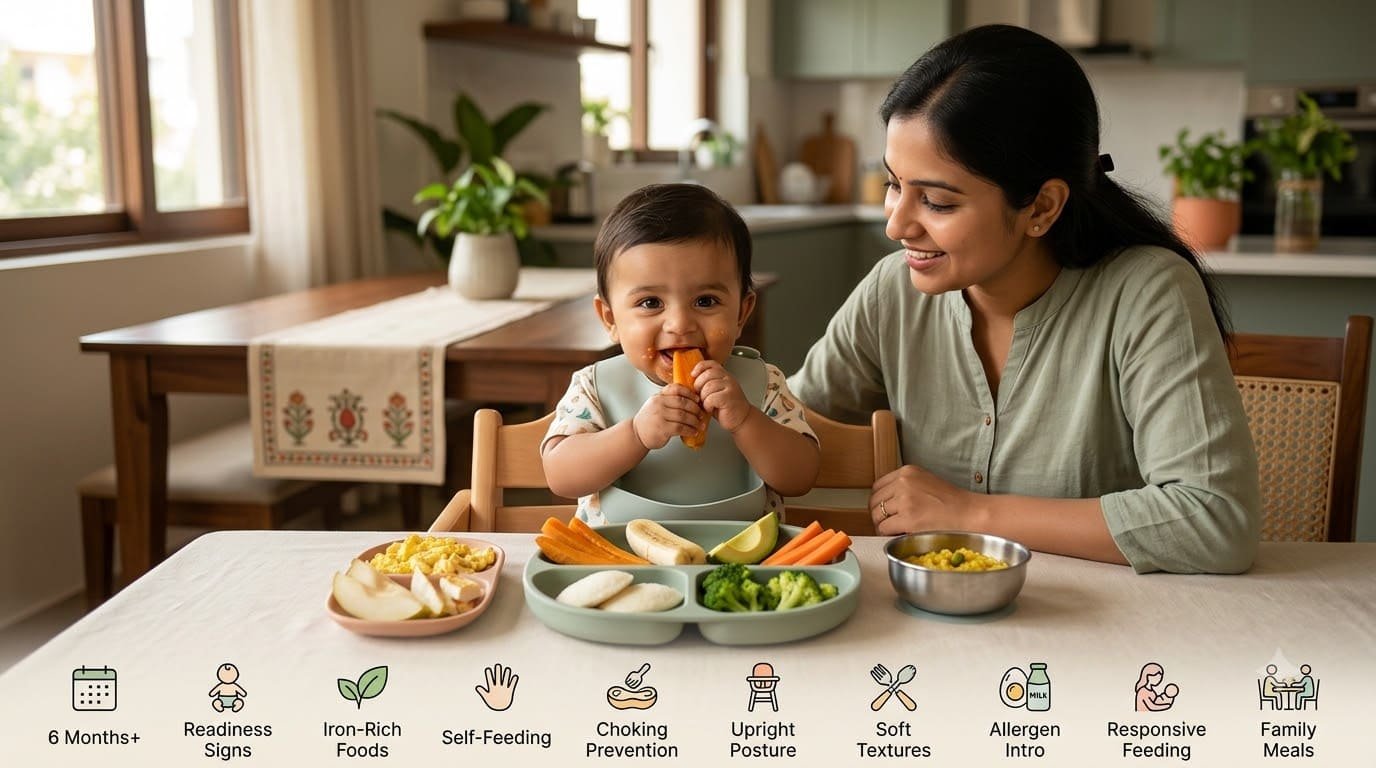
Baby led weaning India is one of the most searched topics among Indian parents with babies approaching six months — and one of the most confusing, because most baby led weaning content available online is written for Western audiences with Western foods.
I started baby led weaning with my daughter at six and a half months. Our paediatrician was supportive but gave us very little practical guidance beyond “you can try it.” The resources I found online showed avocado toast fingers and steamed broccoli florets. We didn’t have avocado. My daughter’s first finger food was a soft piece of ripe banana, followed by a stick of boiled sweet potato, followed by soft idli torn into pieces.
All three worked. All three were developmentally appropriate. None of them required a special shop or a Western cookbook.
This guide is the Indian version of baby led weaning guidance — what it is, why the evidence supports it, which Indian foods work perfectly as first finger foods, what the safety rules actually are, and how to do it in an Indian household where the family eats rice, dal, roti, sabzi, and curd rather than quinoa and hummus.
What Baby Led Weaning India Actually Means
Baby led weaning India follows the same core principle as everywhere else: instead of spoon-feeding purees to your baby, you offer appropriately prepared pieces of soft food and allow the baby to feed themselves, at their own pace, from the very beginning of solid foods.
“Weaning” in this context means the British English use of the word — introducing solid foods — not stopping breastfeeding. Baby led weaning does not require stopping breastfeeding. Breast milk or formula continues as the primary nutrition source until twelve months.
According to the World Health Organization’s complementary feeding guidelines, complementary foods from six months should be introduced in a way that responds to the infant’s hunger and satiety cues — which is the foundation of baby led weaning. The Indian Academy of Pediatrics recommends that complementary feeding begins at six months with appropriate textures that progress with the baby’s developmental readiness.
Baby led weaning is not a fixed rule system — it is an approach. Many families use a combination of finger foods and some soft spoon-fed foods. This “combined approach” is perfectly valid and works well in Indian households where soft foods like khichdi and dal are natural meal components.
Why Baby Led Weaning — The Evidence
Self-regulation of intake: Babies who feed themselves from the beginning are more likely to stop when full — because they control the pace and quantity. Research suggests this may contribute to better appetite regulation and a lower risk of childhood obesity compared to spoon-feeding, where the adult often encourages “one more bite.”
Exposure to textures and flavours: Babies who experience varied textures from the beginning of solids are less likely to become picky eaters. The repeated exposure to different foods — including foods that are mashed, lumpy, soft, and eventually more complex — builds a more flexible palate.
Motor development: Self-feeding from six months exercises the fine motor skills — pincer grasp, hand-to-mouth coordination — that are developing rapidly at this age. The practice reinforces developmental milestones.
Family meal integration: Baby led weaning naturally integrates the baby into family mealtimes — they eat modified versions of what the family eats rather than separate “baby food.” In Indian households where family meals together are culturally important, this is a natural fit.
Reduced burden on parents: No making separate purees, no spoon-fighting, no worrying about transitioning from purees to lumps. The baby moves at their own pace through textures.
Is Your Baby Ready? — Signs of Readiness
The WHO and IAP both recommend starting solids at six months. Baby led weaning specifically requires certain developmental readiness markers:
Can sit up with minimal support — this is the most important safety requirement. A baby who cannot sit upright cannot safely manage finger foods. The sitting position allows them to lean forward and spit out anything they can’t manage.
Has lost the tongue-thrust reflex — younger babies automatically push foreign objects out of their mouth. By six months this reflex has typically diminished enough for solids to be managed.
Shows interest in food — reaches for food, watches others eat with interest, opens mouth when food approaches.
Has good head control — head must be stable enough to manage eating safely.
Age range: Most babies are developmentally ready at six months. Some are ready slightly earlier, some slightly later. Follow your baby’s development, not the calendar exclusively.
The Most Important Safety Rule — Gagging vs Choking
The most common reason Indian parents avoid baby led weaning is fear of choking. This fear is understandable and worth addressing properly.
Gagging is normal and protective. A baby’s gag reflex is positioned much further forward in the mouth than an adult’s — this means it triggers easily, pushing food forward and out rather than back toward the airway. You will see your baby gag during baby led weaning. This is expected. It is the system working correctly.
Gagging looks like: Baby coughing, spluttering, momentarily struggling with a piece of food, going slightly red, then recovering and continuing. This is not an emergency.
Choking is different and serious. Choking looks like: baby is silent (not coughing), face may go pale or blue, baby cannot breathe or cry, obvious distress.
The safety rules that prevent choking:
Never leave a baby alone while eating. Always sit with them at arm’s length.
Never give foods that break into hard chunks — raw carrot, raw apple, whole nuts, whole grapes, hard biscuits. These are choking hazards regardless of approach.
Always ensure the baby is upright — never reclining.
Learn infant choking first aid before you start baby led weaning. One course or a reliable video watched and understood beforehand is the most important preparation.
10 Best Indian First Foods for Baby Led Weaning
1. Ripe Banana — The Perfect First Food
Why it works: Soft, easily gummed, naturally sweet, no preparation required. Nutritious — provides potassium, vitamin B6, and energy. The texture is ideal for a baby just beginning to manage solids.
How to serve: Peel halfway and give the baby the whole banana to hold. Or cut into thick finger-sized pieces. The peel provides grip for small hands that can’t yet hold slippery surfaces well.
Age: From 6 months
2. Boiled Sweet Potato — Soft, Nutritious, Easy
Why it works: Boiled sweet potato becomes very soft and easy to gum. It provides beta-carotene, vitamin C, and complex carbohydrates. The natural sweetness is appealing to babies.
How to serve: Boil until very soft. Cut into thick finger-length pieces or wedges. Should be soft enough to squash easily between your thumb and forefinger — if it passes this test, it’s the right consistency.
Age: From 6 months
3. Soft Idli — The Indian Baby Led Weaning Classic 🌾
Why it works: Idli is soft, mild, easy to grasp, and made from fermented rice and dal — providing protein alongside carbohydrates. The fermentation process is nutritious and easy to digest.
How to serve: Fresh, room-temperature or slightly warm. Tear into pieces appropriate for small hands — large enough to hold, small enough to manage. Avoid very hot idli.
Can dip in: A small amount of mild sambar (no chilli) or plain curd for extra nutrition and flavour exploration.
Age: From 6 months
4. Boiled Carrot Sticks — Vitamin A and Crunch
Why it works: Boiled until soft, carrot provides beta-carotene, vitamin A, and a flavour babies often enjoy. The stick shape is easy to hold.
How to serve: Boil until you can pierce easily with a fork. Cut into thick sticks. Must be genuinely soft — raw or al dente carrot is a choking hazard.
Age: From 6 months (boiled only — never raw)
5. Dal Paratha Strips — Iron and Protein Together
Why it works: Dal paratha — roti made with moong or masoor dal mixed into the dough — provides iron, protein, and complex carbohydrates in one piece. Made without spices for babies.
How to serve: Make a plain dal paratha without chilli or strong spices. Cut into finger-width strips. Must be soft enough to gum — not too crispy.
The iron advantage: Dal is one of the best plant-based iron sources available. Pairing it with the vitamin C in the meal (a small piece of tomato alongside) improves iron absorption.
Age: From 6-7 months
6. Soft Paneer Pieces — Protein and Calcium
Why it works: Paneer is soft, mild, and rich in protein and calcium — exactly what a growing baby needs. It holds its shape enough for a baby to grasp but is soft enough to gum safely.
How to serve: Cut into small cubes or finger-sized pieces. Fresh, room temperature. Plain — no spices for babies under 8 months.
Age: From 6 months
7. Ripe Mango Pieces — Summer Superfood
Why it works: Fully ripe mango is soft, nutritious, and naturally sweet. It provides vitamin C (which helps iron absorption), beta-carotene, and natural sugars for energy.
How to serve: Cut into thick slices. Remove the skin. The flesh should be very soft and ripe — not stringy.
Note: Fully ripe mango only. Unripe or semi-ripe mango is not appropriate.
Age: From 6 months
8. Khichdi — The Indian Complete Meal
Why it works: Dal and rice khichdi — soft, warm, nutritious — is one of the most complete first foods available. When made slightly thicker than usual and given by loaded spoon or offered as soft lumps, it works perfectly as an early baby led weaning food.
How to serve: Make slightly thicker than your usual consistency. Offer loaded on a spoon placed in front of the baby and let them bring it to their mouth. Or offer as soft spoonfuls placed directly in front of the baby. Add a small amount of ghee for healthy fats and calorie density.
The BLW note: Soft, mashable foods like khichdi are a “combined approach” — they’re not finger foods but are offered in a baby-controlled way. This counts as baby led weaning when the baby controls the spoon.
Age: From 6 months
9. Cooked Egg — Choline and Complete Protein
Why it works: Egg provides complete protein, choline for brain development, and vitamin D. Scrambled egg can be offered as soft pieces. Hard-boiled egg wedges are another option.
How to serve: Scrambled (soft pieces) or hard-boiled (cut into wedges). Well-cooked — no runny yolk. Add a small amount of ghee.
Note on egg introduction: Current IAP guidance supports early introduction of eggs (from 6 months) as it may reduce egg allergy risk. If there is a family history of egg allergy, discuss with your paediatrician first.
Age: From 6 months
10. Ragi Fingers / Ragi Ladoo — Iron and Calcium
Why it works: Ragi is extraordinarily rich in calcium and iron — two of the most important nutrients for babies. Ragi fingers (made from ragi flour, water, and ghee, shaped into soft sticks) or small ragi ladoos are excellent finger foods.
How to make ragi fingers: Mix ragi flour with water to make a thick paste. Add a small amount of ghee. Cook until thick and slightly firm. Shape into finger-width sticks. Cool to room temperature. Should be soft enough to gum easily.
Age: From 6-7 months
Foods to Avoid in Baby Led Weaning — Safety List
Choking hazards — never give:
- Whole grapes (cut into quarters)
- Whole cherry tomatoes (cut)
- Whole nuts or nut pieces
- Raw hard vegetables (raw carrot, raw apple)
- Hard biscuits or crackers
- Popcorn
- Whole seeds
Not appropriate under 12 months:
- Honey (botulism risk)
- Cow’s milk as main drink (small amounts in food are fine)
- Salt (baby kidneys cannot process adult levels)
- Sugar in significant amounts
- Spicy chilli — mild spices are fine
Not appropriate under 8-9 months:
- Strong spices in large amounts
- Bitter gourd, very fibrous vegetables
Baby Led Weaning India — Managing Family Pressure
In many Indian households, the introduction of solids comes with significant family involvement and opinion. Grandparents may expect purees, worry about gagging, or insist the baby isn’t eating “enough.”
Honest guidance for navigating this:
The gagging conversation: Show family members what normal gagging looks like before you start. Explain that it is protective, not dangerous. Having this conversation before the first meal rather than during it goes much better.
The quantity conversation: Baby led weaning babies often appear to eat very little in the first weeks — much of the food goes on the floor, the face, and the high chair. This is completely normal. Breast milk or formula continues as primary nutrition until twelve months. The first months of baby led weaning are about exploration and skill development, not calorie intake.
The “baby is hungry” pressure: If family is concerned the baby isn’t getting enough food — keep track of wet nappies (6+ per day indicates adequate hydration) and attend regular weight check appointments. Steady weight gain alongside baby led weaning is the evidence that things are going well.
For more on managing picky eating as the baby grows and food preferences develop, our picky eater strategies guide covers the transition from the early exploration phase to managing more established preferences.
FAQ — Baby Led Weaning India
Q: My baby is 6 months but can’t sit up without support. Should I wait?
Yes — sitting with minimal support is the key readiness sign for baby led weaning. A baby who cannot sit upright cannot safely manage finger foods. Wait until sitting is stable. This may be a few more weeks. Start with pureed foods in the meantime if you’re concerned about delaying solids.
Q: My baby keeps gagging on everything. Should I stop?
Gagging in the first weeks of baby led weaning is very common and expected. Unless the gagging is leading to actual choking (baby goes silent, cannot breathe), continue. The gag reflex is protective and the frequency of gagging typically reduces significantly within 2–4 weeks as the baby develops skill and confidence with food. If you’re concerned, discuss with your paediatrician.
Q: Can I do baby led weaning alongside purees?
Absolutely — this combined approach is used by many families and is perfectly valid. It gives the baby the benefits of finger food exploration alongside the nutritional reliability of spoon-fed purees. Many Indian families find this approach natural because foods like khichdi and dal are easily served both ways.
Q: My mother-in-law says the baby will choke. How do I handle this?
Show her the difference between gagging (normal, protective) and choking (serious, silent). Explain that you will always supervise, that you’ve learned first aid, and that the foods you’re offering are specifically chosen for safety. Having this conversation before the first meal, with evidence from the IAP or WHO guidelines, works better than having it mid-meal.
Q: How much should my baby be eating in the first month of baby led weaning?
Very little, in terms of actual swallowed food. The first month is about exploration — touching, smashing, tasting, occasionally swallowing. Breast milk or formula remains the primary nutrition source. Don’t measure success by how much is eaten. Measure by engagement, enjoyment, and the developmental skill-building that’s clearly happening.
Q: Which Indian spices can I introduce and when?
Mild spices — jeera (cumin), haldi (turmeric), dhania (coriander powder) — can be introduced from 6-7 months in small amounts. They provide flavour exposure that supports acceptance of family foods. Strong spices — chilli, heavy garam masala, very strong ginger — are better left until after 9-12 months. Salt should be kept minimal throughout the first year.
More from MumPappaHub — Read These Next:
- Starting Baby on Solid Foods: Complete Guide
- Superfoods for Toddler Brain Development
- Iron Rich Foods Babies Toddlers India
- Foods to Help Toddler Gain Weight India
- Picky Eater Strategies That Work
- Toddler Nutrition and Picky Eating
- Baby Development Month by Month
- Indian Baby Weight Chart 0-12 Months
- Baby Vaccination Schedule India 2026
- Newborn Sleep Tips
- Newborn Care Tips
- Baby Fever Guide
About This Article
Written by the MumPappaHub editorial team — including a mother who found only avocado toast and broccoli floret recipes when she searched baby led weaning and whose daughter’s actual first finger food was a piece of ripe banana, followed by boiled sweet potato, followed by soft idli. All three worked perfectly. None required a special shop.
Reviewed for accuracy against WHO complementary feeding guidelines and Indian Academy of Pediatrics recommendations on solid food introduction. This content is for general informational purposes only. Always consult your paediatrician before starting solids, particularly if your baby was premature or has developmental concerns.
MumPappaHub — Real talk for real parents. mumpappahub.com

1 Comment