
Medical Disclaimer: This article is for informational purposes only and does not replace professional medical advice. Every baby develops differently. If you have concerns about your baby’s development, always consult your paediatrician.
When do babies start walking? Ours were five months apart, and both were completely normal. My nephew took his first steps at nine months. My daughter waited until fourteen and a half months. Both are perfectly healthy, perfectly normal children who now run so fast I can barely keep up with either of them
But those five months in between? Those were the months I spent quietly panicking, comparing, googling at midnight, and asking my mother the same question approximately three times a week.
Is she okay? Why isn’t she walking yet? Should I be worried?
If you’re asking the same questions right now — this article is for you. The honest, complete version. Not just “most babies walk between nine and fifteen months” and nothing else. The actual story of how walking develops, what helps, what doesn’t, and — most importantly — when the answer to “should I be worried” is genuinely yes.
The Short Answer First
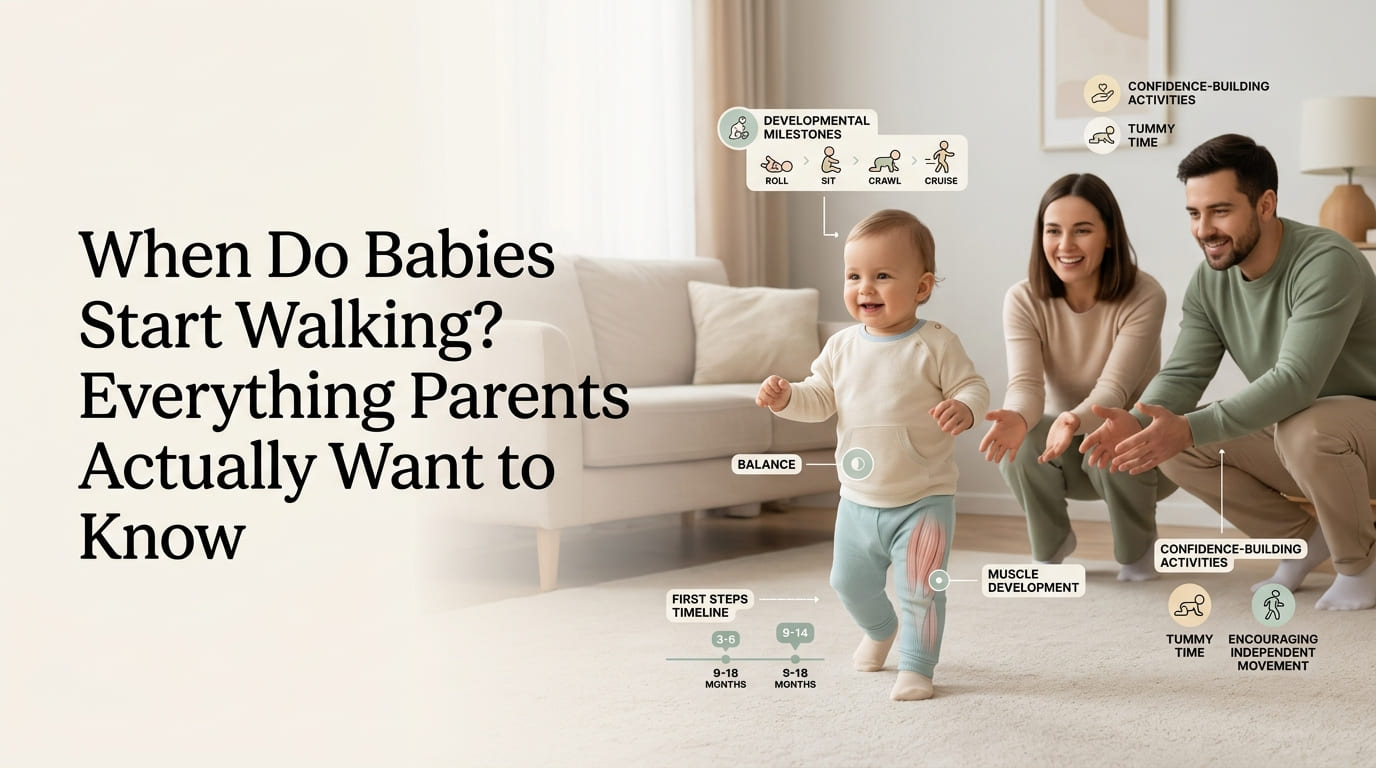
Most babies take their first independent steps somewhere between 9 and 12 months and are walking confidently by 14 to 15 months.
But — and this matters — up to 18 months is still considered within the normal range by most paediatric guidelines. A baby who isn’t walking at 13 months is not automatically behind. A baby who isn’t walking at 17 months needs a paediatrician’s assessment.
That’s the range. Everything else is details.
How Walking Actually Develops — The Stages Nobody Explains
Walking doesn’t just happen one day. It’s the final step in a sequence of physical development that begins in the first weeks of life. Understanding this sequence makes the whole thing feel much less mysterious.
Stage 1 — Head and Neck Control (0–4 months)
Everything starts here. A baby who can hold their head steady is beginning to build the core strength and postural control that walking eventually requires. Tummy time — which most babies hate and most parents feel guilty about not doing enough — is genuinely important at this stage. It builds the neck, shoulder, and back muscles that form the foundation of everything that comes later.
Stage 2 — Rolling and Sitting (4–8 months)
Rolling builds trunk strength and teaches the brain to coordinate both sides of the body. Sitting independently — usually around six months — is a major milestone because it means the baby now has enough core stability to hold their upper body upright against gravity.
If your baby isn’t sitting independently by seven to eight months, that’s worth mentioning to your paediatrician — not because it’s definitely a problem, but because sitting is a prerequisite for everything that follows.
Stage 3 — Pulling to Stand (7–10 months)
This is where it starts to look like walking is coming. Babies grab furniture, trouser legs, anything in reach, and haul themselves upright. Once standing, they hold on and look enormously pleased with themselves.
This stage is important because it builds the leg strength, balance, and weight-shifting skills that walking needs. Let them do it. Don’t lower the furniture to stop them pulling up — the pulling up is the training.
Stage 4 — Cruising (8–12 months)
Cruising is walking along furniture — hands on the sofa, shuffling sideways, then reaching for the coffee table, then the next chair. It looks tentative. It is tentative. But it’s teaching the baby something crucial — how to shift their weight from one leg to the other, which is the fundamental mechanics of walking.
Babies who cruise confidently are usually not far from independent walking. The gap between confident cruising and first steps is often just a matter of courage — the willingness to let go.
Stage 5 — Standing Independently (9–12 months)
Standing without holding anything, even for just a few seconds. This usually appears before first steps and can be quite sudden — one day they’re holding on, the next they’re standing in the middle of the room looking slightly surprised at themselves.
Stage 6 — First Steps (9–18 months)
First steps are rarely dramatic. Most babies take two or three wobbly steps, sit down abruptly, and look at you. They may not do it again for several days. The brain is processing what just happened, building the neural pathways, preparing to do it consistently.
Walking develops gradually over weeks — from a few steps here and there, to crossing a room, to walking as the primary mode of getting around. Most babies take three to six weeks from first steps to confident walking.
What Affects When a Baby Starts Walking
Body type and build
Bigger, heavier babies sometimes take a little longer simply because they have more weight to manage as they build the necessary strength. This is completely normal and not a cause for concern.
Personality and temperament
Some babies are cautious. They watch and observe before attempting. They practise in private and debut fully formed skills. Others throw themselves at everything immediately and fall repeatedly without apparent concern.
Both types walk. They just get there differently.
How much floor time they get
Babies who spend a lot of time in bouncers, swings, prams, and baby carriers — and less time on the floor moving freely — may reach walking slightly later because they’ve had less opportunity to build the relevant muscles and coordination through movement.
This isn’t a criticism. Modern baby equipment exists for good reasons. But if your baby is approaching twelve months and not yet pulling to stand, increasing floor time is a reasonable first step.
Whether they’re a bottom shuffler
Bottom shuffling — scooting around on the bottom rather than crawling — is a legitimate alternative movement style that some babies adopt. Bottom shufflers often walk later than crawlers, sometimes not until sixteen to eighteen months. But they do walk. If your baby is an enthusiastic bottom shuffler — don’t worry, just give it a little more time.
Premature birth
Babies born prematurely should have their milestones assessed against their corrected age — their age from their due date, not their birth date. A baby born eight weeks early who is now twelve months old is developmentally closer to a ten-month-old. Using their corrected age gives a much more accurate picture of where they should be.
What Helps Babies Learn to Walk
The single most important thing — floor time
Free movement on the floor is how babies build every physical skill they need for walking. Crawling, rolling, pulling up, cruising — all of it happens on or from the floor. Babies who have plenty of unstructured floor time reach motor milestones more consistently than babies who spend most of their time in equipment.
This doesn’t need to be organised or educational. Just put them on the floor and let them move.
Barefoot is better
Shoes before walking are largely unnecessary and can actually interfere with development. Feet contain proprioceptors — sensory receptors that give the brain information about where the body is in space. Walking barefoot on different surfaces — carpet, wood, grass, tiles — gives the feet sensory information that helps the brain develop balance and coordination.
Once walking is established and your baby will be outside on hard surfaces, proper-fitting shoes are important. But indoors, barefoot is best.
Push toys — the good kind
A sturdy push toy that doesn’t move too fast can help a baby practice walking upright while still having something to hold onto. The key word is sturdy — it needs to be stable enough that it doesn’t shoot away from them when they lean on it.
Baby walkers — the seated, wheeled kind that babies sit inside — are a different matter entirely. Most paediatric bodies advise against them. They don’t help babies learn to walk and can actually delay development by allowing babies to move without building the muscles needed for independent walking. They’re also a significant safety hazard. Our child development milestones guide covers this in more detail.
Encouraging without pressuring
Holding your hands out and encouraging your baby to walk toward you — yes. Holding them upright and moving their legs for them — no. You can’t teach a baby to walk by walking them. They need to figure out the balance and coordination themselves.
Encourage. Create safe spaces to practise. Celebrate attempts as enthusiastically as achievements. And then let them do it in their own time.
Walking and What Comes After — The First Weeks
First steps are exciting. The weeks that follow are humbling.
New walkers fall. Constantly. Dozens of times a day. This is completely normal and is not a sign of a problem. The brain and body are still calibrating — learning how to manage balance while moving, how to change direction, how to stop without sitting down abruptly.
New walkers also often walk with their feet wide apart, toes turned out or in, and a kind of lurching, whole-body commitment to each step. This is normal gait for a new walker. It takes months to develop the smooth, coordinated walking of an older child.
Intoeing — feet turned inward — is very common in new walkers and almost always resolves on its own by age three without any intervention. Outtoeing — feet turned outward — is equally common and equally likely to self-correct.
If you’re concerned about how your baby is walking — the pattern, the gait, whether they’re weight-bearing equally on both legs — mention it to your paediatrician at a routine check. Most of what looks concerning in new walkers is just normal development.
Baby-Proofing for the Walking Stage
The week before my daughter started walking, a friend said to me — “you think you’ve baby-proofed, but you haven’t. You’ve toddler-proofed for a baby who can’t reach things. A walking baby can reach everything.”
She was completely right.
Once your baby starts pulling to stand and cruising, it’s time to do a serious safety review. Our child safety proofing guide is worth reading now — before first steps, not after the first accident.
The basics: corner guards on sharp furniture edges. Cabinet locks on anything containing cleaning products, medicines, or breakables. Stair gates — top and bottom. Heavy furniture secured to walls. Hot drinks out of reach always, not just when you remember.
Walking babies are fast. Faster than you expect. And they go straight for the most dangerous thing in the room with impressive consistency.
When to Talk to Your Paediatrician
This is the section I wish someone had given me a clear checklist for.
Definitely speak to your doctor if:
Your baby is not walking by 18 months. This is the clearest cut-off point. Most guidelines say assessment is warranted if independent walking hasn’t started by eighteen months.
Your baby was walking and has stopped. Loss of a skill that was previously established is always worth investigating promptly — not in a panic, but without delay.
Your baby only walks on their tiptoes consistently after they’ve been walking for a few months. Occasional toe-walking is normal. Consistent toe-walking as the only walking pattern needs assessment.
Your baby significantly favours one side — crawling with one leg dragging, or walking with a noticeable limp. Asymmetry in movement warrants a look.
Your baby isn’t pulling to stand by 12 months — this is an earlier indicator that’s worth raising, not a crisis but something to discuss.
You have a gut feeling something is off. Trust that. Parents notice things. Paediatricians would rather assess and reassure than have a parent wait too long on something that needed attention.
For a complete picture of what to expect and when at every age, our child development milestones guide and baby first year milestones cover the full developmental picture alongside walking.
The Comparison Trap — A Word About This
There will always be a baby in your mother’s group who walked at nine months. There will always be an Instagram reel of an eight-month-old taking steps to the sound of a triumphant song.
These babies are real. They are also not your baby.
Development within the normal range is just that — a range. A baby walking at nine months and a baby walking at sixteen months are both developing completely normally. The nine-month walker has no developmental advantage over the sixteen-month walker. They will both be running by age two. They will both be driving you mad on the stairs by age three.
The comparison serves nothing except anxiety. And you already have enough of that.
If your baby is progressing through the stages — building strength, pulling up, cruising, attempting — the walking will come. Their timeline is their own.
FAQ — When Do Babies Start Walking
About Timing and Milestones
Q: What is the average age for babies to start walking?
Most babies take their first independent steps between 9 and 12 months and are walking confidently by 14 to 15 months. Up to 18 months is still considered within the normal developmental range. If your baby isn’t walking by 18 months, speak to your paediatrician.
Q: My baby is 13 months and not walking. Should I be worried?
Not necessarily. Thirteen months is well within the normal range — the upper end of normal is 18 months. If your baby is pulling to stand, cruising furniture, and showing interest in movement — walking is likely coming. If they’re not yet pulling to stand at 13 months, that’s worth mentioning to your paediatrician.
Q: My baby walked at 10 months. Is that too early?
Nine to ten months is early but not unusual — some babies are simply physically ready earlier. As long as they’re walking on flat feet with reasonable balance, early walking isn’t a concern. Mention it at your next routine check if you want reassurance.
About Development and Support
Q: Do baby walkers help babies learn to walk faster?
No — and most paediatric bodies advise against them. Baby walkers allow movement without building the muscles needed for independent walking. They can delay walking and are also a significant safety hazard. Push toys — the kind babies stand behind and push — are a safer alternative.
Q: Should my baby wear shoes before they’re walking?
No. Before walking is established, shoes are unnecessary and can interfere with the sensory feedback feet need to develop balance. Bare feet indoors is best. Once your baby is walking outside on hard surfaces, properly fitted shoes are important.
Q: My baby bottom-shuffles instead of crawling. Will they still walk?
Yes — bottom shufflers walk. They often start a bit later than crawlers — sometimes not until 16 to 18 months — but the outcome is the same. Bottom shuffling is just a different movement style, not a developmental delay.
About Concerns and Red Flags
Q: My baby only walks on their tiptoes. Is this normal?
Occasional toe-walking is common in new walkers. Consistent toe-walking as the only pattern after several months of walking warrants a paediatrician’s assessment — it can sometimes indicate tightness in the calf muscles or, occasionally, something that benefits from early intervention.
Q: My baby was walking and suddenly stopped. What should I do?
Loss of a previously established skill always needs prompt medical assessment. Call your paediatrician the same day — not because it’s definitely serious, but because regression in skills is something that should always be looked at without delay.
Q: My baby has flat feet. Will this affect walking?
Almost all babies and toddlers have flat feet — the arch develops gradually through childhood as muscles strengthen. Flat feet in babies and young toddlers are completely normal and almost always develop a normal arch by age five to six without any intervention.
More from MumPappaHub — Read These Next:
- Child Development Milestones: What’s Normal at Every Age
- Baby First Year Milestones
- Toddler Language Development
- Child Safety Proofing Guide
- Sensory Play for Toddlers
- Toddler Tantrums Tips
- Baby Skin Care Routine
- 4 Month Sleep Regression
- Potty Training Guide
- Newborn Care Tips
- Screen Free Play Ideas
About This Article: Written by the MumPappaHub editorial team. Reviewed for accuracy against current paediatric developmental guidelines. This content is for general informational purposes only and does not constitute medical advice. Always consult your paediatrician if you have concerns about your baby’s development.
MumPappaHub — Real talk for real parents. mumpappahub.com

1 Comment