
Medical Disclaimer: This article is for informational purposes only and does not replace professional medical advice. Always consult your paediatrician before trying any remedy, especially for babies under 3 months. If your baby shows signs of serious illness, seek medical help immediately.
Baby cold and cough home remedies are what every exhausted parent Googles at 3 AM — I know because I was one of them. Three in the morning. My son was seven months old. He was congested, miserable, couldn’t feed properly, couldn’t sleep, and I was sitting on the bathroom floor holding him in the steam from the shower because I had no idea what else to do.
I’d already called my mother. I’d already googled. I’d already done the thing where you read five different articles and they all say something slightly different and you end up more confused than when you started.
What I needed was someone to just tell me — here’s what works, here’s what doesn’t, here’s when to stop trying home remedies and call the doctor.
So that’s exactly what this is.
First — Why Babies Get So Many Colds
The immune system is still learning
Babies are born with some immunity borrowed from their mothers, but this fades over the first few months. Their own immune systems are still developing — building up defences against pathogens one infection at a time.
The average baby gets six to eight colds in their first year. That sounds alarming but it’s completely normal — and each one actually strengthens their immune system for the future. Cold viruses spread easily through the air and through contact, and babies touch everything and then put their hands in their mouths approximately four hundred times a day.
In monsoon season specifically — July through September — the combination of humidity, people spending more time indoors, and viral spread through condensation means colds spike dramatically. If your baby has caught something right now, they’re in very good company.
Why you can’t give babies cold medicine
This is the thing that catches new parents completely off guard. Most over-the-counter cold medicines — decongestants, antihistamines, cough suppressants — are not safe for babies under two years old. Some aren’t safe until six years old. The FDA and most paediatric bodies worldwide have been clear on this for years.
Which means when your baby has a cold, you are essentially on your own with supportive care. No quick fix. Just you, some saline drops, and patience.
The good news — there are things that genuinely help. They just aren’t medicines.
Home Remedies That Actually Work
1. Saline Drops — The Single Most Effective Thing You Can Do
If you do nothing else on this list, do this.
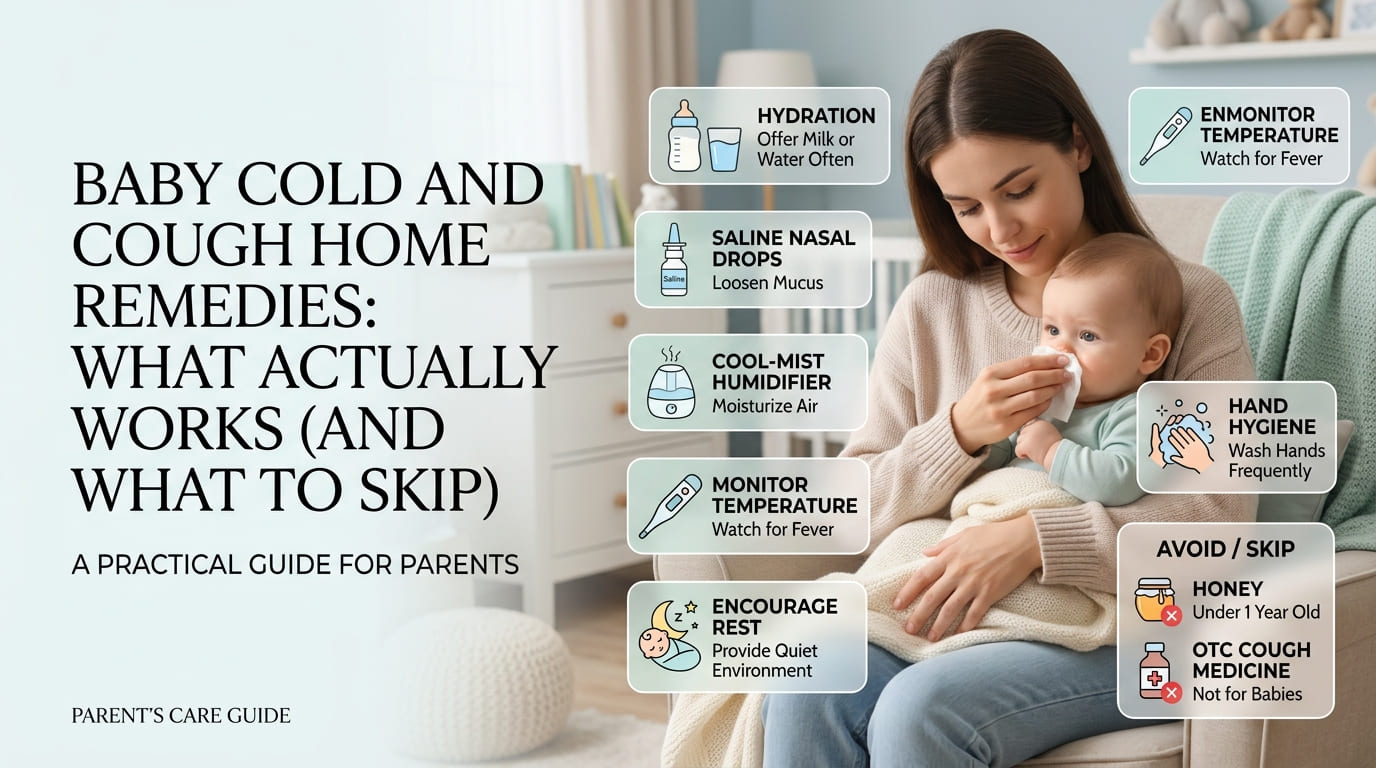
Saline nasal drops — simply sterile salt water — thin the mucus in a congested baby’s nose and make it easier to clear. They’re completely safe from birth. They work. And they make everything else — feeding, sleeping, breathing — significantly easier when a baby is blocked up.
How to use them: lay your baby on their back with their head slightly tilted back. Put two to three drops in each nostril. Wait thirty seconds. Then use a nasal aspirator to gently suction out what’s loosened.
The nasal aspirator part sounds horrible and babies hate it, but it works remarkably well. The bulb syringe type that comes with most baby first aid kits does the job. The NoseFrida — which is the one parents either love or find too disgusting to contemplate — is genuinely more effective and worth trying if you can get past the concept.
Do this before feeds and before sleep. It makes both go significantly better.
2. Steam — The Bathroom Trick That Works
This is exactly what I was doing at three in the morning and it was the right instinct.
Run a hot shower in a closed bathroom. Sit in the steamy room — not in the shower, just in the room — with your baby for ten to fifteen minutes. The warm, moist air loosens congestion and helps babies breathe more easily.
You don’t need a humidifier, though one helps if you have it. You don’t need any special equipment. Just a hot shower and a closed door.
Do this two or three times a day during the worst of a cold. It’s particularly helpful before bedtime — a session of steam followed by saline drops and suctioning, then a feed, then sleep gives the best chance of a reasonable night.
3. Elevated Head Position During Sleep
Congestion is worse lying flat. For adults this is why we prop ourselves up on extra pillows when we have a cold. For babies, pillows aren’t safe — but there’s a workaround.
Place a tightly rolled towel or a small firm pillow under one end of the mattress — under the mattress, not on top of it. This creates a gentle incline that helps drainage without creating any unsafe surface for the baby to sleep on.
Even a slight elevation makes a noticeable difference to how well a congested baby sleeps.
4. Breast Milk — Genuinely Medicinal
This one sounds like something grandmothers say but it’s actually backed by real science.
Breast milk contains antibodies that are specifically tailored to the pathogens the mother has recently been exposed to — which includes whatever virus the baby has caught, since they usually catch it from someone in the household. When a baby nurses while sick, the mother’s body detects the infection through the baby’s saliva and ramps up antibody production in the milk specifically to fight that pathogen.
It’s not magic. It’s immunology.
If you’re breastfeeding — feed more frequently during illness. Don’t switch to formula thinking it’ll be easier. The breast milk itself is actively helping them fight the infection.
Some parents also put a drop of breast milk in each nostril as a natural saline-like solution. The jury is out on how effective this is versus actual saline drops, but it’s completely harmless if you want to try it.
For tips on maintaining supply during a difficult period, our how to increase breast milk supply guide is worth reading.
5. Honey — But Only After 12 Months
Honey has real evidence behind it as a cough remedy. Studies show it coats the throat, soothes irritation, and reduces cough frequency — it actually outperforms some cough medicines in studies on children.
But — and this is absolute — honey is not safe for babies under twelve months. It can contain Clostridium botulinum spores which cause infant botulism. This is not a precaution that can be bent. No honey before twelve months, in any form, for any reason.
After twelve months — half a teaspoon of raw honey at bedtime, or mixed into warm water, is a genuinely effective natural cough remedy.
6. Warm Fluids for Older Babies
For babies who have started solids — from around six months — warm liquids help thin mucus and soothe an irritated throat.
Warm water offered in a sippy cup. A thin, warm vegetable broth — homemade, no salt, no onion for very young babies. Warm diluted apple juice.
These aren’t medicines. They’re comfort. And comfort matters when a baby is miserable.
For babies still exclusively on milk — breast milk or formula is all the fluid they need. Don’t add water for babies under six months.
7. Ajwain Potli — The Traditional Remedy That Has Real Basis
If you grew up in an Indian household, someone has probably already mentioned this.
Ajwain — carom seeds — contains thymol, which has natural decongestant properties. The traditional potli method: dry roast a tablespoon of ajwain seeds in a pan until warm and fragrant. Tie them in a thin muslin cloth to make a small bundle. Hold this near — not against — your baby’s chest or near their nose while they’re awake and you’re watching them.
The warmth and aroma helps loosen congestion. It’s not a substitute for saline drops. But it’s not nothing either, and generations of Indian mothers weren’t wrong.
Do not place the potli directly against baby’s skin — test the temperature on your own wrist first, and keep it moving rather than resting in one place. Never use while the baby is sleeping.
8. Coconut Oil Massage
Warm coconut oil — slightly warmed, not hot — massaged gently onto the chest, back, and the soles of the feet has been used in Indian households for generations for cold and cough relief.
The warmth and gentle massage helps with congestion and is deeply comforting for a sick baby. The skin-to-skin contact itself releases oxytocin which supports healing.
There’s limited formal research on this specifically, but there’s also no harm in it, and comfort has genuine therapeutic value. A warm massage before bed can help a sick baby settle significantly better than they would without it.
9. Garlic in Ghee — For Older Babies
Another traditional remedy with a real mechanism. Garlic contains allicin, which has antimicrobial and antiviral properties. Ghee is a carrier that helps absorption and coats the throat.
For babies who have started solids — from around eight to nine months — a small amount of ghee in which a garlic clove has been warmed can be mixed into dal or khichdi. Not raw garlic, not large amounts, just the infused ghee as part of a meal.
Don’t give this to babies who haven’t started solids yet. And don’t overdo it — a small amount in food is helpful, feeding garlic directly is not the goal.
10. Keep the Room Clean and Humidified
Dry air worsens congestion. Central heating in winter and air conditioning in summer both dry the air significantly. In monsoon, humidity is usually not the problem — but if you’re using AC, the room can get drier than you’d think.
A cool-mist humidifier in the baby’s room adds moisture to the air and eases breathing. Clean it every day — a dirty humidifier circulates mould and bacteria, which is the last thing a sick baby needs.
If you don’t have a humidifier — a bowl of water near a heat source, or wet towels hung in the room, adds some moisture to the air.
Things to Avoid — Please Read This Section
Vicks VapoRub on babies under 2
Vicks contains camphor, eucalyptus oil, and menthol — all of which can cause breathing problems and even seizures in young children when applied directly to the skin. Don’t use it on babies. Not on the chest, not on the back, and absolutely not under the nose.
There is a baby-specific version — Vicks BabyRub — which is formulated without these ingredients and is safe from three months. Make sure you’re using the right product.
Steam inhalation with boiling water
Steam from a running shower — safe. Leaning a baby’s face over a bowl of boiling water — never. This is a scalding risk. Not worth considering.
Any cold medicine not specifically prescribed by a doctor
Decongestants, antihistamines, cough syrups — if a doctor hasn’t specifically prescribed it for your baby at their age and weight, it should not be given. Pharmacists cannot prescribe these for babies. Well-meaning relatives recommending adult medicines in small doses — firmly say no.
Old mustard oil remedies that involve heating on the chest
Some traditional practices involve heated mustard oil applied directly to a baby’s chest. Burn risk. Skip it.
When to Stop Home Remedies and Call the Doctor
This is the most important section in the article and I want to be very clear about it.
Call immediately — same day, don’t wait
Your baby is under three months old and has any fever at all — any temperature above 38°C. This is always an emergency in very young babies. Don’t manage it at home.
Breathing is laboured — you can see the skin pulling in between the ribs or at the base of the throat with each breath. Nostrils are flaring. Breathing is significantly faster than normal.
Your baby is not feeding — missing two or more feeds in a row, or taking significantly less than usual for more than twenty-four hours.
Lips or fingernails look bluish or grey. This means oxygen levels are low. Emergency.
Your baby is unusually difficult to rouse — not just sleepy-because-sick, but not responding normally to stimulation.
High-pitched cry that’s different from anything you’ve heard before.
Call within twenty-four hours
Fever above 38°C in a baby over three months that lasts more than two days.
A cough that’s getting significantly worse rather than better after five to seven days.
Signs of ear infection — pulling at one ear, unusual crying, fever alongside cold symptoms. Ear infections are very common complications of colds in babies and need antibiotic treatment.
Any symptom that’s getting worse rather than improving after a week.
For more on managing fever — when to worry and when to watch — our baby fever guide and toddler fever guide cover both ages in detail.
How Long Does a Baby Cold Last?
This is the question every parent asks and the answer is genuinely — seven to ten days for most colds.
Days one to three are usually the worst — peak congestion, disrupted sleep, miserable baby. Days four to six, symptoms start to plateau. Days seven to ten, gradual improvement.
If things are not improving at all by day seven — call your paediatrician.
A cough can linger for two to three weeks after the other symptoms have resolved. This is normal and doesn’t mean the infection is still active. The airway is just still a bit irritated.
What you’re watching for is deterioration, not just persistence. If symptoms are stable or slowly improving — continue supportive care. If symptoms are actively worsening — call.
Preventing the Next Cold — What Actually Helps
Handwashing. This one intervention prevents more infant illness than anything else combined. Wash your hands before picking up your baby, before feeds, after nappy changes, when returning from outside. Ask visitors to do the same.
Breastfeeding if possible — the ongoing immune support of breast milk reduces the frequency and severity of infections throughout the first year.
Keeping sick siblings and family members away from young babies during active illness — easier said than done, but worth trying.
Avoiding crowded indoor spaces during peak cold season — monsoon, winter. Where you can, choose outdoor meeting places over indoor ones.
For more on building your baby’s immunity from the inside out, our superfoods for toddler brain development article covers the nutritional side of immune support as your baby grows.
FAQ — Baby Cold and Cough
About Remedies and Safety
Q: Can I give my baby cold medicine from the chemist?
No over-the-counter cold medicines are recommended for babies under two years old. Many are not safe until six years old. If you feel your baby needs medication beyond supportive care — saline, steam, rest — speak to your paediatrician who can assess and prescribe if appropriate.
Q: Is it safe to use a nasal aspirator every day?
Yes — used gently, nasal suctioning with saline drops is completely safe to do multiple times a day. Over-aggressive suctioning can irritate the nasal lining so be gentle, but frequency isn’t the issue.
Q: Can I put anything in my baby’s bath to help with congestion?
A few drops of eucalyptus oil in a baby’s bath is sometimes suggested — but eucalyptus is not recommended for children under two as it can affect breathing. Plain warm water bath followed by steam in the bathroom is safer and equally effective.
About Feeding During Illness
Q: My baby won’t feed properly because of congestion. What do I do?
Saline drops and suctioning immediately before a feed makes a significant difference. Try shorter, more frequent feeds rather than longer ones. Babies can usually manage to nurse even when congested — they pause to breathe through their mouth more often. If your baby is refusing feeds completely for more than twelve hours — call your doctor.
Q: Should I stop breastfeeding when I’m sick so my baby doesn’t catch it?
No — continue breastfeeding. By the time you have symptoms, your baby has already been exposed. Continuing to breastfeed means they receive the antibodies your body is producing specifically to fight whatever you have. Stopping breastfeeding removes that protection.
About When to Worry
Q: My baby has had a cold for two weeks. Is this normal?
A single cold lasting seven to ten days is normal. A cough can linger for up to three weeks. But if your baby has had active cold symptoms — congestion, runny nose, fever — for more than ten days without improvement, or if symptoms resolved and then returned, that needs a doctor’s assessment. It could be a secondary infection like an ear infection or sinusitis.
Q: Can a baby cold turn into something more serious?
Yes, in some cases. The most common complications are ear infections, chest infections, and croup — a viral infection causing a distinctive barking cough and breathing difficulty. This is why monitoring symptoms and knowing when to call is important. Worsening rather than improving after five to seven days — call.
Q: My baby sounds very wheezy. Should I be worried?
Wheezing — a high-pitched whistling sound when breathing out — in a baby with a cold needs medical assessment. It can indicate bronchiolitis, which is a viral lower respiratory infection common in babies under one year. Some cases are mild and manageable at home, others need hospital treatment. Don’t try to manage wheezing at home without speaking to a doctor first.
More from MumPappaHub — Read These Next:
- Baby Fever Guide: What’s Normal and When to Worry
- Toddler Fever Guide
- Monsoon Baby Care Tips
- Baby Blues vs Postpartum Depression
- Newborn Care Tips
- How to Increase Breast Milk Supply
- Starting Baby on Solid Foods
- Baby Food Recipes for 6 Months
- Child Development Milestones
- Baby First Year Milestones
- Newborn Sleep Tips
- Postpartum Recovery Guide
About This Article: Written by the MumPappaHub editorial team. Reviewed for accuracy against current paediatric guidelines. This content is for general informational purposes only and does not constitute medical advice. Always consult your paediatrician for concerns about your baby’s health.
MumPappaHub — Real talk for real parents. mumpappahub.com

3 Comments