
News Source: Ministry of Women and Child Development, Government of India | Published: August 1–7, 2026
World Breastfeeding Week 2026 India brought an important reminder from the Government of India — one that every new mother and family member needs to hear.
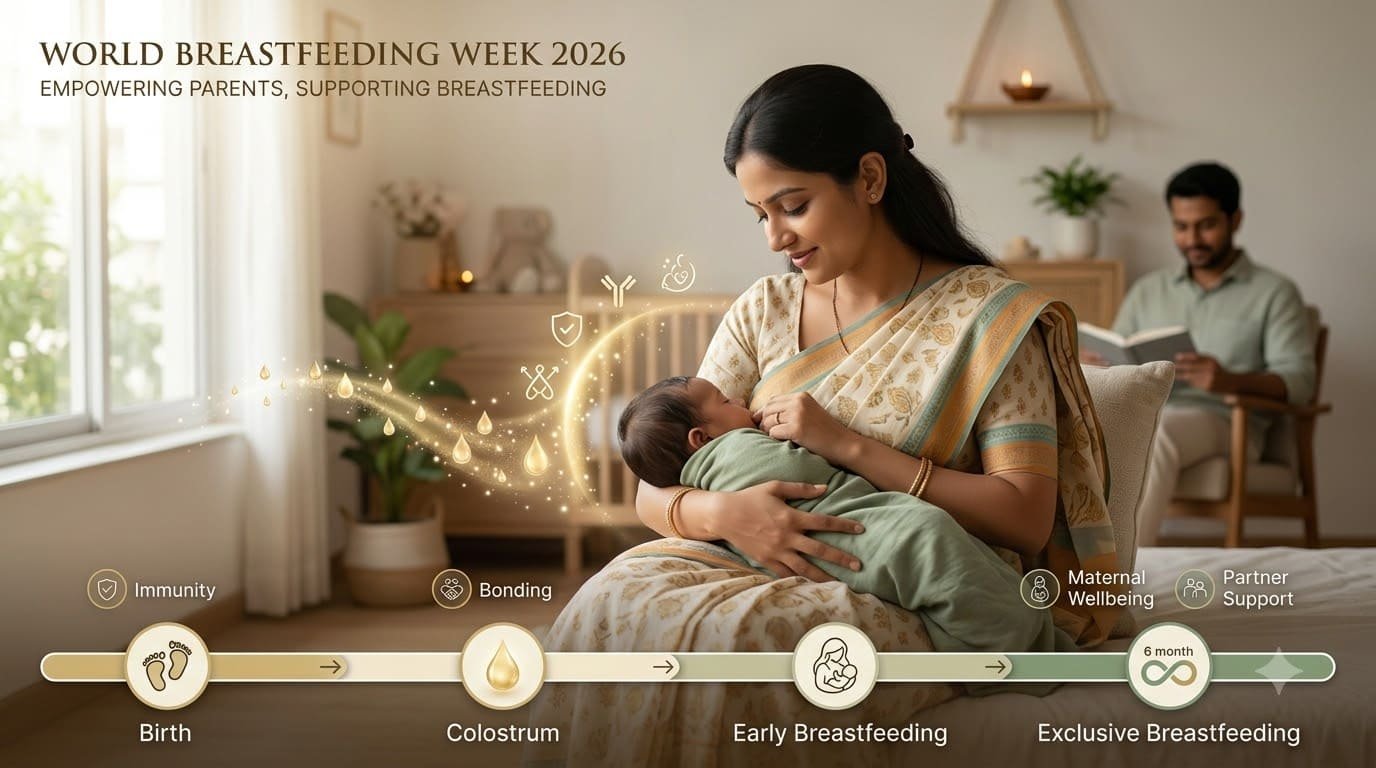
The Ministry of Women and Child Development observed World Breastfeeding Week from August 1 to 7, 2026, with a nationwide campaign focused on raising awareness among families, communities, and healthcare providers. The central message of this year’s campaign was clear: colostrum — the thick, yellowish first milk produced after birth — is the baby’s first natural vaccine and must not be discarded.
What the Government Said — Key Points
The Ministry’s official communication highlighted several important points for Indian families:
The Golden Hour: Every newborn should receive breast milk within the first hour after birth. This first feed within sixty minutes of delivery is called the Golden Hour, and it gives the baby an immediate dose of colostrum — the most concentrated source of antibodies available to a newborn.
Colostrum must not be thrown away: In many parts of India, the traditional practice of discarding colostrum — considering it impure or “dirty milk” — continues in some households. The Ministry specifically addressed this, stating that colostrum is rich in antibodies and essential nutrients and is, in fact, the baby’s first natural vaccine.
Exclusive breastfeeding for six months: The Ministry reiterated that breast milk alone — without water, honey, ghutti, glucose, or formula — meets all of a baby’s nutritional and hydration needs for the first six months. Nothing else needs to be added.
Continue breastfeeding beyond six months: After six months, complementary foods are introduced alongside breast milk, which should ideally continue up to two years and beyond.
Benefits for mothers too: The Ministry noted that breastfeeding is not only good for babies — it supports the mother’s postpartum recovery and reduces the risk of breast cancer, ovarian cancer, type-2 diabetes, and postpartum depression.
Why This Matters for Indian Families
India’s breastfeeding rates, while improving, still have significant room to grow — particularly in the areas of early initiation (within the first hour) and exclusive breastfeeding for six months.
Two specific challenges are particularly common in Indian households:
The colostrum misconception: Many grandparents and elders advise that colostrum should be discarded and replaced with honey, ghee, or formula in the first days. The science is now very clear — colostrum is the most immunologically valuable substance a newborn receives in the first hours of life. Discarding it deprives the baby of irreplaceable early immune protection.
The “not enough milk” concern: Many Indian mothers stop breastfeeding early because they believe they don’t have enough milk. In most cases, milk supply establishes itself through feeding frequency — the more the baby feeds, the more milk is produced. A perceived low supply in the first days is almost always a supply that needs time and frequent feeding to establish itself.
What Experts and Community Workers Are Saying
ASHA workers and Anganwadi workers across India play a critical role in supporting breastfeeding at the community level. The Ministry specifically called on these community health workers — alongside healthcare professionals, families, and citizens — to create an environment that supports and enables breastfeeding for every mother.
The campaign also acknowledged working mothers, encouraging them to express and safely store breast milk so that breastfeeding can continue even when direct feeding isn’t possible.
What This Means for You
If you are a new mother or expecting:
The first hour after birth matters enormously — ensure your birth team supports early breastfeeding initiation and ask specifically for your baby to be placed skin-to-skin immediately after delivery if possible.
If someone in your family advises discarding colostrum — you now have the Government of India and the World Health Organization both agreeing that this is the opposite of what should happen.
If you’re struggling with milk supply in the early days — frequent feeding is the most effective way to establish supply. Contact your ASHA worker, Anganwadi worker, or a lactation consultant for support.
For detailed guidance on increasing breast milk supply, what Indian foods support lactation, and the science behind supply and demand, our how to increase breast milk supply guide covers everything Indian breastfeeding mothers need to know.
MumPappaHub’s Take
The government campaign’s framing — “colostrum is the baby’s first natural vaccine” — is one of the clearest, most accessible ways to communicate what the science has established for decades. Vaccines protect against specific diseases. Colostrum provides broad-spectrum immune protection at precisely the moment when a newborn’s immune system is most vulnerable and least equipped to protect itself.
The cultural practice of discarding colostrum has persisted in some Indian communities not from malice but from misunderstanding — an old belief that the thick, yellowish colour indicated something was wrong. Changing this one practice, at scale, would meaningfully improve infant health outcomes across India.
The Ministry’s message is right. The Golden Hour is real. Colostrum is valuable. Feed it.
Related Reading on MumPappaHub:
- How to Increase Breast Milk Supply: Indian Foods & Tips
- Foods to Avoid During Pregnancy India
- Baby Blues vs Postpartum Depression: Honest Guide
- Newborn Care Tips: Complete Guide
- Newborn Sleep Tips: What Actually Works
- Starting Baby on Solid Foods India
Source: Ministry of Women and Child Development, Government of India. World Breastfeeding Week 2026 official communication, July 31, 2026.
MumPappaHub — Real talk for real parents. mumpappahub.com
