
Medical Disclaimer: This article is for informational purposes only and does not replace professional medical advice. If your baby shows any symptoms of dengue or mosquito-borne illness, seek immediate medical attention. Do not attempt to treat these conditions at home.
How to protect baby from dengue monsoon season is something I wish I’d researched before, not after. The evening it happened, I thought my son just had a cold.
He was eight months old. It was August — deep monsoon, the kind where the rain hasn’t stopped for four days and there’s standing water everywhere. He had a fever. Not alarming at first. Babies get fevers. I gave him paracetamol, kept him close, watched him through the night.
By the next morning the fever was higher. By the afternoon, something felt different. Not just sick — wrong. That particular quality of wrong that every parent recognises but can’t quite explain.
We were at the paediatrician within the hour. Blood test. Dengue positive.
He was fine. We caught it early, he was treated and monitored, and he recovered completely. But I will never forget those forty-eight hours. And I will never forget thinking — I should have known more. I should have been more careful. I didn’t know what I didn’t know.
This article is everything I wish someone had told me before that August.
The Monsoon Reality in India — Why This Matters Right Now
Every year between July and September, dengue cases in India spike dramatically. The National Vector Borne Disease Control Programme reports tens of thousands of confirmed dengue cases during monsoon months — and these are only the confirmed ones. Actual numbers are significantly higher.
Babies and young children are particularly vulnerable because their immune systems are still developing. Moreover, they cannot tell you their head hurts or their joints ache. By the time symptoms become obvious in a very young baby, the disease has often progressed further than it would in an older child.
This is not meant to frighten you. Instead, it’s meant to make you take this seriously — because the good news is that most mosquito-borne illness is preventable. The mosquito has to bite your baby first. Therefore, your job is simply to make sure it doesn’t.
Understanding the Threat — What Mosquitoes Actually Spread
Dengue — The Biggest Monsoon Threat for Babies
Dengue is caused by the dengue virus and spread by the Aedes aegypti mosquito — a daytime biter that breeds in clean, stagnant water. This is important to understand. It is not dirty water that attracts this mosquito. Rather, it is the water in your flower pot, the water collected in an upturned bottle cap, or the water sitting in your child’s outdoor toys.
Dengue in babies looks different from dengue in adults. Instead of the classic “breakbone fever,” watch for high fever that doesn’t respond normally to paracetamol, unusual irritability, refusal to feed, rash, and lethargy that goes beyond normal sick-baby sleepiness.
There is no specific antiviral treatment for dengue. As a result, management is entirely supportive — fluids, monitoring, fever management, and in severe cases, hospitalisation. Early detection, therefore, is everything.
Malaria — Still Present in Many Parts of India
Malaria is caused by the Plasmodium parasite and spread by the Anopheles mosquito — a night biter that breeds in slow-moving or stagnant dirty water. It remains endemic in many parts of India, particularly in states like Odisha, Jharkhand, Chhattisgarh, and parts of Northeast India.
In babies, malaria symptoms include high fever with chills, shaking, vomiting, and extreme pallor. Furthermore, malaria can progress to severe anaemia and cerebral malaria in young children with frightening speed. Consequently, this must be treated as a medical emergency without delay.
Chikungunya — The Overlooked One
Chikungunya is spread by the same Aedes mosquito as dengue, peaks in the same season, and is frequently misdiagnosed as dengue or viral fever. The distinguishing feature in older children and adults is severe joint pain — but babies can’t tell you about joint pain. In infants, chikungunya often presents as fever, rash, and extreme irritability.
Chikungunya is rarely fatal but can cause significant suffering and, in some cases, prolonged joint symptoms that last months.
Zika — Especially Important During Pregnancy
Zika virus is also spread by Aedes mosquitoes and has been reported in India. For babies already born, Zika presents as mild fever and rash. The bigger concern is for pregnant women — Zika infection during pregnancy is associated with serious birth defects including microcephaly. If you are pregnant or planning pregnancy, mosquito protection is doubly important. Our pregnancy guide covers infection risks during pregnancy in detail.
Prevention — This Is Where You Have Real Control
1. The Mosquito Net — Most Effective, Most Underused
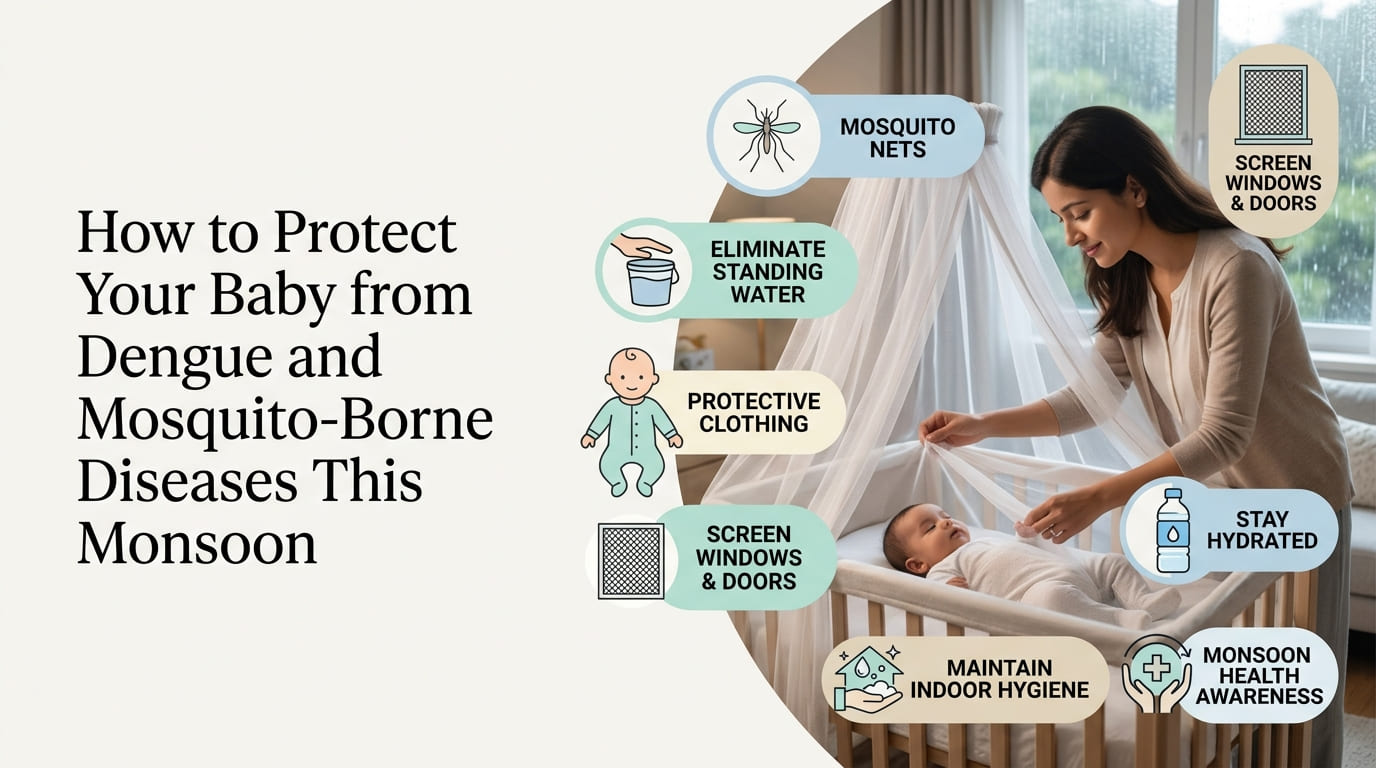
A properly fitted mosquito net over your baby’s sleeping area is the single most effective protection available. There are no chemicals involved, no questions about safety for young babies — just a physical barrier that mosquitoes cannot penetrate.
Use it for every sleep — day naps and night sleep both. Aedes mosquitoes bite during the day, particularly around dawn and dusk. As a result, a baby napping in the afternoon without a net is genuinely at risk.
Make sure the net has no holes and is properly tucked under the mattress. Check it regularly — even a small hole can let multiple mosquitoes in overnight.
2. Safe Mosquito Repellents for Babies — What’s Actually Safe
This is where parents get confused — and understandably so, because the rules are specific.
Under 2 months: No repellents of any kind. Mosquito nets and protective clothing only.
2 months to 2 years: DEET-based repellents are not recommended. Use repellents containing Picaridin (also called icaridin) at concentrations of 10% or less, specifically formulated for babies. Apply only to exposed skin — not on hands, not on face, not near the mouth. Never apply under clothing.
Over 2 years: Low-concentration DEET (10–20%) is considered safe by most paediatric guidelines when used correctly — on exposed skin, not on face or hands, washed off when returning indoors.
Natural repellents — citronella, eucalyptus — sound appealing but are generally less effective and eucalyptus oil is not safe for children under three. If you use a natural repellent, reapply more frequently.
Whatever repellent you use — apply it yourself and then dress your baby. Never spray directly onto a baby’s skin. Spray on your hands first, then apply.
3. Protective Clothing — Underestimated and Effective
Full-length cotton clothing during dawn and dusk significantly reduces mosquito bites. It sounds simple — because it genuinely is.
Loose-fitting is better than tight, since mosquitoes can bite through fabric pressed closely against skin. Additionally, light colours are better than dark, as mosquitoes are attracted to darker shades.
Long-sleeved cotton jhablas, full-length pajamas for sleep, socks on the feet — all of these reduce exposed skin. Moreover, cotton is breathable enough to stay comfortable even in monsoon heat.
4. Eliminate Breeding Grounds — Start This Today
Aedes mosquitoes breed in clean, stagnant water. The breeding site is often right in or around your home. This is where prevention happens at a community level — and it starts with your own space.
Check and empty or cover every possible water collection point around your home. Flower pot saucers — empty them weekly. Cooler water — change it every three days. Water storage containers — keep them tightly covered. Tyres stored outside — drill drainage holes or store indoors. Children’s outdoor toys — store face down so they don’t collect water. Bird baths — change water every three days. Blocked drains and gutters — clear them.
It takes twenty minutes. It eliminates breeding sites that could produce hundreds of mosquitoes.
5. Physical Barriers in the Home
Mosquito screens on windows and doors — properly fitted with no gaps — significantly reduce indoor mosquito populations. Check existing screens for holes regularly.
If you use an electric mosquito repellent device — the plug-in liquid or mat type — position it away from your baby’s breathing zone. These work by releasing insecticide into the air. They’re effective but the baby shouldn’t be directly breathing the fumes all night. In a well-ventilated room, positioned across the room from where the baby sleeps, they’re considered safe.
Mosquito coils are not recommended in enclosed spaces with babies — the smoke contains compounds that can irritate infant airways and lungs.
6. Timing Your Baby’s Outdoor Time
Aedes mosquitoes — dengue and chikungunya — bite most actively during the two hours after sunrise and the two hours before sunset. Anopheles mosquitoes — malaria — bite primarily at night.
Avoiding outdoor time during these peak windows significantly reduces your baby’s exposure. The middle of the day and indoor time after dark are the lower-risk windows.
When you do go out during higher-risk times — repellent on exposed skin, protective clothing, pram net or carrier cover in place.
Dengue Symptoms in Babies — Know These Exactly
Early symptoms — days 1 to 3
Sudden high fever — often 39°C or above — comes on quickly and doesn’t respond as well as expected to paracetamol. Additionally, unusual irritability or crying that can’t be settled in the normal ways is a key early sign. Refusal to feed, significantly reduced feeding, and general lethargy — more sleepy than a normal sick baby — are also common early indicators.
These symptoms overlap with many common baby illnesses. However, the fever pattern combined with the degree of irritability and lethargy is what raises the flag for dengue specifically.
Warning symptoms — days 4 to 6
This is the critical window in dengue — sometimes called the defervescence phase, when the fever may actually drop but the disease quietly progresses.
Watch for skin rash — flat or slightly raised red patches, often starting on the trunk and spreading to the arms and legs. Furthermore, bleeding from the gums or nose — even minor bleeding — is significant at this stage. Persistent vomiting, extreme pallor, a swollen or hard abdomen, and rapid breathing are also serious warning signs.
If any of these appear after a few days of fever — go to hospital immediately. Do not wait to see whether things improve on their own.
What makes dengue in babies different
Babies cannot tell you their head is splitting or their joints feel like they’re breaking — the classic dengue symptoms in adults. In babies, the presentation is dominated by fever, feeding refusal, and the quality of their cry and responsiveness.
Trust your instincts. If your baby has had a fever for more than two days and something feels wrong beyond just sick — get a blood test. Dengue is confirmed by blood test and early diagnosis genuinely changes outcomes.
Our baby fever guide covers exactly when a baby’s fever needs same-day attention and when you can manage at home — worth reading alongside this.
Malaria Symptoms in Babies — Different from Dengue
Malaria follows a different pattern from dengue. The classic presentation involves cycles of fever with chills — the baby spikes a high temperature, shakes, then the fever drops, and then spikes again. This cyclical pattern — though not always obvious in very young babies — is a distinguishing feature worth knowing.
Extreme pallor, vomiting, and a baby who is very difficult to rouse are all serious signs. In babies specifically, malaria can progress to severe anaemia and complications very quickly. Therefore, if you live in or have recently visited a malaria-endemic area and your baby develops fever — tell your doctor about any recent travel immediately.
At the Doctor — What to Expect
When you bring a feverish baby to the paediatrician with possible dengue or malaria, expect a blood test. For dengue specifically, the NS1 antigen test detects the virus in the first few days of illness. Additionally, platelet count and haematocrit are monitored as markers of disease severity.
Most cases of dengue in babies are managed as outpatients with close monitoring — frequent fluid intake, paracetamol only for fever, daily platelet count checks if needed, and a clear list of symptoms that mean come back immediately.
However, hospitalisation becomes necessary when platelets drop significantly, when warning signs of severe dengue appear, or when the baby cannot maintain adequate oral fluid intake.
Important: Do not give ibuprofen or aspirin for dengue fever. Both affect platelet function and can worsen bleeding complications. Use paracetamol only, at the correct dose for your baby’s weight. Our toddler fever guide covers safe fever management in detail.
If Your Baby Is Diagnosed with Dengue — What Happens Next
Stay calm. Most dengue cases in previously healthy babies, when caught and managed early, resolve without serious complications.
Follow your doctor’s instructions precisely — particularly around fluid intake, paracetamol dosing, and the specific warning signs that mean go back immediately. Furthermore, keep a fever diary — time, temperature, what was given, and when the next dose is due. This small habit helps you track patterns clearly and communicate effectively with your doctor.
Continue breastfeeding if you are breastfeeding. Breast milk maintains hydration and provides immune support that is genuinely valuable during illness. Our guide on how to maintain breast milk supply has tips for keeping supply up during a difficult period.
Above all — rest. Yours and the baby’s. This is recovery time and nothing else matters right now.
Staying Vigilant for the Rest of Monsoon
Dengue season in India doesn’t end until October at the earliest. Once your prevention systems are in place — nets, repellent routine, breeding grounds eliminated — maintaining them consistently matters far more than doing them intensely for just one week.
The mosquito that bites your baby at 6pm on a Tuesday in September is just as capable of transmitting dengue as the one in July. So keep the net up. Keep the repellent routine going. Keep emptying those flower pot saucers.
For a complete picture of monsoon baby health — skin, respiratory, digestive, and mosquito protection — our monsoon baby care guide covers the full seasonal picture.
FAQ — Dengue and Mosquito Protection for Babies
About Prevention
Q: What is the safest mosquito repellent for babies under 1 year?
For babies under 2 months, no repellent is safe — use only mosquito nets and protective clothing. For babies 2 months to 2 years, Picaridin-based repellents at 10% or lower, specifically formulated for babies, are the safest option. Apply only to exposed skin, never on hands, face, or near the mouth. Always apply to your own hands first and then onto the baby — never spray directly.
Q: Can I use a mosquito coil in my baby’s room?
No. Mosquito coils release compounds that can irritate and damage infant airways and lungs. Use mosquito nets over the sleeping area instead. Electric plug-in repellent devices — positioned away from the baby’s breathing zone in a ventilated room — are a safer alternative for general room protection.
Q: How often should I change the water in flower pots to prevent dengue mosquitoes?
Every three days or less. Aedes aegypti mosquitoes — which spread dengue — can complete their breeding cycle from egg to adult in as little as seven days in standing water. Emptying or changing standing water at least twice a week breaks this cycle.
About Symptoms and Diagnosis
Q: What are the signs of dengue in a baby?
Key signs include sudden high fever (often 39°C or above) that doesn’t respond well to paracetamol, unusual irritability, refusal to feed, skin rash (flat red patches), extreme lethargy, and in later stages — bleeding from gums or nose, persistent vomiting, and swollen abdomen. In babies, the absence of “breakbone” joint pain — common in adults — makes dengue harder to identify. If your baby has had a fever for more than two days with unusual irritability or lethargy, get a blood test.
Q: How is dengue diagnosed in babies?
Through a blood test — specifically the NS1 antigen test in the first few days of illness, and dengue antibody tests (IgM/IgG) from around day 5. Platelet count and haematocrit are also checked as markers of disease severity. Your paediatrician will advise which tests are appropriate based on how many days the fever has been present.
Q: My baby has a fever during monsoon. How do I know if it’s dengue or a regular viral fever?
You often can’t tell from symptoms alone — which is exactly why a blood test is important when a baby has a fever lasting more than 48 hours during monsoon season, especially with unusual irritability or refusal to feed. Don’t try to diagnose dengue at home. Get a blood test and let the results guide management.
About Treatment and Management
Q: What medicine should I give my baby for dengue fever?
Paracetamol only — at the correct dose for your baby’s weight, as directed by your paediatrician. Do not give ibuprofen or aspirin. Both affect platelet function and can worsen bleeding complications in dengue. Never self-medicate — always follow your doctor’s specific instructions for dose and frequency.
Q: Can I manage dengue at home or does my baby need hospitalisation?
Many cases of dengue in babies are managed as outpatients with close monitoring — but this decision must be made by your paediatrician, not at home. Hospitalisation is recommended when platelet counts fall significantly, when warning signs of severe dengue appear, or when the baby cannot maintain adequate hydration. Your doctor will give you specific warning signs that mean come back immediately or go to emergency.
Q: Can a baby get dengue more than once?
Yes — and the second infection with a different dengue serotype carries a higher risk of severe dengue. There are four dengue serotypes. Immunity after infection is serotype-specific, meaning infection with one type doesn’t protect against the others. This is one reason why prevention remains important even after a baby has had dengue once.
About Specific Situations
Q: I live in a high-rise apartment. Do I still need to worry about dengue mosquitoes?
Yes. Aedes aegypti mosquitoes can fly to significant heights and breed in small amounts of water found even on high floors — air conditioning drip trays, plant pot saucers, water collected on balconies. High-rise living reduces but does not eliminate the risk.
Q: Is it safe to take my baby to a park during monsoon?
Yes, with precautions. Apply repellent to exposed skin before going out, dress your baby in protective clothing, use a pram net if your baby is in a pram, and avoid the peak biting times — early morning and late afternoon. Parks with good drainage and no standing water are lower risk than those with puddles and dense vegetation.
More from MumPappaHub — Read These Next:
- Baby Fever Guide: When to Worry and When to Watch
- Toddler Fever Guide: Safe Management at Home
- Monsoon Baby Care: Complete Seasonal Guide
- Baby Cold and Cough Home Remedies
- Child Safety Proofing Guide
- Newborn Care Tips
- Child Development Milestones
- How to Increase Breast Milk Supply
- Postpartum Recovery Guide
- First Trimester Survival Guide
About This Article: Written by the MumPappaHub editorial team. Content reviewed for accuracy against guidelines from the World Health Organization (WHO), National Vector Borne Disease Control Programme (NVBDCP), and current paediatric recommendations. This content is for general informational purposes only and does not constitute medical advice. Always consult your paediatrician if your baby shows signs of illness.
MumPappaHub — Real talk for real parents. mumpappahub.com
