
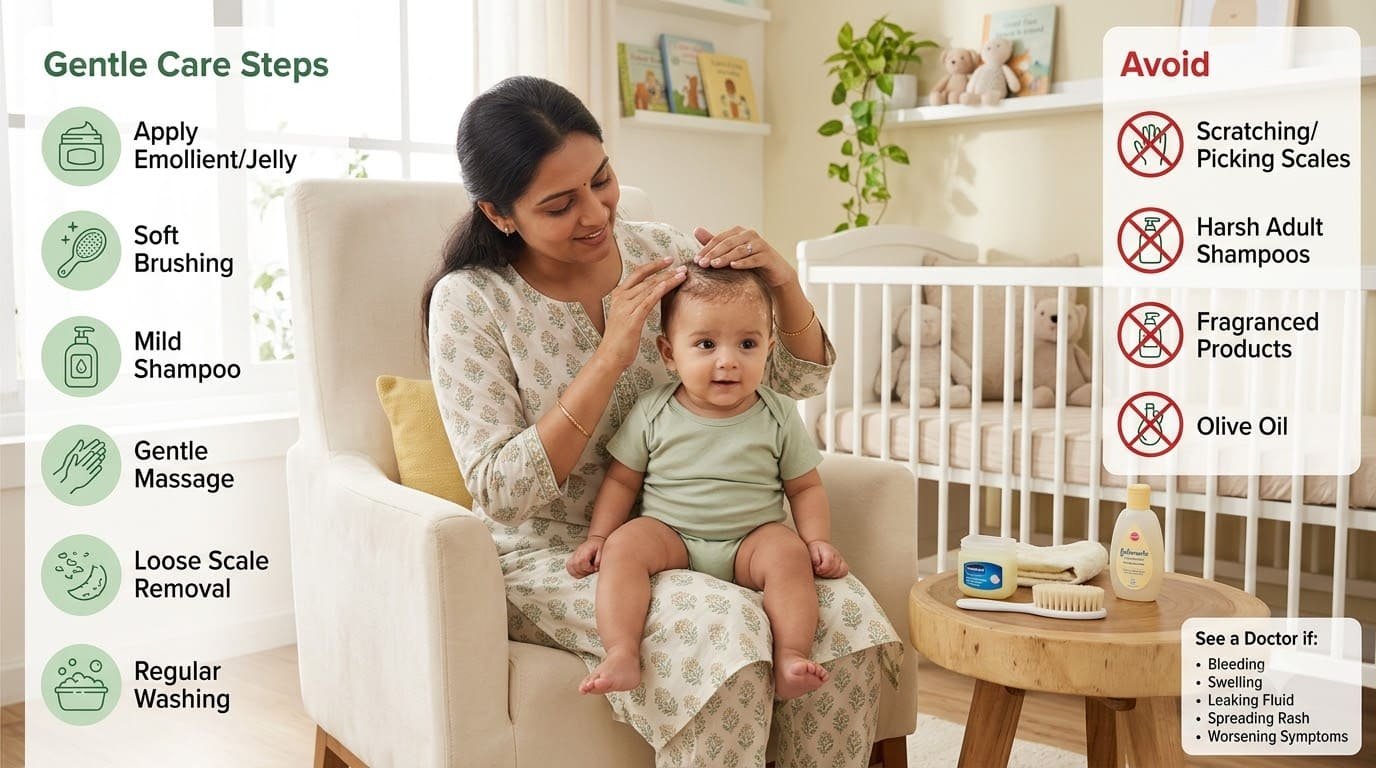
Medical Disclaimer: This article is for informational purposes only and does not replace professional medical advice. If you’re unsure whether your baby’s scalp condition is cradle cap or something else, consult your paediatrician.
Cradle cap in babies is one of those things nobody warns you about until you’re staring at it yourself. My son was about five weeks old when I noticed the patch. Yellowish, a little greasy-looking, right at the crown of his head where his hair was thinnest. My first thought, at 6 AM on almost no sleep, was that I’d somehow given him some kind of infection by not washing his hair properly. I remember scrubbing his scalp a little too hard in the bath that evening, trying to get it off, and only making it look worse.
It took a call to our paediatrician the next morning to actually get the word for it: cradle cap. Completely common, completely harmless, and — this was the part that annoyed me a little — completely not my fault for under-washing or over-washing anything.
If you’re staring at a similar patch on your own baby’s head right now, googling at an hour you’d rather not admit to, here’s everything I wish I’d known that first week — what cradle cap in babies actually is, what genuinely helps, and what I tried that made things worse before they got better.
What Cradle Cap Actually Is
Cradle cap, medically known as infantile seborrhoeic dermatitis, shows up as yellow or white flaky, sometimes greasy-looking patches on a baby’s scalp. It can also appear on the eyebrows, behind the ears, or in skin folds, though the scalp is by far the most common spot.
It’s caused by overactive oil glands in a newborn’s skin, likely influenced by hormones passed from mother to baby before birth. It has nothing to do with poor hygiene, and nothing to do with anything you did or didn’t do during pregnancy or after birth. This was the single most reassuring thing our paediatrician told me, and I wish someone had said it to me before I’d already spent an evening feeling vaguely guilty about it.
Cradle cap typically appears within the first few weeks of life and most commonly resolves on its own by around six to twelve months, as the baby’s oil gland activity settles down.
Cradle Cap vs Other Scalp Conditions: How to Tell the Difference
Not every scalp issue in a baby is cradle cap, and it’s worth knowing the difference before assuming.
Cradle cap typically looks greasy, yellowish or white, and scaly, usually without significant redness or apparent discomfort to the baby.
Eczema, in contrast, tends to be drier, redder, and often itchy — a baby with eczema may seem uncomfortable or scratch at the area, which isn’t typical with cradle cap.
Ringworm, a fungal infection, usually presents as a distinct, ring-shaped patch with a raised, defined edge, and often causes hair loss specifically within that ring.
If you’re genuinely unsure which of these you’re looking at, a quick check with your paediatrician is worth it — the treatments differ meaningfully, and what helps cradle cap won’t help a fungal infection or eczema flare.
7 Things That Actually Helped With My Son’s Cradle Cap
1. I stopped trying to scrub it off
This was my first instinct and it was the wrong one. Aggressively scrubbing a baby’s scalp to remove the flakes can irritate the skin and, in some cases, make the patches look worse before they look better. Gentle is genuinely the operative word here.
2. Oil massage, left on, then gently brushed out
A small amount of a mild oil — coconut oil or a plain baby oil — massaged gently onto the affected area and left on for fifteen to twenty minutes softened the flakes considerably. After that, a soft-bristled baby brush, used in gentle circular motions, lifted a lot of the loosened flakes without any real effort.
3. Regular, gentle washing with a mild baby shampoo
Washing the scalp every two to three days with a mild, fragrance-free baby shampoo, rather than avoiding washing out of caution, actually helped keep the oil buildup in check. This was counterintuitive to me at first — I’d assumed less washing was safer, but the opposite was closer to true here.
4. A soft brush, used daily, even without oil
On days I didn’t do the oil treatment, simply brushing his scalp gently with a soft baby brush during or after bath time helped prevent the flakes from building up as much between washes.
5. Patience, more than any single product
Genuinely, the biggest factor was time. Some patches cleared within a couple of weeks. Others lingered for a couple of months despite consistent care. Nothing I tried sped this up dramatically — consistency mattered more than any specific product.
6. Keeping his nails trimmed
This one isn’t about the scalp directly, but about preventing him from scratching at it once he was old enough to reach and rub at his own head. Short nails meant less risk of him irritating the area further himself.
7. Not panicking when it came back slightly
Cradle cap can flare up again even after seeming to clear, particularly during the first several months. Knowing this in advance saved me a second round of unnecessary worry when a small patch reappeared around month four.
What Didn’t Work For Me
Picking at the flakes directly with my fingers. I tried this exactly once, out of frustration, and it left a small red irritated patch that took longer to settle than the cradle cap itself would have on its own.
Using adult dandruff shampoo. A well-meaning relative suggested this, and I’m glad I checked with our paediatrician before trying it — adult anti-dandruff formulations aren’t designed for a baby’s sensitive scalp and can cause irritation.
Skipping baths to “let it heal.” This actually seemed to make the buildup worse, not better, since the natural oil accumulation continued without the gentle washing to keep it in check.
Expecting a single treatment to clear it completely. I kept waiting for one “aha” fix. There wasn’t one. It was consistent, gentle care over weeks, not a single remedy.
When Cradle Cap Might Need a Doctor’s Attention
Most cradle cap is mild, harmless, and resolves with basic home care. A few signs are worth mentioning to your paediatrician rather than continuing to manage it alone.
The area appears red, swollen, or warm to the touch, which can indicate a secondary infection rather than simple cradle cap. There’s visible discharge or oozing from the patches. The condition spreads significantly beyond the scalp to the face, body, or nappy area with a different appearance than typical cradle cap. Your baby seems uncomfortable, unusually fussy, or scratches at the area persistently. The patches don’t improve at all despite several weeks of consistent gentle care.
According to the Indian Academy of Pediatrics, most infantile seborrhoeic dermatitis resolves without medical intervention, though a paediatric evaluation is reasonable if there’s uncertainty about the diagnosis or if home care isn’t showing any improvement after a few weeks.
For more on your baby’s overall skin care routine beyond just the scalp, our baby skin care routine guide covers broader skincare basics for the newborn stage.
A Simple Weekly Routine That Worked For Us
Two to three times a week: apply a small amount of mild oil to the scalp, leave for fifteen to twenty minutes, then gently brush with a soft baby brush before or during bath time, followed by a gentle wash with mild baby shampoo. On the days in between: a quick, gentle brush during the regular bath routine, without oil, just to keep loose flakes from building up.
This isn’t the only routine that works — plenty of paediatricians suggest slight variations — but it’s the one that worked consistently for us without ever irritating his skin.
For more on newborn care basics during this same early stage, our newborn care tips and newborn sleep tips guides cover a lot of what else comes up in those first few months alongside something like cradle cap.
FAQ — Cradle Cap in Babies
Is cradle cap contagious?
No. Cradle cap is not contagious and cannot be passed to another baby or person through contact. It’s caused by internal factors like overactive oil glands, not by any infectious agent.
How long does cradle cap usually last?
Most cases resolve within a few weeks to a few months with basic care, though it can occasionally persist, in a milder form, until closer to a baby’s first birthday. It generally isn’t a cause for concern even when it lingers longer than expected.
Can I use coconut oil for cradle cap treatment?
Yes, plain coconut oil is commonly used and generally considered safe for this purpose. Apply a small amount, leave it on for fifteen to twenty minutes to soften the flakes, and gently brush before washing it out.
Will cradle cap affect my baby’s hair growth?
No, cradle cap doesn’t affect the hair follicles or long-term hair growth. Any hair that comes away while gently brushing loosened flakes is typically hair that was already in a natural shedding phase, not hair being pulled out by the condition itself.
Is cradle cap the same as dandruff?
They’re related conditions — both fall under seborrhoeic dermatitis — but cradle cap in babies tends to look greasier and more yellow, while dandruff in older children and adults is typically drier and flakier. The gentle care approach is similar for both.
Should I stop washing my baby’s hair if they have cradle cap?
No, and this was one of my own early mistakes in assuming otherwise. Regular, gentle washing with a mild shampoo actually helps manage the oil buildup that causes cradle cap, rather than making it worse.
Can adults get cradle cap too?
The infant version is specific to babies, but the same underlying condition, seborrhoeic dermatitis, can affect adults in different forms, most commonly as dandruff or flaky patches on the scalp, face, or chest.
More from MumPappaHub — Read These Next:
- Baby Skin Care Routine
- Newborn Care Tips
- Newborn Sleep Tips
- Monsoon-Safe Baby Skincare Products
- Diaper Rash Treatment India
- Baby Fever Guide
- Baby’s First Year Milestones
- How to Choose the Right Daycare for Your Toddler
About the Author
This article was written by the MumPappaHub editorial team, drawing on personal parenting experience alongside guidance from paediatric health resources including the Indian Academy of Pediatrics. This content is for general informational purposes only and does not constitute medical advice. Always consult your paediatrician for concerns about your baby’s skin or scalp.
MumPappaHub — Real talk for real parents. mumpappahub.com
