
News Source: Ministry of Women and Child Development, Government of India | Bal Raksha Bharat (Save the Children India) | September 1, 2026
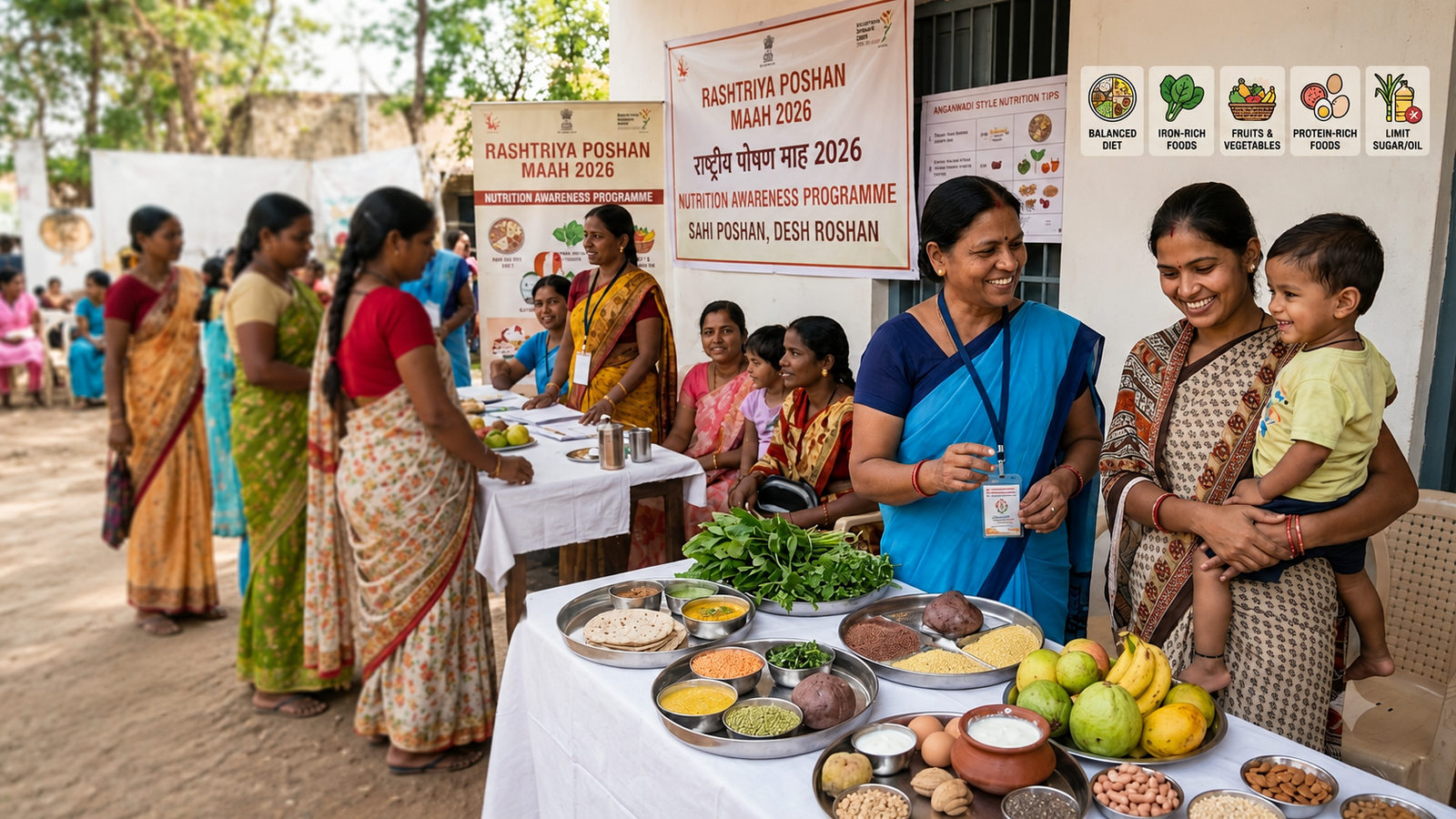
Rashtriya Poshan Maah 2026 India began on September 1 — and this year’s National Nutrition Month has direct, practical meaning for every Indian parent of a young child, pregnant woman, and new mother across the country.
The 8th Rashtriya Poshan Maah runs throughout September 2026, led by the Ministry of Women and Child Development under the Poshan Abhiyaan framework. This year’s campaign carries themes that address the nutrition challenges most affecting Indian families right now — and every parent reading this should know what they mean for their child.
What Is Rashtriya Poshan Maah?
Rashtriya Poshan Maah — National Nutrition Month — is observed every September across India under the Poshan Abhiyaan (POSHAN 2.0) mission. It is a nationwide campaign to combat malnutrition, build nutrition awareness, and drive community-level action on child and maternal nutrition.
The month involves awareness campaigns at Anganwadi centres, community health sessions, growth monitoring drives, and educational outreach through ASHA workers and Anganwadi workers across every state and union territory.
For Indian parents — this month is an opportunity. Anganwadi centres in your area will be running extra sessions, growth monitoring, and nutritional counselling throughout September. If you have a child under 6 or are pregnant or breastfeeding — make contact with your local Anganwadi centre this month.
This Year’s Key Themes — What They Mean for Parents
The 8th Rashtriya Poshan Maah 2026 focuses on five critical themes:
1. Addressing Obesity — Reducing Sugar and Oil Consumption
India now faces a double burden of malnutrition — undernutrition in some communities and rapidly rising childhood obesity in others, particularly in urban areas. The 2026 campaign specifically targets sugar and oil reduction for children.
What this means for parents:
The average Indian toddler’s diet has changed dramatically in the last decade. Packaged biscuits, instant noodles, fruit juice packets, flavoured milk drinks, and processed snacks have become significant parts of children’s diets in urban and semi-urban areas — all high in sugar, refined oil, and salt, and low in actual nutrition.
The campaign’s message is simple: whole Indian food — dal, curd, vegetables, ragi, eggs — provides far better nutrition than packaged alternatives at a fraction of the cost.
A recent study presented at NUTRITION 2026 found that 80% of packaged toddler foods fail WHO nutritional standards. The government’s message this Poshan Maah directly addresses the same problem.
2. Early Childhood Care and Education — Poshan Bhi Padhai Bhi
The “Poshan Bhi Padhai Bhi” initiative recognises that nutrition and early learning are inseparable. A malnourished child cannot learn effectively. A well-nourished child has the cognitive foundation for healthy development.
What this means for parents:
The first 1,000 days — from conception to a child’s second birthday — are the most critical window for both nutritional and cognitive development. What your baby eats in this period directly shapes brain architecture, learning capacity, and long-term health.
If your child is under 2 — this is the window. Iron-rich foods from 6 months, adequate protein, DHA for brain development, and exclusive breastfeeding for the first 6 months are the pillars of this critical period.
3. Infant and Young Child Feeding (IYCF) Practices
IYCF practices — exclusive breastfeeding for 6 months, appropriate complementary feeding from 6 months, continued breastfeeding to 2 years — remain the cornerstones of child nutrition programmes.
What this means for parents:
Despite widespread awareness campaigns, India’s exclusive breastfeeding rates remain below optimal. The most common reasons: perceived insufficient milk, pressure to introduce water or formula early, and lack of support for working mothers.
The Poshan Maah IYCF sessions at Anganwadi centres this September offer free lactation support, complementary feeding guidance, and nutritional counselling. If you are breastfeeding or have recently introduced solids — contact your local Anganwadi centre.
4. Men’s Involvement in Nutrition and Caregiving
One of the most significant themes of Poshan Maah 2026 is the explicit inclusion of men — fathers and husbands — in the nutrition conversation. Historically, nutrition campaigns have been directed almost exclusively at women.
What this means for Indian families:
A father who understands why his child needs iron-rich dal rather than processed biscuits, who supports his wife’s breastfeeding, who ensures the household food includes adequate vegetables and protein — this involvement makes a measurable difference to child nutrition outcomes.
This is a MumPappaHub moment — the “Pappa” in our name. Fathers who are engaged in their children’s nutrition and health make better outcomes more likely.
5. Ek Ped Maa Ke Naam — Nutrition and Environment Together
The “Ek Ped Maa Ke Naam” (One Tree in Mother’s Name) initiative links nutrition sustainability with environmental action — planting fruit and vegetable-bearing trees that provide local food nutrition for families.
5 Best Nutrition Actions for Indian Parents This Poshan Maah
Action 1 — Visit Your Anganwadi Centre This September
Every Anganwadi centre in India is running extra nutrition sessions, growth monitoring drives, and free nutritional counselling throughout September. If you have a child under 6, or are pregnant or breastfeeding:
Go this month. Get your child’s weight and height measured. Access the free nutritional guidance being offered. Connect with your ASHA worker for home visits.
Action 2 — Check Your Child’s Iron Status
Iron deficiency anaemia affects 50–70% of Indian children under 5. Most parents don’t know their child is iron deficient because the symptoms — fatigue, pale skin, reduced appetite — are easily attributed to other causes.
If your child hasn’t had a haemoglobin test this year — request one from your paediatrician or government health centre this month. Iron deficiency is treatable, but only if identified. Our iron rich foods babies toddlers India guide covers the best Indian foods to prevent and address iron deficiency.
Action 3 — Replace One Packaged Snack With a Real Food This Month
The obesity and sugar theme of Poshan Maah 2026 gives Indian parents a specific, practical challenge: identify one packaged snack your toddler eats regularly and replace it with a whole food alternative this September.
Packaged biscuit → Ragi laddoo Fruit juice packet → Fresh seasonal fruit Flavoured milk drink → Plain warm milk with a pinch of haldi Puffed corn snack → Roasted chana or peanuts (age-appropriate)
This one change, maintained consistently, makes a meaningful difference to a child’s nutritional intake.
Action 4 — Fathers — Take One Active Role in Your Child’s Nutrition This Month
In the spirit of this year’s men’s involvement theme: one concrete action for fathers this September.
Know what your child ate today. Once a week, prepare one meal for your child. Know whether your child’s haemoglobin has been tested. Attend one Anganwadi visit or paediatrician appointment with your partner.
Action 5 — Learn the First 1,000 Days
If your child is under 2 — understand that this period is irreplaceable. The brain development, bone density, immune function, and metabolic programming that happen in these first 1,000 days cannot be fully compensated for later.
For a complete guide to nutrition in the first year, our baby development month by month guide covers developmental milestones alongside nutritional needs at each stage.
MumPappaHub’s Take
Poshan Maah happens every September. What makes the 2026 campaign particularly significant is its acknowledgement that malnutrition in India is now two-sided — the persistent undernutrition that has always been the focus, and the rapidly growing problem of over-nutrition and childhood obesity in urban areas.
Both problems have the same solution at the household level: real Indian food. Dal, ragi, curd, eggs, palak, seasonal vegetables, ghee. These foods — already in Indian kitchens for generations — address both undernutrition and obesity better than any supplement or packaged product.
The government’s Anganwadi system reaches millions of families. Use it this month if you have access to it. And if you don’t — the information it’s distributing is exactly what we cover every day at MumPappaHub.
Related Reading on MumPappaHub:
- Iron Rich Foods Babies Toddlers India
- Superfoods for Toddler Brain Development India
- Starting Baby on Solid Foods India
- How to Increase Breast Milk Supply
- Toddler Weight Gain Foods India
- Baby Development Month by Month
Source: Bal Raksha Bharat (Save the Children India) — 8th Rashtriya Poshan Maah 2026 overview. Ministry of Women and Child Development, Government of India — Poshan Abhiyaan official campaign guidelines, September 2026.
MumPappaHub — Real talk for real parents. mumpappahub.com
