
News Source: NUTRITION 2026 Conference, American Society for Nutrition | Research by University of Texas at Austin | July 26, 2026
Ultra processed toddler foods India parents should know about — a major new study presented at NUTRITION 2026, the flagship annual conference of the American Society for Nutrition, has found that 4 out of 5 packaged toddler foods are ultra-processed, and nearly half fail WHO nutritional standards for children aged 6 to 36 months.
While the study was conducted in the United States, its findings are directly relevant to Indian parents — because the same packaged toddler food brands and product categories are increasingly available in Indian supermarkets, and the same marketing pressures apply.
What the Study Found
Researchers from the University of Texas at Austin examined nearly 2,800 packaged food products from the baby and toddler aisles of 21 grocery stores. Their findings, presented at NUTRITION 2026:
81% of toddler foods were ultra-processed — meaning they were industrially manufactured with multiple additives, preservatives, flavour enhancers, and artificial ingredients.
49% of all products failed at least one WHO nutritional standard — including standards for sugar, sodium, fat, and calorie density — for foods intended for children aged 6 to 36 months.
Ultra-processed foods were significantly more likely to be high in sugar than less-processed alternatives.
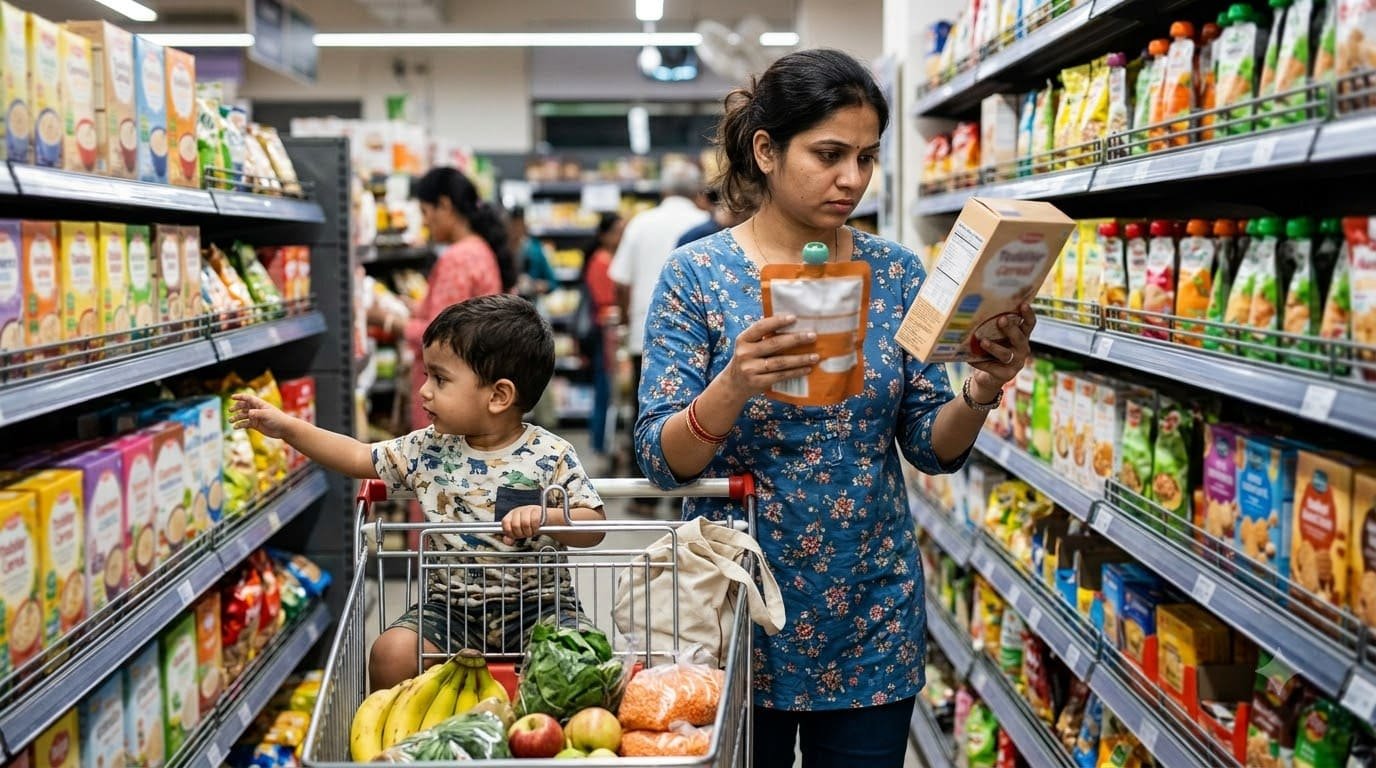
Common products flagged included fruit pouches, oat bars, packaged macaroni, puffed snacks, and meat sticks — many of which are marketed with health claims on their packaging.
Why This Matters for Indian Parents
India’s packaged toddler food market is growing rapidly. The same product categories — fruit pouches, puffed snacks, packaged biscuits and rusks, growing-up formula, and packaged porridge mixes — are now standard on supermarket shelves in Indian cities, marketed with words like “natural,” “organic,” “fortified,” and “healthy.”
The research highlights a critical point: the presence of health claims on packaging does not guarantee that a product meets nutritional standards.
Parents reading “no added sugar” on a fruit pouch may not realise the product is still ultra-processed. Parents buying “multigrain” biscuits may not recognise that the product is predominantly refined flour with minimal nutritional value.
The WHO Nutrition and Promotion Profile Model — the standard used in this research — sets specific limits on sugar, sodium, saturated fat, and total calorie density for commercial foods marketed to children under three years. Half the products on shelves failed these standards.
Ultra-Processed Foods — What the Term Actually Means
Ultra-processed foods are not simply “processed” foods like canned vegetables or pasteurised milk. They are industrially manufactured products that contain ingredients not typically found in home cooking — emulsifiers, flavour enhancers, colours, preservatives, modified starches, and sweeteners.
The NOVA food classification system — widely used in nutritional research — places foods in four categories:
Group 1: Unprocessed or minimally processed — fresh fruits, vegetables, eggs, plain meat, plain milk.
Group 2: Processed culinary ingredients — oils, butter, flour, salt.
Group 3: Processed foods — cheese, canned fish, bread.
Group 4: Ultra-processed — packaged snacks, fruit pouches with additives, puffed toddler snacks, packaged rusks, most growing-up formulas.
Research links ultra-processed food consumption to more than 30 health conditions in the longer term, including childhood obesity, type 2 diabetes, and disrupted gut microbiome development.
The Indian Context — What to Watch Out For
In Indian supermarkets, the following toddler food categories commonly fall into the ultra-processed category:
Packaged rusks and teething biscuits: Most contain refined flour, sugar, and multiple additives despite being marketed for babies from 6 months.
Fruit and vegetable pouches: Convenient and popular — but many contain added sugar, concentrates rather than whole fruit, and minimal fibre.
Puffed snacks for toddlers: High in sodium and often artificially flavoured, despite “no artificial colours” claims on the front.
Growing-up formula (Stage 3/4 milk): Marketing for these products is aggressive, but WHO and IAP are both clear that regular cow’s milk, curd, and dal provide the nutrition these products claim to offer — without the added sugar that many growing-up formulas contain.
Packaged porridge mixes: Vary significantly — some are genuinely nutritious, others are predominantly refined grain with minimal protein or fibre.
What to Do Instead — The Indian Kitchen Advantage
The good news for Indian parents is significant: traditional Indian home cooking for toddlers is inherently less processed and more nutritious than packaged alternatives.
Dal, ragi, khichdi, curd, mashed vegetables, boiled eggs, soft fruit — none of these are ultra-processed. They provide the iron, protein, calcium, and complex carbohydrates that packaged toddler foods attempt to replicate — without the additives, without the excess sugar, and without the cost.
Practical guidelines for Indian parents:
When buying packaged toddler food, check the ingredients list — not just the front-of-pack claims. The shorter the ingredients list, the less processed the product.
Look for added sugar under multiple names — glucose, fructose, sucrose, corn syrup, dextrose, maltodextrin all indicate added sugar.
Prioritise home-cooked food as the primary source of nutrition. Packaged products should supplement, not replace, home cooking.
Be sceptical of “organic” and “natural” claims on packaged toddler foods — these terms regulate ingredients, not processing level or nutritional quality.
For detailed guidance on what to actually feed babies and toddlers from six months, our starting baby on solid foods guide covers the complete first-foods approach. And for the specific Indian foods that support brain development and healthy growth, our superfoods for toddler brain development guide has the full list.
MumPappaHub’s Take
The research from NUTRITION 2026 confirms what nutrition experts have been saying for years — and what Indian grandmothers have known intuitively for generations: the best food for a toddler is food that looks like food.
Dal, ragi, curd, eggs, soft vegetables, ripe fruit — these are the toddler superfoods that have always been in the Indian kitchen. The proliferation of packaged toddler foods has created the impression that convenience products are nutritionally equivalent or superior to home-cooked food. They are not.
This doesn’t mean packaged foods are never acceptable — they serve a practical purpose during travel, in busy households, and as occasional snacks. But they should not be the foundation of a toddler’s diet, and the health claims on their packaging should not be taken at face value.
Read the ingredients. Cook when you can. Trust the dal.
Related Reading on MumPappaHub:
- Superfoods for Toddler Brain Development
- Starting Baby on Solid Foods India
- Foods to Help Toddler Gain Weight India
- Toddler Nutrition and Picky Eating
- Iron Rich Foods Babies Toddlers India
- Picky Eater Strategies That Work
Source: NUTRITION 2026 Annual Meeting, American Society for Nutrition, July 25–28, 2026. Research presented by Erin A. Hudson, University of Texas at Austin. Nutritional standards referenced from WHO Nutrition and Promotion Profile Model (NPPM).
MumPappaHub — Real talk for real parents. mumpappahub.com
