
Medical Disclaimer: This article is for informational purposes only. Every baby is different. Always consult your paediatrician if you have concerns about your baby’s sleep.
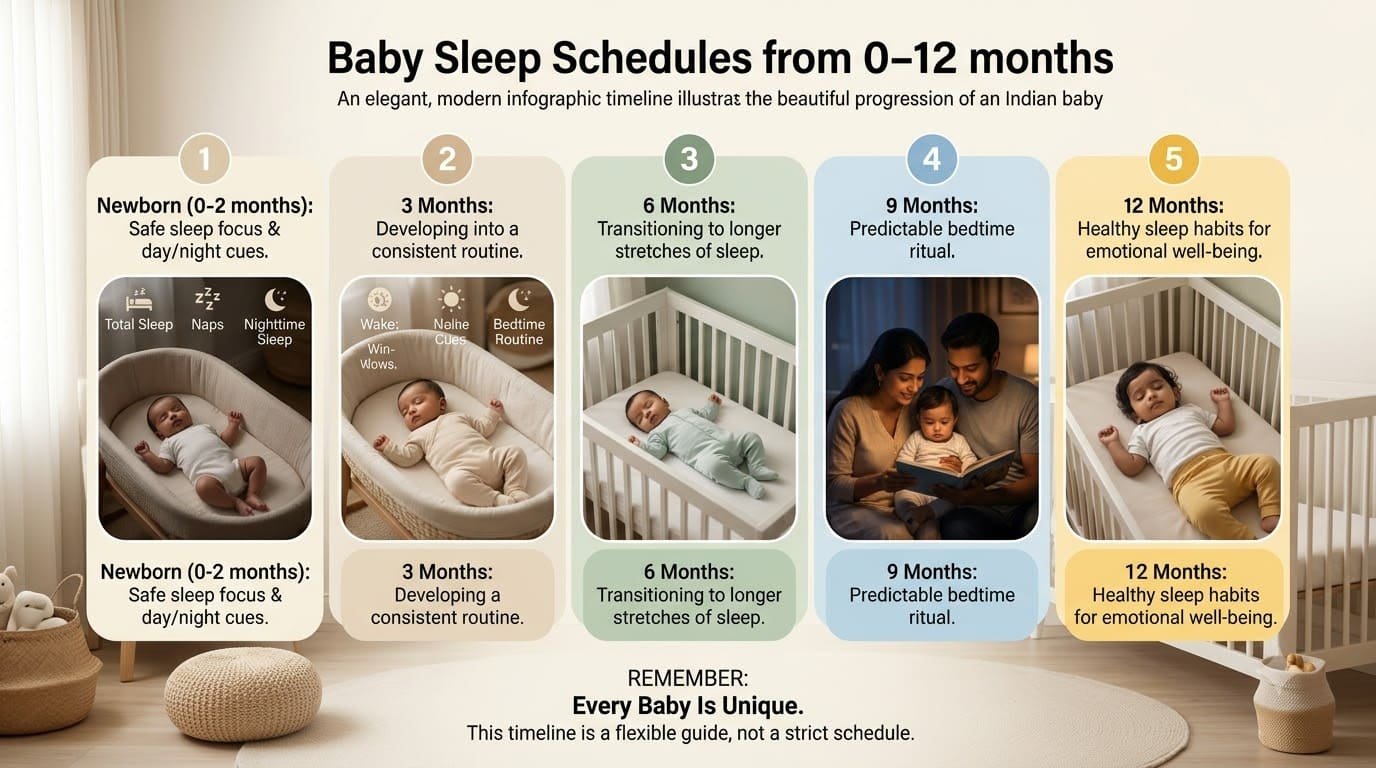
This baby sleep schedule month by month India guide covers every stage from newborn to 12 months — wake windows, nap counts, and what actually works for Indian families.
Baby sleep schedule month by month India is one of those topics that every new parent desperately searches at 2 AM — usually while holding a baby who has not read any of the schedules you’ve carefully bookmarked.
My son’s relationship with sleep in his first year could most charitably be described as “creative.” He had his own schedule, and it bore only passing resemblance to anything I’d read. He napped when he wanted, woke when he felt like it, and seemed personally affronted by the concept of a bedtime routine until he was about four months old.
What I needed — and what took me months to piece together — was not a rigid schedule to enforce, but an understanding of how baby sleep actually changes month by month. Once I understood what was developmentally happening, I could work with his sleep rather than constantly feeling like I was losing a battle against it.
This is that guide. Month by month, what’s actually happening, what realistic schedules look like for Indian babies and families, and the specific Indian context that most guides completely ignore.
Baby Sleep Schedule Month by Month India — Why It Keeps Changing
Baby sleep changes dramatically across the first year because the brain is developing at an extraordinary rate. A two-month-old’s sleep is not a broken version of a twelve-month-old’s sleep — it’s a completely different biological system.
According to the World Health Organization’s child development framework, sleep in early infancy is fundamentally different from adult sleep — with shorter cycles, more REM sleep, and no established circadian rhythm. The Indian Academy of Pediatrics recommends that sleep guidance for Indian babies account for the specific cultural context — including joint family households, varied climates, and different daily routines.
Three key concepts to understand before the monthly schedules:
Wake windows: The amount of time a baby can comfortably stay awake between sleeps before becoming overtired. This increases from 45 minutes at birth to 3-4 hours by twelve months. Keeping wake windows is the single most useful thing you can do for baby sleep at any age.
Sleep cues: The signs a baby gives that they’re ready for sleep — eye rubbing, yawning, looking away, losing interest in play, fussiness. Acting on sleep cues before the baby becomes overtired makes settling significantly easier.
Overtiredness: A baby who has stayed awake too long is harder to settle, sleeps more lightly, and wakes more frequently. The goal is not to keep the baby awake longer — it’s to put them down before they hit overtiredness.
Month 1 — No Schedule, Just Survival
Total sleep: 14–17 hours per day Night sleep: No distinction from day sleep Nap count: 4–6 short sleeps across 24 hours Wake window: 45–60 minutes maximum Night feeds: Every 2–3 hours — completely normal
What’s actually happening
Your newborn has no circadian rhythm. The suprachiasmatic nucleus — the brain’s internal clock — has not yet calibrated to light and dark cycles. Your baby does not know it is night. They are not making a lifestyle choice about sleep. They are a newborn.
Sleep comes in fragments of one to three hours around the clock. This is biologically appropriate for this age. The stomach is tiny and empties quickly, requiring frequent feeding. The brain needs abundant REM sleep for the neural development happening at a remarkable rate.
What to do in month 1
Survival is the goal. Not a schedule. Not sleep training. Survival.
Begin one thing that will pay off later: keep daytime feeds and interactions bright and engaging. Keep nighttime feeds dim, quiet, and boring. You are beginning to build the day-night distinction — even though it won’t be visible yet.
Indian context: Many families have extended family or helpers present in month one — particularly in joint households where the nani or dadi takes nighttime shifts. If this is available, use it. Taking a rest while someone holds the baby for two hours is not laziness. It’s survival.
Sample month 1 pattern (flexible, not a schedule)
No fixed pattern — feed on demand, sleep on demand
Night: wake every 2-3 hours for feeds
Day: sleep between feeds — 4-6 times across the day
Aim: dim and quiet nights, brighter days
Month 2 — The First Hints of Pattern
Total sleep: 14–16 hours per day Night sleep: 1 longer stretch beginning (3–5 hours possible) Nap count: 4–5 naps Wake window: 60–75 minutes Night feeds: 3–4 times
What’s actually happening
Around six weeks, the social smile arrives — and shortly after, the first hints of a day-night distinction begin to emerge. Some babies start giving a slightly longer first stretch of night sleep. Some don’t yet. Both are normal.
The six-week mark is often the peak of colic and fussiness — many babies are hardest to manage around this time regardless of what you do. This too passes.
What to do in month 2
A very simple bedtime routine can begin — not a rigid one, but a consistent sequence of events that signals sleep is coming. Feed, then gentle massage, then quiet dark room. Even at this age, consistency matters.
Indian context: Baby massage — maalish — fits naturally into this routine. A gentle maalish with warm oil followed by a warm bath in summer, or just the maalish in cooler months, then feeding in a dim room is a beautifully effective bedtime sequence that works with Indian tradition rather than against it.
Sample month 2 day pattern
Wake: 7 AM
Nap 1: 8:15–9:30 AM
Nap 2: 11–12:30 PM
Nap 3: 2–3:30 PM
Nap 4: 5–5:45 PM
Bedtime: 7:30–8 PM
Night feeds: 2–3 times
Month 3 — Longer Stretches, Shorter Naps
Total sleep: 14–16 hours per day Night sleep: First stretch 4–6 hours in many babies Nap count: 4–5 naps Wake window: 75–90 minutes Night feeds: 2–3 times
What’s actually happening
The circadian rhythm is beginning to establish. Many babies give a longer first stretch of night sleep — sometimes 4–6 hours. This is enormously encouraging. Don’t get too attached — the four-month sleep regression is coming.
Naps at this age are still unpredictable. Many are short — 30–45 minutes. This is a single sleep cycle and is developmentally normal, not a problem. Some naps will be longer, particularly the midday nap.
What to do in month 3
Keep the bedtime routine consistent. Move bedtime earlier — between 7 and 8 PM is ideal for most babies at this age. An earlier bedtime typically results in better night sleep, not more frequent waking.
Indian context: The “keep the baby up late so they sleep later” strategy does not work — it results in overtiredness that worsens sleep. A baby put to bed at 7:30 PM in India will sleep better than one kept up until 10 PM. This can require some renegotiation with extended family members who want to see the baby in the evenings.
Sample month 3 day pattern
Wake: 7 AM
Nap 1: 8:30–9:15 AM
Nap 2: 11–12 PM
Nap 3: 2–3 PM
Nap 4: 4:30–5:15 PM
Bedtime: 7:30 PM
Night feeds: 2 times
Month 4 — The Sleep Regression Arrives
Total sleep: 12–15 hours per day Night sleep: Disrupted — frequent waking Nap count: 3–4 naps Wake window: 90 minutes–2 hours Night feeds: Back to 3–4 times possibly
What’s actually happening
The four-month sleep regression is not a regression — it is a permanent neurological change. Sleep architecture matures to resemble adult sleep — with multiple cycles of light and deep sleep rather than the simpler newborn pattern. Babies who were sleeping in longer stretches suddenly wake more frequently because they are now rousing at the end of each light sleep cycle and don’t yet know how to go back to sleep independently.
This is the hardest month for many families. It is also temporary.
For detailed guidance on exactly what’s happening and what helps, our 4 month sleep regression guide covers this comprehensively.
What to do in month 4
Begin practising the drowsy-but-awake technique — putting the baby down when sleepy but not fully asleep. This teaches the baby to fall asleep in the cot rather than in arms, which is the skill they need to link sleep cycles independently.
Sample month 4 day pattern
Wake: 7 AM
Nap 1: 8:45–9:45 AM
Nap 2: 11:30 AM–1 PM
Nap 3: 3–4 PM
Bedtime: 7–7:30 PM
Night: variable — possibly frequent waking
Month 5 — Settling After the Storm
Total sleep: 12–15 hours per day Night sleep: Beginning to improve for many babies Nap count: 3 naps Wake window: 2–2.5 hours Night feeds: 2–3 times
What’s actually happening
For many families, month five brings some improvement after the chaos of month four. The new sleep architecture is established — the baby’s brain is adjusting to it. Naps may begin consolidating slightly.
What to do in month 5
If you’ve been working on drowsy-but-awake, continue. Nap times are becoming more predictable — begin offering naps at roughly consistent times rather than purely on demand.
Indian context: Summer heat in India significantly affects baby sleep. A cool room — ideally with a fan or AC — dramatically improves sleep quality. Lightweight cotton clothing and breathable cotton sheets rather than synthetic fabrics make a real difference in Indian summers. A baby who is too warm wakes frequently and sleeps lightly regardless of any other intervention.
Sample month 5 day pattern
Wake: 7 AM
Nap 1: 9–10 AM
Nap 2: 12:30–2 PM
Nap 3: 4–4:45 PM
Bedtime: 7:30 PM
Night feeds: 2 times
Month 6 — Solids Begin, Sleep May Shift
Total sleep: 12–15 hours per day Night sleep: 10–12 hours (with 1–2 feeds for breastfed babies) Nap count: 2–3 naps Wake window: 2–2.5 hours Night feeds: 1–2 times for breastfed, possibly zero for formula-fed
What’s actually happening
Solids begin around six months — and sleep often shifts alongside this. Some babies consolidate sleep further once solids are established. Others go through a brief disruption as the digestive system adjusts.
Many babies are ready to drop from three naps to two around this time — though some manage three naps until seven or eight months.
Signs the baby is ready to drop to 2 naps
Taking a long time to fall asleep for the third nap. Waking early from the third nap. Resisting bedtime because the third nap finished too close to it.
What to do in month 6
If the baby is ready, begin transitioning to two naps by extending wake windows slightly and pushing nap times later. Don’t rush this — a baby dropped from three naps before they’re ready will be overtired.
Sample month 6 day pattern
Wake: 7 AM
Nap 1: 9:30–11 AM
Nap 2: 2–3:30 PM
Bedtime: 7 PM
Night feeds: 1–2 times
Months 7–8 — Two Naps, More Predictable
Total sleep: 12–15 hours per day Night sleep: 10–12 hours Nap count: 2 naps Wake window: 2.5–3 hours Night feeds: 0–2 times
What’s actually happening
Two naps are now established for most babies. The schedule becomes more predictable — a morning nap and an afternoon nap, with a reasonably consistent bedtime. This is the sweet spot many parents were waiting for.
The 8-month sleep regression affects some babies — triggered by developmental leaps including crawling, pulling to stand, and object permanence development. Separation anxiety also peaks around this time, which affects settling.
Indian context: Extended family visits, festivals, and travel disrupt schedules during this period. A missed nap or late bedtime occasionally will not permanently damage sleep. Consistency on the regular days matters more than perfection every day.
Sample months 7–8 day pattern
Wake: 7 AM
Nap 1: 9:30–11 AM
Nap 2: 2–3:30 PM
Bedtime: 7–7:30 PM
Night feeds: 0–1 time
Months 9–10 — Consolidation
Total sleep: 12–14 hours per day Night sleep: 10–12 hours Nap count: 2 naps Wake window: 3–3.5 hours Night feeds: 0–1 time
What’s actually happening
Sleep is more predictable now. Most babies are sleeping through the night or close to it — with one feed or none. Two solid naps anchor the day. Bedtime is consistent.
Object permanence is now robust — which means separation at bedtime can become more emotional. The baby knows you exist when you leave the room. Consistent settling routines matter more than ever.
What to do in months 9–10
A very consistent bedtime routine — the same sequence every night — helps signal that sleep is coming. Bath, massage, feed, dark room, white noise, and bed in the same order every night builds a strong sleep association.
Sample months 9–10 day pattern
Wake: 7 AM
Nap 1: 9:45–11 AM
Nap 2: 2:30–4 PM
Bedtime: 7:30 PM
Night feeds: 0–1 time
Months 11–12 — Approaching the One-Nap Transition
Total sleep: 12–14 hours per day Night sleep: 10–12 hours Nap count: 2 naps (some approaching 1) Wake window: 3.5–4 hours Night feeds: 0 (most babies)
What’s actually happening
Most babies continue two naps through twelve months, with the transition to one nap typically happening between thirteen and eighteen months. Some early-transitioning babies begin showing signs of readiness for one nap around twelve months.
Signs the baby is not yet ready to drop the morning nap: resists the afternoon nap, bedtime goes smoothly. Signs they may be ready: takes a very long time to fall asleep for the morning nap, the afternoon nap is being cut short by late bedtime resistance.
Sample months 11–12 day pattern
Wake: 7 AM
Nap 1: 10–11:30 AM
Nap 2: 3–4:15 PM
Bedtime: 7:30 PM
Night feeds: 0
The Indian Household — Specific Challenges and Solutions
The joint family evening problem
In many Indian households — particularly joint families — evenings are the most social time. Relatives arrive, the grandparents want to play with the baby, the atmosphere is stimulating and lively. And your six-month-old needs to be in bed by 7:30 PM.
This is a genuine tension. The solution that works for most families: establish the bedtime routine as non-negotiable, and let family interaction happen earlier in the evening rather than right at bedtime. A baby who has had time with grandparents at 5–6 PM can still go to bed at 7:30 PM without significant disruption.
The phrase “doctor has told us the baby needs to sleep at this time” is remarkably effective in Indian families and is also completely true.
Festival disruptions
Diwali, Eid, Holi, Christmas — Indian families celebrate significantly, and celebrations frequently involve late nights, noise, and disrupted schedules. One or two nights of disruption does not damage a baby’s sleep long-term. The key is returning to the normal schedule the very next day, not gradually.
Summer heat
Indian summers significantly affect baby sleep quality. A room temperature above 26°C consistently disrupts sleep. If AC is available — use it for sleep. A fan circulating air is better than no cooling at all. Dress babies in a single layer of breathable cotton — not bundled up, regardless of what grandparents advise.
Mosquito nets vs white noise
Many Indian families use mosquito nets for baby sleep, which is appropriate. White noise — a small fan, a white noise machine, or a phone app at low volume — works well alongside a net and significantly reduces the impact of household noise on baby sleep.
For more on newborn sleep in the early months, our newborn sleep tips guide covers the first few weeks in detail. And for the most disruptive sleep event of the first year, our 4 month sleep regression guide explains exactly what’s happening and what helps.
FAQ — Baby Sleep Schedule Month by Month India
Q: My 3-month-old won’t nap longer than 30 minutes. Is this normal?
Yes — very. A 30–45 minute nap is a single sleep cycle and is developmentally normal at this age. Short naps are not a problem to fix — they’re a phase. Many babies naturally begin taking some longer naps from 4–6 months as sleep cycles mature. In the meantime, four to five shorter naps across the day is completely appropriate.
Q: My baby was sleeping well and suddenly started waking more at 4 months. What happened?
This is the four-month sleep regression — a permanent neurological change in sleep architecture. Sleep becomes lighter and more cycle-based, like adult sleep, and babies rouse between cycles. It is not a temporary blip. It is a permanent change that requires the baby to learn to link sleep cycles independently. See our 4 month sleep regression guide for detailed guidance.
Q: My mother-in-law says I should keep the baby up late so they sleep late in the morning. Is this right?
No — this is one of the most persistent sleep myths. Overtired babies sleep worse, not better. An earlier bedtime (7–8 PM) typically results in better night sleep and a similar or earlier morning wake time. “Sleep begets sleep” is well-supported by sleep research.
Q: When should I start a bedtime routine for my baby?
A simple, consistent bedtime routine can begin from six weeks. It doesn’t need to be elaborate — feed, gentle massage or bath, dark quiet room, and bed in the same order every evening. The consistency matters more than what the routine includes. By three to four months, the routine itself begins to trigger drowsiness.
Q: My 8-month-old was sleeping well but is suddenly waking again. Why?
The 8–10 month range often includes a sleep disruption triggered by major developmental leaps — crawling, pulling to stand, increased separation awareness. It is temporary. Maintain the consistent schedule and routine, respond to the baby’s needs at night without introducing new sleep associations you don’t want long-term, and it typically resolves within two to four weeks.
Q: How do I handle nap schedules during festival visits and travel?
Accept that one to two days of disruption won’t cause lasting damage. Protect the bedtime where possible even if naps are disrupted. Return to the normal schedule the day after the disruption rather than trying to gradually ease back. Babies are more adaptable than we give them credit for — it’s the extended disruption that causes problems, not the occasional one.
More from MumPappaHub — Read These Next:
- Newborn Sleep Tips: What Actually Works
- 4 Month Sleep Regression: Complete Guide
- Baby Sleep Training Guide
- Baby Development Month by Month
- Baby First Year Milestones
- Signs of Intelligent Baby India
- Indian Baby Weight Chart 0-12 Months
- Baby Vaccination Schedule India 2026
- Baby Fever Guide
- Newborn Care Tips
- Baby Blues vs Postpartum Depression
- Superfoods for Toddler Brain Development
About This Article
Written by the MumPappaHub editorial team — including a mother whose son had a deeply creative relationship with sleep in his first year that bore little resemblance to any schedule she’d bookmarked. He eventually slept. Most of them do.
Reviewed for accuracy against WHO child development guidelines and Indian Academy of Pediatrics sleep guidance. This content is for general informational purposes and does not constitute medical advice. Always consult your paediatrician with specific concerns about your baby’s sleep.
MumPappaHub — Real talk for real parents. mumpappahub.com

2 Comments