
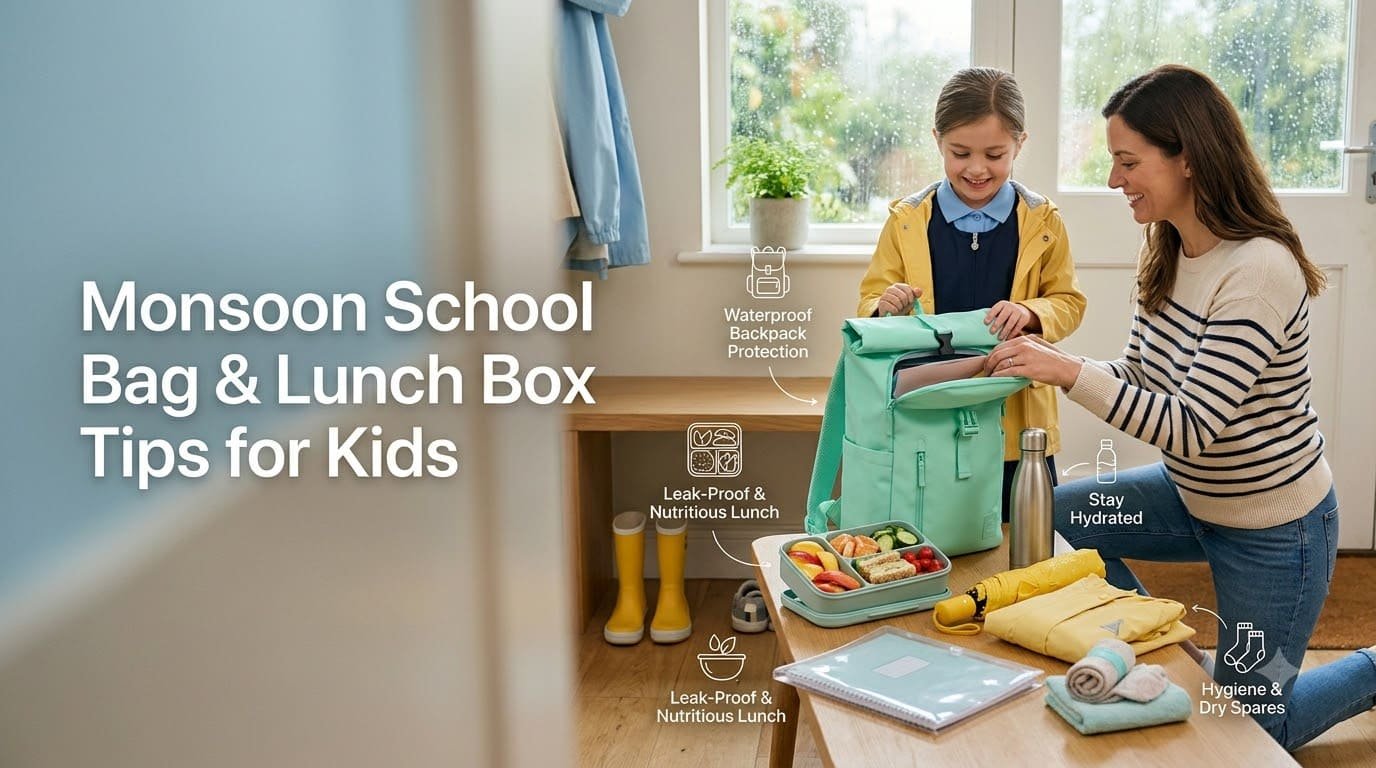
There’s a particular kind of Monday morning chaos that only monsoon parents know — and it’s exactly why monsoon school bag tips matter so much this season. The school bag got soaked at the bus stop on Friday…
If this sounds familiar, you’re not alone. Monsoon turns school-bag logistics into a genuine daily challenge. Most of the frustration is fixable, though. It just takes a few smart choices about what you buy and how you pack.
This guide walks through everything. Choosing the right bag. Packing food that actually survives humidity. Protecting books and stationery. And the small daily habits that save you from Monday-morning meltdowns.
Why Monsoon Is Genuinely Harder on School Bags
It isn’t just about rain getting in. Humidity itself creates a damp environment inside a closed bag. Even on dry days, ordinary bags weren’t designed to handle this.
Books absorb ambient moisture and start to curl. They can also develop a musty smell. Leather and certain synthetic straps can develop mildew if they stay damp too long. Food spoils faster in humid conditions too. This matters for a lunch packed at 7 AM and opened five or six hours later. Metal zippers and buckles are also more prone to rusting through the season.
According to the World Health Organization, food left at room temperature in warm, humid conditions faces a much higher risk of bacterial growth. That’s exactly the situation a packed lunch sits in for hours during monsoon.
Understanding this is the first step to solving it. Most of the “monsoon bag problem” is really a moisture-management problem. Once you approach it that way, the solutions become fairly straightforward.
Choosing the Right School Bag for Monsoon
Look for genuinely waterproof, not just “water-resistant”
There’s a real difference between the two. Water-resistant fabric holds up against light drizzle. But it soaks through in sustained rain. Genuinely waterproof bags use sealed seams, coated fabric, and rain flaps over zippers. Check for these features specifically when buying.
Check Waterproof School Bags on Amazon →
Prioritise sealed or covered zippers
Standard exposed zippers are one of the most common entry points for water. Bags with a rain flap or covered zipper track keep the interior significantly drier, even in heavier rain.
Choose synthetic over leather or canvas
Leather and canvas both absorb water and take much longer to dry. A bag that gets wet on Monday might still be damp on Wednesday. Synthetic, coated nylon or polyester dries faster. It also doesn’t develop the musty smell that damp canvas often does.
Consider a separate rain cover
Your child’s current bag might not be fully waterproof, and buying a new one isn’t always practical. A simple elasticated rain cover that slips over the entire bag is an inexpensive, effective interim solution.
Check School Bag Rain Covers on Amazon →
Ventilation matters too
A bag fully sealed against water but with no ventilation can still trap humidity inside. Over time, this encourages mould growth on books. A few small ventilation points help. Simply airing the bag out fully each evening works too.
Packing Lunch That Survives Monsoon Humidity
Choose insulated, leak-proof containers
An insulated lunch box keeps food at a more stable temperature for longer. This matters more in monsoon than parents often realise. Warm, humid air outside the box accelerates spoilage inside if there’s no insulation at all.
Check Insulated Leak-Proof Lunch Boxes on Amazon →
Favour foods that hold up well
Some foods simply travel better in humid conditions than others. Dry preparations like parathas, cutlets, and sandwiches with drier fillings hold up well. Anything with wet gravy or dairy-based sauce spoils faster. It also makes everything else in the box soggy. Fruits like apples, oranges, and grapes travel well. Cut fruit that oxidises quickly, like bananas or mangoes, is best avoided for a lunch that sits for hours.
Keep wet and dry components separate
Use a small divided container, or pack sauces and dips separately from the main food. This prevents everything turning soggy by lunchtime. It alone solves a huge portion of the “my child didn’t eat lunch” complaints during monsoon.
Skip anything highly perishable
Dairy-heavy items, anything with mayonnaise, and previously-cooked non-vegetarian dishes carry higher risk in warm, humid conditions. This matters most over several hours without refrigeration. If your child’s school doesn’t have refrigerated storage, stay more conservative with these during peak monsoon.
A small ice pack helps more than you’d think
Tuck a small reusable ice pack into the lunch bag. It keeps the internal temperature lower for the first few hours. This meaningfully reduces spoilage risk for a lunch packed early in the morning.
Check Reusable Ice Packs for Lunch Boxes on Amazon →
Protecting Books, Notebooks, and Stationery
Use a waterproof pouch or folder specifically for books and notebooks inside the main bag. Even a fully waterproof bag benefits from this extra layer. Interior compartments are often the ones that get missed when checking for dampness.
Encourage your child to check their bag each evening. Don’t leave a wet bag closed overnight. Moisture trapped overnight is what actually causes musty smell and paper curling — more than the rain itself.
A small silica gel packet inside the bag’s main compartment absorbs residual moisture. It’s a simple, low-cost addition that makes a noticeable difference over the season.
Keep a spare plastic folder in the bag at all times. Your child can then slip loose papers or a wet notebook into it during the day.
For pens and stationery, use a zip pouch rather than a loose stationery box. This prevents pens and pencils from rolling around in a damp compartment and picking up moisture.
Daily Habits That Make the Biggest Difference
Air the bag out every single evening. Even five minutes with it open and empty prevents most of the long-term damage from trapped humidity.
Check the raincoat or umbrella is actually in the bag. Don’t leave it behind after the last dry day. This sounds obvious, but it’s one of the most common monsoon mishaps.
Pack a spare pair of socks in a small ziplock bag for younger children. Wet socks through the school day are a common, easily preventable discomfort.
Wipe down the bag’s exterior with a dry cloth when your child gets home. Don’t let rainwater sit and soak in overnight.
Rotate two bags if possible. Use one while the other fully dries, especially during weeks of continuous rain.
For more on keeping your child healthy this season, see our guide on monsoon baby care tips and our immunity-boosting foods for kids in monsoon.
What to Do If a Bag Already Smells Musty
If a bag has already developed a musty smell, a few things help before you consider replacing it. Empty it completely and let it air-dry in a well-ventilated spot. Avoid direct sun, which can damage certain fabrics and coatings. Wipe the interior with a cloth dampened with diluted white vinegar — this helps neutralise musty odours. Leave a small open box of baking soda inside the empty bag overnight to absorb lingering odour.
If the smell persists after this, it may indicate mould inside the seams or padding. In that case, replacement is the safer option. This matters most for younger children, who may be more sensitive to mould exposure.
FAQ — Monsoon School Bag & Lunch Packing
Q: How can I make my child’s existing school bag more waterproof without buying a new one?
A separate rain cover that slips over the entire bag is the most effective low-cost option. You can also treat the fabric with a waterproofing spray. This typically needs reapplying every few weeks. It also works better on canvas or fabric bags than on already-coated synthetic ones.
Q: What foods should I avoid packing for school lunch during monsoon?
Dairy-based sauces, mayonnaise, and previously-cooked non-vegetarian dishes carry higher spoilage risk. So does quickly-oxidising cut fruit like banana or mango. This risk grows over several hours without refrigeration. Drier preparations, whole fruits, and foods with separated wet and dry components generally hold up better.
Q: How do I stop my child’s notebooks from getting damp even when the bag doesn’t get directly rained on?
Ambient humidity alone can dampen paper over time inside a closed bag. Use a waterproof pouch or folder specifically for books. Add a small silica gel packet. Air the bag out every evening. These are the most effective steps to prevent this.
Q: Is it necessary to buy an insulated lunch box, or does a regular one work fine in monsoon?
An insulated lunch box isn’t strictly necessary. But it meaningfully reduces spoilage risk by keeping food at a more stable temperature for longer. This matters more during monsoon than during cooler months. For lunches packed early morning and eaten hours later, insulation makes a real difference.
Q: My child’s school bag smells musty even though it doesn’t look visibly wet. What’s causing this?
This is usually caused by trapped humidity rather than visible water. Moisture from ambient air, sweat, or brief dampness never fully dries out because the bag stays closed. Airing the bag out completely every evening is the single most effective habit to prevent this.
More from MumPappaHub — Read These Next:
- Monsoon Baby Care Tips
- Immunity-Boosting Foods for Kids in Monsoon
- Newborn Visitor Rules 2026
- 8 Proven Tips to Handle Toddler Tantrums
- Toddler Nutrition & Picky Eating
- Budget-Friendly Baby Products 2026
About This Article: Written by the MumPappaHub editorial team. Practical tips compiled from common monsoon parenting challenges across Indian households. This content is for general informational purposes only.
MumPappaHub — Real talk for real parents. mumpappahub.com
