
Medical Disclaimer: This article is for informational purposes only and does not replace professional medical advice. If your child shows any symptoms of typhoid, cholera, or any waterborne illness, seek medical attention immediately. Always consult your paediatrician for diagnosis and treatment.
The monsoon my son was five, he came home from school on a Friday complaining of a headache.
By Sunday the fever was 39.5°C. By Tuesday it was climbing every evening despite paracetamol. By Thursday — a week after that first headache — the hospital confirmed typhoid.
He’d been drinking water from his school water cooler. The cooler that got its supply from a tank that had been compromised during the heavy rain earlier that month. Seven other children in his class got sick too.
I keep thinking about what I didn’t know then. I didn’t know that typhoid fever builds slowly — that the gradual, daily rise in temperature is actually the disease’s signature. I didn’t know that monsoon is when waterborne diseases in children spike most dramatically. I didn’t know what signs to watch for or how quickly to act.
This article is everything I learned after that week — organised clearly, so you don’t have to learn it the hard way.
What Are Waterborne Diseases? (Typhoid & Cholera Explained)
The basics every parent needs to understand
Waterborne diseases are illnesses caused by pathogens — bacteria, viruses, and parasites — that enter the body through contaminated water or food prepared with contaminated water.
According to the World Health Organization, unsafe drinking water causes approximately 1.4 million deaths every year globally — the majority in children under five. In India, waterborne diseases remain one of the leading causes of childhood illness and hospitalisation, with cases spiking dramatically every monsoon season.
The most significant waterborne diseases affecting children in India are typhoid, cholera, hepatitis A, and acute gastroenteritis. Of these, typhoid and cholera are the ones parents need to understand most clearly — because both can become serious quickly, both are frequently misidentified in their early stages, and both are entirely preventable.
Typhoid — what it actually is
Typhoid fever is caused by the bacterium Salmonella typhi. It spreads through the faecal-oral route — contaminated water or food that has been touched by someone who carries the bacteria. It does not spread through casual contact or the air.
Once swallowed, the bacteria penetrate the gut lining, enter the bloodstream, and cause a systemic infection that affects the whole body. The liver, spleen, and lymph nodes all become involved. Without treatment, complications can develop — intestinal perforation, internal bleeding, and in severe cases, death.
The good news — typhoid responds well to antibiotics when caught early. The key is catching it early, which means knowing what it looks like.
Cholera — what it actually is
Cholera is caused by the bacterium Vibrio cholerae, which produces a toxin in the gut that causes the intestines to secrete massive amounts of fluid. The result is the profuse, watery diarrhoea that makes cholera so dangerous — not because of the infection itself, but because of the speed and severity of dehydration it causes.
In a child, severe dehydration from cholera can develop within hours. This is why cholera is one of the few diseases where speed of response — starting oral rehydration immediately, getting to a hospital if the case is severe — is literally a matter of life or death.
Cholera spreads through contaminated water and food — particularly seafood from contaminated water and raw produce washed in it. Monsoon, when water sources get contaminated by flooding, creates ideal conditions for cholera outbreaks.
Other important waterborne diseases in children
Hepatitis A — a viral liver infection spreading through contaminated water and food. Often mild or symptom-free in young children but can cause significant illness in older children and adults. A vaccine exists and is recommended for children in India.
Acute gastroenteritis — viral or bacterial stomach illness causing vomiting and diarrhoea. The most common waterborne illness, peaking in monsoon. Usually self-limiting but dangerous in young children due to dehydration risk.
Leptospirosis — bacterial infection from water contaminated with animal urine. Risk increases when children play in floodwater. Can progress to affect liver and kidneys.
Why Monsoon Increases the Risk of Waterborne Diseases for Children
What happens to water during heavy rain
Monsoon doesn’t just bring rain — it brings a complete disruption of water safety systems across India simultaneously.
Heavy rainfall overwhelms drainage infrastructure. Sewage overflows into groundwater sources. Pipes running through waterlogged ground develop micro-cracks that allow contamination to enter under pressure. Overhead tanks and storage containers get contaminated by surface water. Water treatment plants struggle to cope with the increased volume and contamination load.
The result — tap water that is safe in February may not be safe in July. Well water that has been reliable for years can become contaminated during a heavy monsoon week. Even bottled water supply chains face disruption when flooding affects distribution and storage conditions.
According to the Indian Academy of Pediatrics, waterborne disease admissions in children increase by 40 to 60 percent during monsoon months compared to the rest of the year. This is not a small increase. It is a predictable, preventable seasonal spike that happens because parents and families don’t change their water habits when the season changes.
Why children are more vulnerable than adults
Children’s immune systems are still developing. Their gut defences — stomach acid concentration, gut flora — are less robust than adults. They absorb proportionally more of what enters their digestive system. And critically — they dehydrate faster.
An adult with cholera can manage a day of illness at home with careful oral rehydration. A child with cholera can reach dangerous dehydration within hours. A toddler with typhoid cannot tell you that their head is pounding behind their eyes. A five-year-old cannot distinguish between feeling generally unwell and the specific systemic illness that typhoid produces.
This is why waterborne diseases in children need earlier recognition and faster action than the same diseases in adults.
School water — the underestimated risk
One of the most common but least discussed transmission routes for typhoid in school-age children is school water. Water coolers, tanks, and taps in schools are often not monitored or treated with the same diligence as home water during monsoon.
Children drink more water at school than at home during humid monsoon days. They use school bathrooms. They share water bottles. All of these create transmission opportunities that parents rarely think about.
Talk to your child’s school at the start of monsoon season. Ask about their water source and treatment practices. This is not overreacting — it is precisely the conversation the seven families in my son’s class wish someone had had in July.
Early Symptoms Parents Should Watch For
Typhoid symptoms in children — recognising the pattern
The pattern is what matters with typhoid. It doesn’t arrive suddenly like the flu or cholera — it builds.
Week one — the creeping fever: Fever that starts moderate and rises progressively — a little higher each evening, never quite coming down to normal. Headache, often severe but hard for young children to articulate. General malaise — the child seems off, uninterested, quieter than usual. Mild abdominal discomfort. Reduced appetite.
What’s notably absent in many typhoid cases — the runny nose and cough of a typical viral illness. A child with a progressive fever and no upper respiratory symptoms during monsoon should make you think typhoid until proven otherwise.
Week two — more pronounced symptoms: Fever now consistently high — 39 to 40°C. Abdomen becoming more tender, particularly in the right lower area. Possible rose spots — faint pink spots on the trunk that appear in some typhoid cases and are easy to miss. Diarrhoea or constipation — either can occur. Significant fatigue.
The danger of the “feeling better” phase: Some children seem to improve slightly around days seven to ten. Don’t be reassured by this. Typhoid can relapse, and untreated or inadequately treated typhoid can develop serious complications — intestinal perforation being the most dangerous — precisely when the family thinks things are improving.
Cholera symptoms in children — recognising the emergency
Cholera announces itself differently — suddenly and dramatically.
Profuse, watery diarrhoea that begins abruptly — often described as “rice-water” stools because of their appearance. Vomiting alongside the diarrhoea. Rapid onset of dehydration — dry mouth, sunken eyes, reduced skin elasticity, reduced urination, increasing weakness.
In children, dehydration from cholera progresses fast. A child who seems manageable at eight in the morning can be in serious trouble by noon. This is not a condition to manage at home with a wait-and-see approach.
General warning signs requiring immediate action
Regardless of which waterborne disease you suspect — get medical attention the same day if your child shows:
Fever above 38°C in a baby under three months — always an emergency.
Fever that has persisted for more than two days without improving.
Signs of dehydration — dry mouth, no tears when crying, sunken eyes, significantly reduced urination, unusual lethargy or drowsiness.
Blood in stool or vomit.
Severe abdominal pain.
A child who is unusually difficult to rouse or not responding normally.
Vomiting that is continuous and preventing any fluid intake.
Safe Drinking Water Practices at Home & School
At home — practical steps for monsoon season
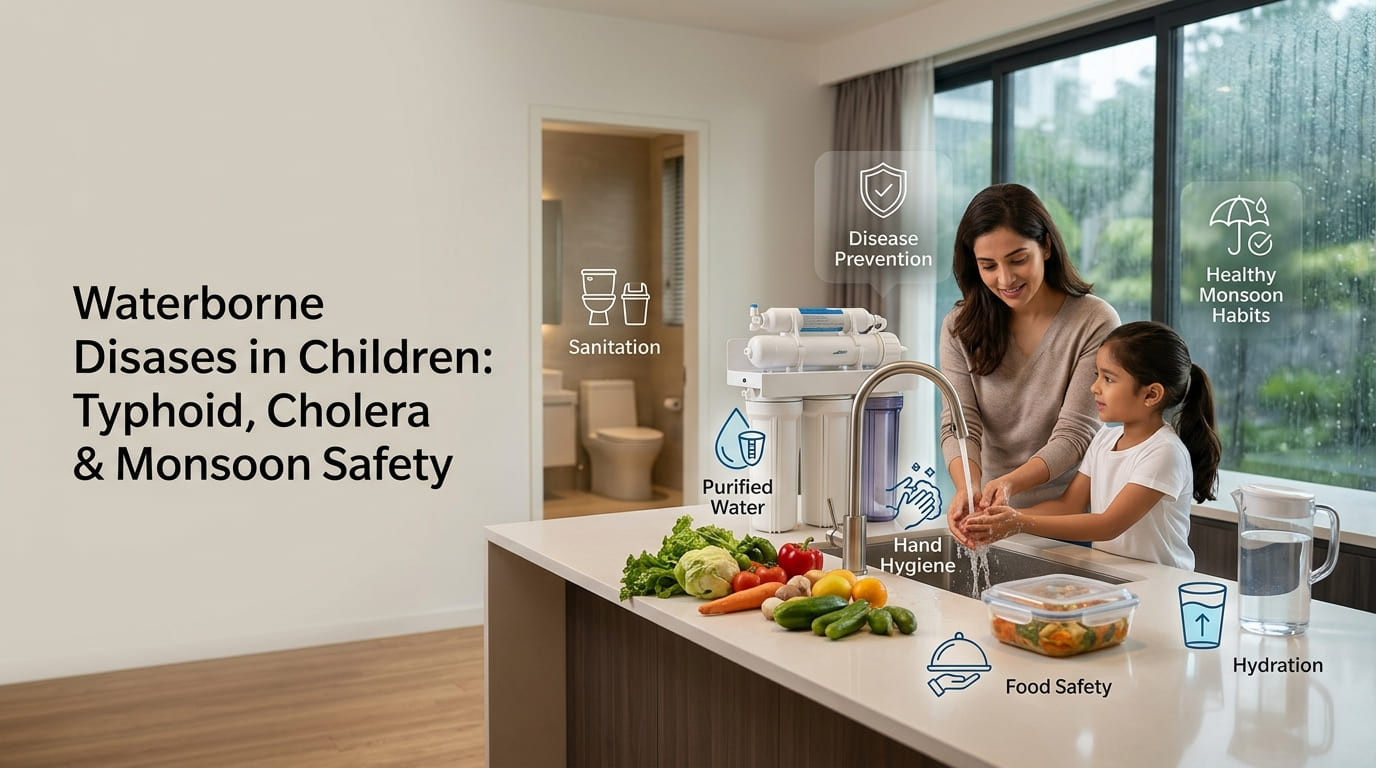
Boil all drinking water. During monsoon — boil water before drinking, even if you usually drink tap water without problems. Bring to a rolling boil for at least one minute. Cool in a covered container. Use within twenty-four hours. This one step eliminates most bacterial and viral waterborne pathogens.
Maintain your water purifier. If you have a UV purifier — service it at the start of monsoon season. Change filters as recommended. Be aware that high sediment loads during monsoon can reduce effectiveness. If the water looks turbid — boil it even if you have a purifier.
Store water safely. Covered containers, cleaned weekly. Never store drinking water in open vessels during monsoon. Don’t let storage containers sit near drains or floor level where flood contamination is possible.
Use purified water for everything oral. Not just drinking — brushing teeth, washing fruits and vegetables, making ice, rinsing pacifiers and baby bottles. Children swallow water during tooth brushing. Ice made from contaminated water is contaminated water.
Reheat food thoroughly. Bacteria multiply faster in warm, humid monsoon conditions. Food that kept safely for two days in the fridge in March may not be safe after one day in July. Reheat completely — not warm, but steaming hot throughout.
At school — conversations worth having
Ask your child’s school at the start of monsoon: What is the source of drinking water? When was the water tank last cleaned? How is water treated before it reaches students? What is the protocol if a student is unwell with a gastric illness?
If the school cannot answer these questions clearly — escalate. This is a child safety issue, not an administrative preference.
Teach your child to carry their own water bottle from home with boiled or purified water. Teach them not to share water bottles during monsoon. Teach them to wash hands before eating anything at school.
For more on building healthy habits in children from an early age, our toddler language development guide and child development milestones cover age-appropriate understanding that helps children follow health rules independently.
Food safety during monsoon
Street food during peak monsoon carries significantly higher risk — not because street food is inherently unsafe, but because the conditions for food safety (clean water for washing, safe storage temperatures, absence of flies) are hardest to maintain during heavy monsoon rain.
Raw and cut produce purchased outside the home is particularly high risk. Wash all produce at home with purified water before consumption. Cook vegetables thoroughly rather than eating raw during peak monsoon weeks.
Seafood carries elevated risk in monsoon — shellfish and fish from contaminated water sources can carry cholera and other pathogens. If in doubt, skip it until the season passes.
When to Consult a Doctor Immediately
Don’t wait — these signs mean go today
Any fever in a baby under three months — regardless of height or cause, always a same-day call.
Fever that rises progressively over two or more days — this pattern, especially without upper respiratory symptoms in monsoon, is typhoid until proven otherwise. Don’t wait for it to resolve on its own.
Any signs of dehydration — dry mouth, sunken eyes, no tears, significantly reduced urination, unusual weakness or drowsiness. In cholera especially, dehydration can progress to dangerous levels within hours in children.
Blood in the stool — always needs same-day assessment. Can indicate serious bacterial infection.
Vomiting that prevents any fluid intake — if your child cannot keep even small sips of water or ORS down for more than four to six hours, they need IV fluids.
Severe abdominal pain — particularly if it is worsening, localised to one area, or accompanied by fever.
A child who seems confused, very drowsy, or difficult to rouse — neurological symptoms alongside fever are always an emergency.
What to tell the doctor
When you call or arrive — tell them specifically: the duration of the fever and its pattern (how it has changed each day), whether there are any diarrhoea or vomiting symptoms and their character, whether your child has been drinking school or outside water, whether anyone else in the household or school has been sick, and what medications you have already given and when.
This information significantly speeds up diagnosis. Typhoid and cholera both require specific blood or stool tests to confirm — your paediatrician will order these based on the clinical picture you describe.
For detailed guidance on fever management in different age groups, our baby fever guide and toddler fever guide cover what’s normal, what needs attention, and how to manage at home while seeking care.
Prevention Tips & Hygiene Habits
The five habits that prevent most waterborne illness
Handwashing — the single most powerful intervention. Wash hands with soap before every meal, after every toilet visit, after playing outside, after touching animals, after touching public surfaces. Twenty seconds minimum. This one habit, done consistently, prevents more waterborne illness than any other single action.
Teach children early. Make it automatic. Keep soap accessible. For young children who can’t wash independently — wash their hands for them, every time, before food enters their mouth. Our potty training guide covers how to make handwashing a built-in habit alongside toilet training.
Boiled or purified water only. As discussed — no compromises during monsoon season. Every family member, including children who are old enough to drink independently, should understand that tap water goes in the pot to boil before it goes in the glass.
Avoid street food and raw produce during peak monsoon. Not forever. Not always. But during the heaviest rain weeks of July and August — eat at home, cook food thoroughly, wash produce in purified water.
Vaccinate. Typhoid vaccine and Hepatitis A vaccine are both available and recommended for children in India. If your child hasn’t had these — speak to your paediatrician. Vaccination doesn’t guarantee protection but significantly reduces the risk and severity of infection.
Keep ORS at home. Oral rehydration solution — available at every pharmacy — should be in every home before monsoon begins. If your child develops diarrhoea or vomiting, start ORS immediately rather than waiting to see if it passes. Early rehydration prevents the progression to severe dehydration.
Building hygiene habits children will actually follow
Rules work better than lectures for children. Instead of explaining the germ theory of disease to a four-year-old, build habits — wash hands before eating, always, no exceptions. Drink only from your water bottle from home. Don’t share food or drinks at school during monsoon.
Make it normal rather than fearful. Children who understand the rule as a simple family habit follow it more consistently than children who’ve been frightened into compliance.
For more on building healthy routines that children maintain independently, our screen-free childhood challenge guide and child safety proofing guide both cover habit-building approaches that work across different ages.
FAQ — Waterborne Diseases in Children: Typhoid, Cholera & Monsoon Safety
About Typhoid
Without treatment, typhoid can persist for three to four weeks and carries significant risk of complications. With appropriate antibiotic treatment, most children begin improving within three to five days of starting medication. However, full recovery — restored energy and appetite — often takes two to three weeks even after the fever resolves. Complete the full antibiotic course even when the child seems better.
Yes — prior typhoid infection provides some immunity but not complete lifelong protection. Vaccination is still recommended after recovery. A second infection can occur, particularly with a different strain. Maintain water safety practices even after a child has recovered from typhoid.
Yes — typhoid vaccine is available in India and recommended for children from two years of age. The Vi polysaccharide vaccine is given as a single injection. A newer conjugate vaccine (Typbar TCV) provides longer-lasting protection and is now recommended over the older vaccine by most paediatric bodies. Speak to your paediatrician about which is appropriate for your child.
About Cholera
Very quickly — within hours in severe cases. This is what makes cholera different from most childhood illnesses. A child who appears ill but manageable in the morning can reach dangerous dehydration by afternoon. If your child has profuse watery diarrhoea and vomiting simultaneously — start ORS immediately and go to hospital, don’t wait at home.
It’s a description of appearance, not actual rice. Cholera stool is very watery and pale, sometimes with small white flecks that resemble rice grains — these are actually mucus. If your child’s diarrhoea looks very watery and pale, not the typical yellow or brown — this is a warning sign worth taking seriously.
Cholera spreads through contaminated water and food — not through casual person-to-person contact. However, a person with cholera who uses the toilet and doesn’t wash hands thoroughly can contaminate surfaces and food, creating secondary transmission within a household. Strict handwashing and separate toilet facilities if possible reduce this risk.
About Prevention and General Safety
You can’t tell by looking at it. Clear water can carry typhoid and cholera bacteria. The only reliable approach during monsoon is to boil all drinking water regardless of how it looks. If you have a water purifier — service it before monsoon and maintain it through the season, but still boil if there has been significant flooding in your area.
Ask specific questions — what is the water source, when was the tank last cleaned, how is it treated. A school that can answer these questions specifically and confidently is more reassuring than one that simply says “it’s safe.” Sending your child with a water bottle from home with boiled or purified water removes the variable entirely.
Yes — ORS should be started immediately when a child has diarrhoea or vomiting, before the doctor visit. It does not interfere with diagnosis or treatment. The WHO home ORS formula is one litre of boiled and cooled water, six level teaspoons of sugar, and half a level teaspoon of salt. However, pharmacy ORS sachets are more accurately balanced — keep these at home and use them first.
There is some evidence that certain probiotic strains reduce the severity and duration of acute gastroenteritis in children. Probiotics do not prevent typhoid or cholera. They are a useful supplementary measure — not a substitute for safe water, hygiene, and vaccination. Speak to your paediatrician about appropriate probiotic supplementation during monsoon.
More from MumPappaHub — Read These Next:
- How to Protect Your Child from Waterborne Diseases This Monsoon
- Baby Fever Guide: When to Worry
- Toddler Fever Guide
- Monsoon Baby Care Tips
- Dengue & Malaria in Children
- Monsoon Skin Infections & Rashes in Children
- Baby Cold and Cough Home Remedies
- Child Development Milestones
- Potty Training Guide
- Child Safety Proofing Guide
- Newborn Care Tips
- Superfoods for Toddler Brain Development
About This Article: Written by the MumPappaHub editorial team. Reviewed for accuracy against current paediatric and public health guidelines on typhoid, cholera, and waterborne diseases in children. This content is for general informational purposes only and does not constitute medical advice. Always seek immediate medical care if you suspect your child has a waterborne illness.
MumPappaHub — Real talk for real parents. mumpappahub.com