
Medical Disclaimer: This article is for informational purposes only and does not replace professional medical advice, diagnosis, or treatment. Always consult your doctor, midwife, or qualified healthcare provider if you have concerns about your pregnancy or health.
Symptoms of pregnancy before missed period are easy to miss if you don’t know what you’re looking for — I almost did. Here’s the thing nobody tells you.
Your body knows before the test does.
Sometimes days before. Sometimes a whole week before. Long before that little line appears, something is already shifting — quietly, without asking your permission, without announcing itself. And if you know what to look for, you might just catch it.
I found out I was pregnant on a Tuesday. But looking back, my body had been dropping hints since the previous Friday at least. The crushing tiredness I blamed on a bad week at work. The smell of the neighbour’s cooking that turned my stomach when it never had before. The strange pulling feeling low in my abdomen that I assumed was my period arriving early.
None of it was what I thought it was.
So this is for anyone sitting in that two-week wait, overanalysing every twinge, wondering if what they’re feeling is real or just wishful thinking. Some of it is real. Here’s how to tell.
Why Symptoms Can Happen Before a Missed Period
Your body doesn’t wait for the test
Most people think pregnancy begins when the period doesn’t show up. But biologically, a lot has already happened by that point.
Conception happens when a sperm fertilises an egg — usually around day fourteen of a twenty-eight day cycle, though this varies enormously. After fertilisation, the egg travels down the fallopian tube and implants in the uterine wall — this happens around six to twelve days after conception. The moment implantation occurs, the body starts producing a hormone called hCG — human chorionic gonadotropin. This is the hormone pregnancy tests detect.
But hCG doesn’t just sit there waiting to be measured. It triggers a cascade of changes in the body almost immediately. Progesterone surges. Blood volume starts to increase. The uterine lining thickens. Everything begins — well before your period is even due.
If you want to understand what comes next after those early signs, our early pregnancy symptoms guide walks through everything from week four onwards.
Why not everyone feels it the same way
Some women notice changes within days of implantation. Others feel absolutely nothing until weeks later — sometimes until the second trimester. Both are completely normal. Sensitivity to hormonal changes varies from person to person, and from pregnancy to pregnancy in the same person.
So if you’re reading this and feeling nothing — that doesn’t mean you’re not pregnant. And if you’re feeling everything — that doesn’t necessarily mean you are. The only way to know for certain is a test.
The Earliest Symptoms of Pregnancy Before a Missed Period
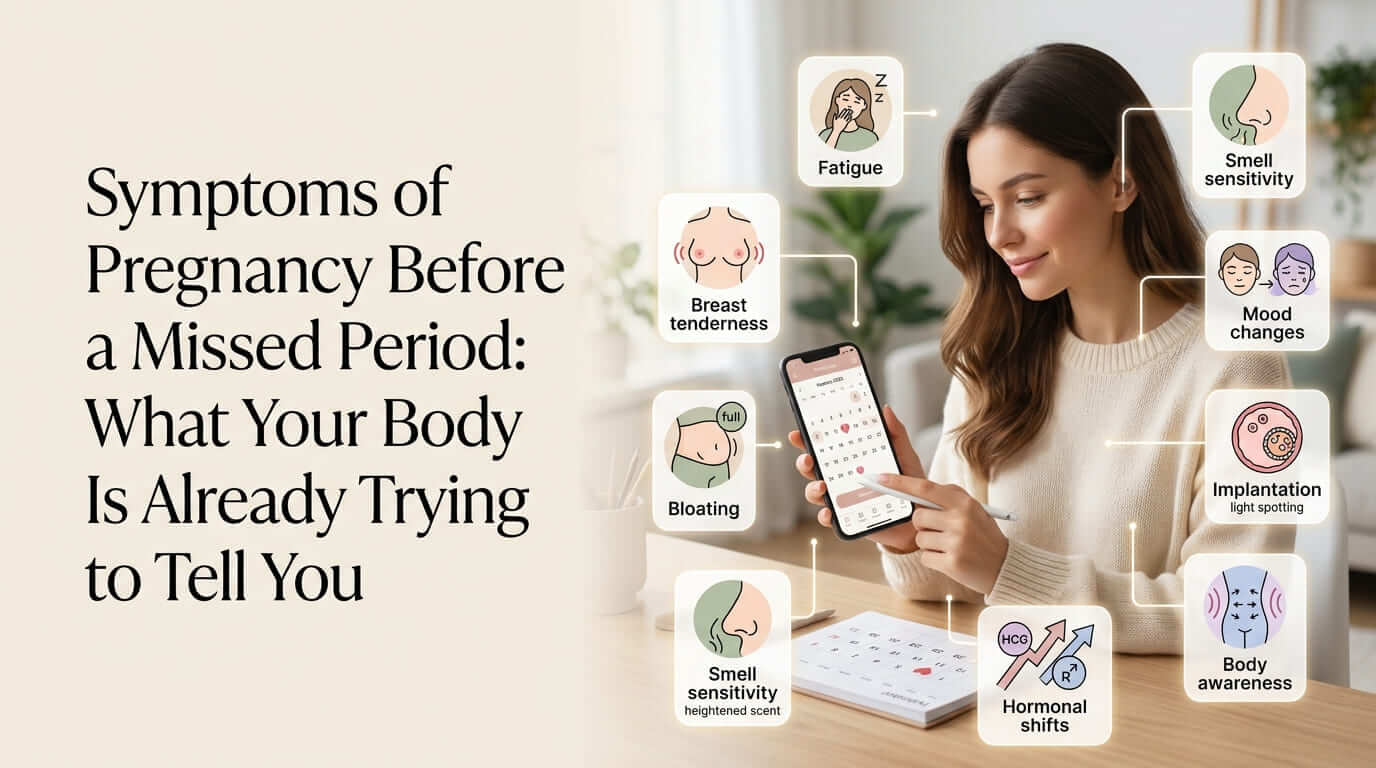
Implantation bleeding — the one that fools everyone
This is probably the most commonly missed early sign, and the reason is simple — it looks like a period starting early.
Implantation bleeding happens when the fertilised egg burrows into the lining of the uterus. This process can cause a small amount of bleeding or spotting — usually light pink or brownish, much lighter than a normal period, and lasting anywhere from a few hours to two days.
The timing is what catches people out. It happens around six to twelve days after conception — which is often right around when a light period might be expected anyway. So women assume their cycle has just started, wait for it to pick up, and when it doesn’t — that’s when the penny drops.
If your “period” arrived lighter than usual, shorter than usual, and a slightly different colour than usual — it might not have been a period at all.
The tiredness that comes from nowhere
This is not normal tired.
Normal tired goes away with sleep. Early pregnancy tired is something else entirely — it sits in your bones. You sleep eight, nine hours and wake up feeling like you haven’t slept at all. Getting off the sofa takes effort. By three in the afternoon you’re fighting to keep your eyes open even though you’ve done nothing particularly taxing.
The reason is progesterone. In early pregnancy it surges rapidly, and progesterone is essentially a sedative hormone. Your body is also doing an enormous amount of work in these early weeks — building a placenta, increasing blood volume, fundamentally restructuring how it functions. That takes energy. A lot of it.
If you’re suddenly exhausted in a way that doesn’t match what your week has looked like — pay attention to that.
Breast tenderness that feels different from usual
Most women are used to some breast tenderness before a period. Early pregnancy tenderness is usually more intense — sometimes significantly so.
Some describe it as a burning feeling. Others say everything feels swollen and heavy. The tenderness often extends into the armpits, which is less common with PMS. For me, the giveaway was that putting on a bra felt wrong in a way it usually didn’t. That level of sensitivity — before I’d even missed a period — was the first thing that made me wonder.
The smell thing — strange and very real
Heightened sense of smell in early pregnancy is one of those symptoms that sounds made up until it happens to you.
Within days of implantation, some women find that smells they never noticed before become overwhelming. The inside of the fridge. Coffee brewing. Someone’s hand cream across the room. Foods that were previously neutral suddenly smell strong, wrong, or deeply unpleasant.
Nobody fully understands why this happens so early, but it’s thought to be connected to rising oestrogen levels. What’s clear is that it’s real, it’s common, and it can start before any other obvious symptoms appear.
If you’ve suddenly found yourself walking into a room and being hit by a smell that nobody else seems to notice — that’s worth noting.
Mild cramping that isn’t a period
Cramping in very early pregnancy gets dismissed constantly because it feels so much like pre-menstrual cramping. But there are differences if you know what to feel for.
Implantation cramps tend to be milder than period cramps — more of a low pulling or tingling sensation than the heavier cramping that comes with a period. Some women describe a feeling of heaviness or fullness in the pelvis — not pain exactly, just a constant low-level awareness of that part of the body.
If your cramps arrived without the period following behind them — that’s information worth paying attention to.
Frequent trips to the bathroom — already
Yes, even this early.
Before the baby is anywhere near big enough to press on the bladder, frequent urination in early pregnancy is driven by hormones. hCG and progesterone increase blood flow to the kidneys, which increases urine production. Women notice this often before they notice much else.
If you’re suddenly waking up once or twice at night to use the bathroom and that’s not normal for you — it might be worth thinking about why.
That metallic taste in your mouth
This one gets almost no airtime in pregnancy symptom lists and it absolutely should.
A metallic or strange taste in the mouth — called dysgeusia — can appear very early in pregnancy, sometimes within days of conception. Everything tastes faintly off. Coffee tastes wrong. Foods you enjoy taste different. There’s a persistent coin-in-the-mouth sensation that won’t shift.
It’s caused by rapidly changing hormone levels affecting taste receptors. It usually eases after the first trimester — but while it’s there it’s genuinely strange and disorienting. If your morning coffee suddenly tastes wrong and you can’t figure out why, file that away.
Mood shifts that seem to come from nowhere
The hormonal changes of early pregnancy can affect mood before most physical symptoms appear. Oestrogen and progesterone both influence the brain’s chemistry — specifically the neurotransmitters that regulate mood.
What this looks like in practice — crying at something that wouldn’t normally affect you. Feeling inexplicably anxious about nothing specific. Irritability that arrives without an obvious cause. A general sense of emotional fragility that doesn’t match what’s actually happening in your life.
My husband still talks about the container lid incident. A week before the positive test. Neither of us had any idea what was actually happening at that point. Now it makes complete sense.
Bloating and a feeling of fullness
Progesterone relaxes smooth muscle throughout the body, including the digestive tract. Even in the earliest days of pregnancy, this can slow digestion and cause bloating, gas, and a feeling of fullness that has nothing to do with how much you’ve eaten.
This is also connected to why nausea arrives early for many women. If morning sickness is already hitting you, our guide on how to manage morning sickness naturally has practical tips that actually work — without needing medication.
Early Pregnancy vs PMS — The Honest Comparison
Why the overlap makes everything confusing
Let’s be straight about this. Many of the symptoms above — breast tenderness, bloating, cramping, mood swings, fatigue — also show up before a period. The lists overlap almost completely and that’s genuinely frustrating when you’re trying to read your own body.
What differs tends to be in the quality and intensity of the symptoms, not just their presence.
What makes pregnancy symptoms feel different
Pregnancy fatigue is deeper. PMS tiredness is unpleasant — but pregnancy tiredness is in a different category entirely.
Pregnancy breast tenderness often extends further — into the armpit area — and tends to be more constant rather than coming and going throughout the day.
The smell sensitivity is rarely a PMS symptom. If smells are suddenly overwhelming in a way that’s completely new for you — that leans more toward pregnancy than PMS.
Implantation bleeding looks different from a period — lighter colour, much shorter duration, no progression from light to heavy to light the way a period moves.
The metallic taste is almost exclusively a pregnancy symptom. PMS doesn’t typically produce that particular experience.
When to take a pregnancy test
Home pregnancy tests work by detecting hCG in urine. Most standard tests are accurate from the first day of a missed period, when hCG is usually high enough to detect reliably.
Some early response tests can detect pregnancy four to five days before a missed period — but a negative result this early doesn’t rule out pregnancy if hCG hasn’t risen enough yet. Always use first morning urine for the most concentrated sample and the clearest result.
If you test early and get a negative — test again when your period is due. If it still doesn’t arrive — test again a few days after that.
What Happens Next — First Trimester Survival
Once you get that positive
Getting a positive test is its own kind of overwhelming — even if you were hoping for it. Suddenly everything feels urgent and you’re not sure what to do first.
Our first trimester survival guide covers exactly this — from booking your first appointment to managing symptoms while keeping your pregnancy private at work. It’s the guide we wish we’d had.
Foods to think about immediately
One of the first things to know once you suspect or confirm pregnancy — there are certain foods to avoid straight away. Our guide on foods to strictly avoid during pregnancy explains what, why, and what to eat instead — without making you feel like every meal is a minefield.
Preparing for what’s coming
If labour signs are something you want to understand before you get there, our piece on early signs of labour is worth bookmarking now and reading at around week thirty-five. Same goes for our hospital bag checklist — most people leave that too late.
The Two-Week Wait — A Note for Anyone in It
If you’ve been trying to conceive, you already know what the two-week wait is. The stretch between ovulation and when you can test. The fortnight that manages to feel simultaneously endless and over in a flash.
Every twinge gets analysed. Each wave of tiredness feels significant, each trip to the bathroom gets noted mentally.
Here’s what’s true — some of what you’re feeling might genuinely be early pregnancy symptoms. Some of it might be your brain, under the stress of hoping, making you hyperaware of sensations you’d normally ignore completely. Both things can be true at the same time and that’s exactly what makes the wait so hard.
If you need something practical to focus on during that stretch — our pregnancy yoga poses guide has gentle movement practices that are safe from early pregnancy and genuinely help manage anxiety.
When Something Feels Wrong — Trust That Feeling
Most early pregnancy symptoms, even the unexpected ones, are completely normal. But some things need medical attention and waiting is not the right move.
Get help immediately for these
Sharp, severe one-sided pain in early pregnancy — especially combined with dizziness or shoulder pain — can indicate an ectopic pregnancy, where the egg has implanted outside the uterus. This is a medical emergency. Don’t wait.
Heavy bleeding — not implantation spotting, but actual heavy bleeding — needs to be checked promptly.
Don’t dismiss emotional symptoms either
If anxiety, low mood, or emotional overwhelm is significant and persistent — please speak to your midwife or doctor. Prenatal anxiety and depression are real, common, and treatable. Our piece on baby blues vs postpartum depression covers the emotional side of the perinatal period honestly — worth reading at any stage.
If something feels significantly wrong — not just unfamiliar but genuinely wrong — call. You know your body. Trust that.
FAQ — Early Pregnancy Symptoms Before Missed Period
About Timing and Testing
Q: Can you feel pregnancy symptoms at 4 days past ovulation?
Implantation typically happens between 6 and 12 days after ovulation, so symptoms driven by implantation are unlikely at 4 DPO. Most reliable symptoms appear after implantation — usually around 8 to 12 DPO. Very early sensations before this are difficult to distinguish from normal cycle changes.
Q: How early can a pregnancy test detect pregnancy?
Some early response tests can detect hCG four to five days before a missed period. Standard tests are most reliable from the first day of the missed period. Testing too early risks a false negative if hCG hasn’t risen enough yet — always retest if your period doesn’t arrive.
Q: Should I test before my missed period?
You can, but results may be less reliable. A positive result before a missed period is generally reliable — false positives are very rare. A negative result before a missed period doesn’t rule out pregnancy. Retest when your period is due if you’re unsure.
About Specific Symptoms
Q: What does implantation feel like?
Most women describe it as a mild cramping or pulling sensation in the lower abdomen — softer than period cramps, sometimes accompanied by a fleeting twinge. Some feel nothing at all. The accompanying spotting — light pink or brown, very light — is often the more noticeable sign.
Q: Is cramping without bleeding a sign of pregnancy?
It can be. Early pregnancy cramping — from implantation and the uterus beginning to change — often occurs without any spotting. Many women experience this and assume their period is imminent. If the period doesn’t follow, it’s worth testing.
Q: What is the most reliable early sign of pregnancy before a missed period?
Implantation bleeding is one of the more specific early signs — it has a distinctive appearance and timing that differs from a period. The metallic taste and heightened smell sensitivity are also more pregnancy-specific. But none of these is definitive — a test is the only reliable confirmation.
About PMS vs Pregnancy Confusion
Q: Can you have pregnancy symptoms and not be pregnant?
Yes. Progesterone rises in the second half of every menstrual cycle regardless of whether conception has occurred — which is why PMS and early pregnancy symptoms overlap so significantly. Stress can also cause missed periods, cramping, mood changes, and fatigue that mimic pregnancy symptoms.
Q: Can stress cause pregnancy-like symptoms?
Yes — stress can delay periods, cause cramping, affect mood and appetite, and disrupt sleep. This is one reason why the two-week wait is particularly difficult — anxiety about the outcome can produce symptoms that mimic what you’re hoping to confirm.
More from MumPappaHub — Read These Next:
- Early Pregnancy Symptoms: The Full Guide
- First Trimester Survival Guide
- 7 Foods to Strictly Avoid During Pregnancy
- How to Manage Morning Sickness Naturally
- Early Signs of Labour: What to Watch For
- Hospital Bag Checklist: What to Actually Pack
- Baby Blues vs Postpartum Depression: Know the Difference
- Postpartum Recovery Guide
- Pregnancy Yoga Poses for Normal Delivery
About This Article: Written by the MumPappaHub editorial team. Reviewed for accuracy against current clinical guidelines. This content is intended for general informational purposes and does not constitute medical advice. If you have specific concerns about your pregnancy, please consult a qualified healthcare professional.
MumPappaHub — Real talk for real parents. mumpappahub.com
