
Medical Disclaimer: This pregnancy calendar is for general informational purposes only. Always follow your gynaecologist’s specific guidance for your pregnancy. Every pregnancy is different.
Pregnancy calendar week by week is where every pregnancy journey begins — the moment a positive test appears and the immediate need to understand what happens next, and the week after, and the forty weeks after that.
This guide is your complete pregnancy calendar — week by week development for your baby, what changes to expect in your body at each stage, which tests are due and when, and the India-specific guidance that most pregnancy calendars miss. When to take your iron tablet and with what. Which Indian foods matter most at each trimester. What the PMSMA programme offers you for free.
This is your complete pregnancy journey — from the week of conception to the week of birth.
Calculate Your Due Date
How due dates are calculated:
Your due date is calculated by adding 280 days (40 weeks) to the first day of your last menstrual period (LMP). This is called Naegele’s rule and is the standard used by gynaecologists worldwide.
Pregnancy & Ovulation Calculator
Example: Last period started: September 1, 2026 Due date: June 8, 2027
Important: Only 5% of babies are born exactly on their due date. Full term is defined as anywhere between Week 37 and Week 42. Most babies arrive within two weeks of the calculated due date.
Pregnancy Calendar Week by Week — Overview Table
| Week | Trimester | Baby Size | Key Milestone |
|---|---|---|---|
| Week 4 | First | Poppy seed | Implantation complete, hCG rises |
| Week 6 | First | Lentil | Heartbeat detectable on ultrasound |
| Week 8 | First | Raspberry | All organs forming simultaneously |
| Week 10 | First | Strawberry | NT scan window opens |
| Week 12 | First | Lime | Miscarriage risk drops significantly |
| Week 13 | First | Peach | First trimester complete |
| Week 16 | Second | Avocado | Baby sex may be visible on scan |
| Week 18 | Second | Bell pepper | First movements felt (quickening) |
| Week 20 | Second | Banana | Anomaly scan — most important scan |
| Week 24 | Second | Corn cob | Viability milestone, diabetes screening |
| Week 27 | Second | Broccoli | Second trimester complete |
| Week 28 | Third | Aubergine | Third trimester begins |
| Week 32 | Third | Coconut | Fetal growth scan |
| Week 36 | Third | Papaya | Lungs mature, full term approaching |
| Week 37 | Third | Winter melon | Full term — baby ready |
| Week 40 | Third | Watermelon | Due date |
The Three Trimesters — What Each Phase Means
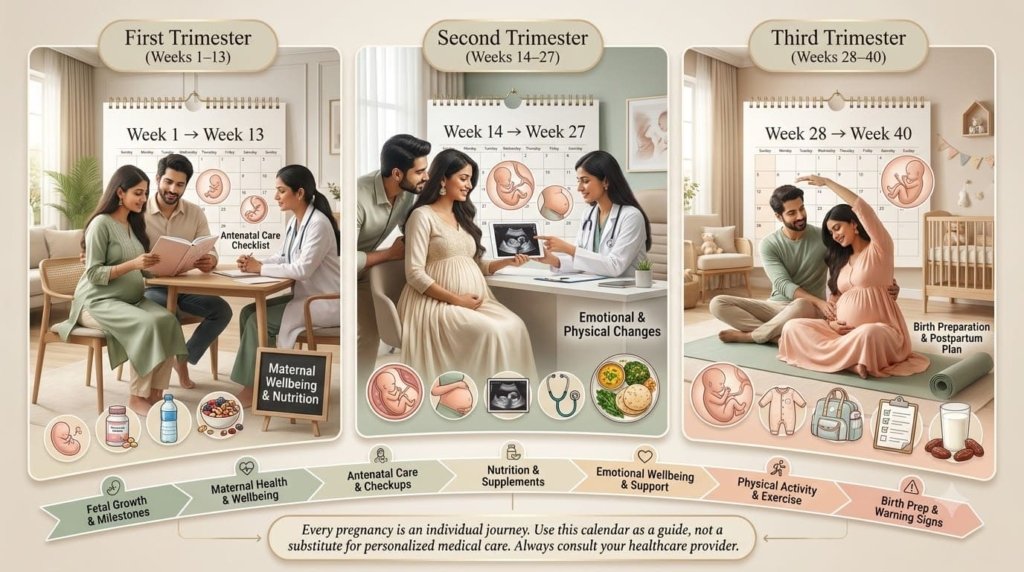
First Trimester — Weeks 1 to 13
The first trimester is the most critical developmental period of your baby’s entire life. Every organ system — brain, heart, lungs, kidneys, liver, spine — is established in these thirteen weeks.
What’s happening with your baby: The embryo grows from a microscopic cluster of cells at Week 4 to a recognisable fetus at Week 13 — complete with fingers, toes, and a beating heart. The baby makes spontaneous movements by Week 8, though you cannot feel them yet.
What you’re experiencing: Nausea (at any hour, not just morning), profound fatigue, breast tenderness, frequent urination, and the quiet anxiety of early pregnancy. The first trimester is often the hardest — you feel the most unwell while showing the least.
Essential first trimester tests:
- First antenatal visit — blood group, haemoglobin, HIV, hepatitis B screening
- Early ultrasound (Week 6-8) — confirms heartbeat and gestational age
- NT Scan (Week 11-13) — nuchal translucency screening for chromosomal conditions
- First trimester blood screening — combined with NT scan
India tip: Register for antenatal care early — before Week 10 if possible. The NT scan window closes at Week 14. Government hospitals offer free first antenatal care. The PMSMA (Pradhan Mantri Surakshit Matritva Abhiyan) provides free specialist antenatal check-ups on the 9th of every month.
Indian nutrition focus: Folic acid supplement (400-600 mcg daily) — critical for neural tube development. Dal, palak, amla, and methi for dietary folate. Ginger (adrak chai, fresh ginger) for nausea — genuinely evidence-based. Small frequent meals rather than three large ones.
Complete First Trimester Guide — Week 1 to 13
Second Trimester — Weeks 14 to 27
The second trimester is what most women describe as the most comfortable phase of pregnancy. Nausea resolves. Energy returns. The bump appears. And somewhere around Week 18-20, you feel your baby move for the first time.
What’s happening with your baby: Your baby grows from 8.7 cm at Week 14 to 36.6 cm at Week 27. The face becomes fully formed. The baby can hear your voice from Week 15. At Week 18-20, you’ll feel the first movements — called quickening — a sensation like gentle bubbles or fluttering. By Week 24, the baby has crossed the viability threshold.
What you’re experiencing: The bump becomes visible. Stretch marks may appear. Braxton Hicks practice contractions begin. Back pain is common. The anomaly scan at Week 20 is one of the most significant moments of pregnancy.
Essential second trimester tests:
- Anomaly scan (Week 18-20) — complete fetal anatomy check, the most important scan of pregnancy
- Gestational diabetes screening (Week 24-28) — critical for Indian women who have one of the highest global rates of gestational diabetes
India tip: Book your anomaly scan now — government hospitals offer this free. Private hospital waiting times can be significant. The gestational diabetes test must not be skipped — you cannot feel gestational diabetes, and unmanaged GDM carries significant risks.
Indian nutrition focus: Iron is the priority — blood volume increases 50% during pregnancy. Dal at every meal with lemon juice to improve absorption. Ragi for iron and calcium. Curd and paneer for calcium and protein. Walnuts and flaxseeds for DHA (fetal brain development).
Complete Second Trimester Guide — Week 14 to 27
Third Trimester — Weeks 28 to 40
The third trimester is when pregnancy transforms from something you’re experiencing into something you’re finishing. Your baby gains most of their birth weight now. Their lungs complete their development. And your body begins preparing for labour in ways that are both subtle and unmistakable.
What’s happening with your baby: From approximately 1 kg at Week 28 to 3.3-3.5 kg at Week 40, your baby is growing rapidly. The brain is in its most active development phase. Eyes open at Week 26 and respond to light. The baby moves into head-down position by Week 35 in most pregnancies. By Week 37 — full term — all systems are mature.
What you’re experiencing: Shortness of breath as the uterus rises toward the diaphragm. Heartburn is almost universal. Sleep becomes very difficult. Pelvic pressure as the baby descends. Braxton Hicks contractions become more frequent. And in the final weeks — an extraordinary combination of exhaustion and readiness.
Essential third trimester tests:
- Fetal growth scan (Week 32-36)
- Group B Streptococcus screening (Week 35-37)
- Ongoing blood pressure monitoring — critical for pre-eclampsia detection
- Non-stress tests if post-dates
India tip: Fetal movement monitoring is important from Week 28 — you should feel at least 10 movements in a 2-hour period during a time when the baby is normally active. If you notice significantly reduced movement — contact your gynaecologist the same day.
Indian nutrition focus: Iron supplement consistently — fetal iron stores are built in the third trimester. DHA from walnuts, ground flaxseeds, fatty fish for non-vegetarians. Six dates daily from Week 36 (research suggests this may support cervical ripening and shorter early labour — discuss with your gynaecologist).
Complete Third Trimester Guide — Week 28 to 40
Essential Antenatal Tests — India Schedule
| When | Test | Where | Cost |
|---|---|---|---|
| As early as possible | First antenatal visit — blood tests, BP, urine | Govt/Private | Free at govt |
| Week 6-8 | Early ultrasound — heartbeat, dates | Private | Varies |
| Week 11-13 | NT Scan — Down’s syndrome screening | Private | Varies |
| Week 18-20 | Anomaly scan — complete fetal anatomy | Govt/Private | Free at govt |
| Week 24-28 | Gestational diabetes screening | Govt/Private | Free at govt |
| Every visit | Blood pressure, urine, fundal height | Govt/Private | Free at govt |
| Week 32-36 | Fetal growth scan | Private | Varies |
| Week 35-37 | GBS screening (if offered) | Private | Varies |
| Weekly from 36 | Antenatal monitoring | Govt/Private | Free at govt |
Government free antenatal care: The PMSMA scheme provides free specialist antenatal consultations on the 9th of every month at government health centres. Blood tests, ultrasounds, and medicines are also available free at government facilities. Ask your ASHA worker or nearest PHC for details.
Pregnancy Nutrition — Trimester by Trimester Indian Guide
First Trimester Priorities:
✅ Folic acid supplement (400-600 mcg) — DAILY
✅ Iron-rich foods — dal, ragi, jaggery
✅ Ginger for nausea — adrak chai, fresh ginger
✅ Small frequent meals
✅ Avoid: raw papaya, excess chai/coffee, alcohol
Second Trimester Priorities:
✅ Iron supplement + lemon/amla for absorption
✅ Calcium — curd, paneer, ragi daily
✅ Protein — dal, eggs, paneer every meal
✅ DHA — walnuts, flaxseeds daily
✅ No chai within 1 hour of iron tablet
Third Trimester Priorities:
✅ Iron — highest demand, take consistently
✅ DHA — peak brain development now
✅ Dates — 6 daily from Week 36
✅ Stay hydrated — 8-10 glasses water
✅ Small frequent meals — stomach has less space
For the complete trimester-wise Indian pregnancy diet guide, our pregnancy diet chart India guide covers every nutrient with Indian food sources.
Signs of Labour — When to Go to Hospital
Understanding when labour has begun is one of the most important things to know in the third trimester:
True labour signs:
- Contractions that are regular, getting stronger, and getting closer together — not relieved by movement
- The 5-1-1 rule: contractions 5 minutes apart, lasting 1 minute, for 1 hour — go to hospital
- Water breaking — go immediately, regardless of contractions
- Bloody show — blood-tinged mucus plug discharge
Go to hospital immediately: 🚨 Any vaginal bleeding 🚨 Water breaking 🚨 Severe headache with visual changes 🚨 Significantly reduced fetal movement 🚨 Contractions before Week 37 that are regular
For detailed guidance on recognising the start of labour, our early signs of labour guide covers every sign with practical guidance.
Your Pregnancy — Related Guides
Complete Trimester Guides:
- First Trimester Week by Week (Week 1-13)
- Second Trimester Week by Week (Week 14-27)
- Third Trimester Week by Week (Week 28-40)
Pregnancy Health Guides:
- Pregnancy Diet Chart India — What to Eat Each Trimester
- Foods to Avoid During Pregnancy India
- Manage Morning Sickness Naturally — Indian Remedies
- Pregnancy Insomnia: What Helps
- Pregnancy Yoga for Normal Delivery
- Early Signs of Labour
- Hospital Bag Checklist India
FAQ — Pregnancy Calendar Week by Week
Q: How is the due date calculated?
Your due date is calculated by adding 280 days (40 weeks) to the first day of your last menstrual period. This is standard medical practice worldwide. If your periods are irregular, your gynaecologist may adjust the due date based on your early ultrasound measurements, which are the most accurate way to date a pregnancy before Week 14.
Q: How many antenatal visits are recommended during pregnancy?
The WHO recommends a minimum of 8 antenatal contacts during pregnancy. In India, the IAP and government guidelines recommend at least 4 visits — ideally in the first trimester, second trimester, and twice in the third trimester. Most private gynaecologists in India recommend monthly visits until Week 32, then fortnightly, then weekly from Week 36. Follow your gynaecologist’s specific advice for your pregnancy.
Q: When will I feel my baby move?
First-time mothers typically feel the first movements — called quickening — between Week 18 and Week 22. In subsequent pregnancies, movement is often noticed earlier (from Week 16) because you recognise what to look for. The sensation is initially subtle — like bubbles or gentle fluttering. It becomes unmistakably distinct kicking and rolling within days to weeks.
Q: What is the anomaly scan and when is it done?
The anomaly scan — also called the mid-pregnancy scan or morphology scan — is a detailed ultrasound performed between Week 18 and Week 20. It checks the baby’s brain, heart, spine, kidneys, limbs, face, and abdominal wall for abnormalities. It is the most comprehensive scan of pregnancy and should not be missed. Government hospitals offer this free. Private hospitals — book early as slots fill quickly.
Q: Is this pregnancy calendar a replacement for seeing a doctor?
No. This calendar provides general information to help you understand your pregnancy journey — it does not replace medical care. Every pregnancy is different. Your gynaecologist’s specific guidance for your individual pregnancy always takes priority over general information.
Q: What should I do if I notice reduced fetal movement?
From Week 28 onward, you should feel at least 10 movements within a 2-hour period during a time when your baby is normally active. If you notice significantly reduced movement — fewer movements than usual, or less than 10 in 2 hours — contact your gynaecologist the same day. Do not wait until your next scheduled appointment. Reduced fetal movement always warrants assessment.
This pregnancy calendar is reviewed against WHO antenatal care guidelines, and FOGSI (Federation of Obstetric & Gynaecological Societies of India) guidelines, and Indian Academy of Pediatrics recommendations. It is updated regularly to reflect current guidance.
MumPappaHub — Real talk for real parents. mumpappahub.com