
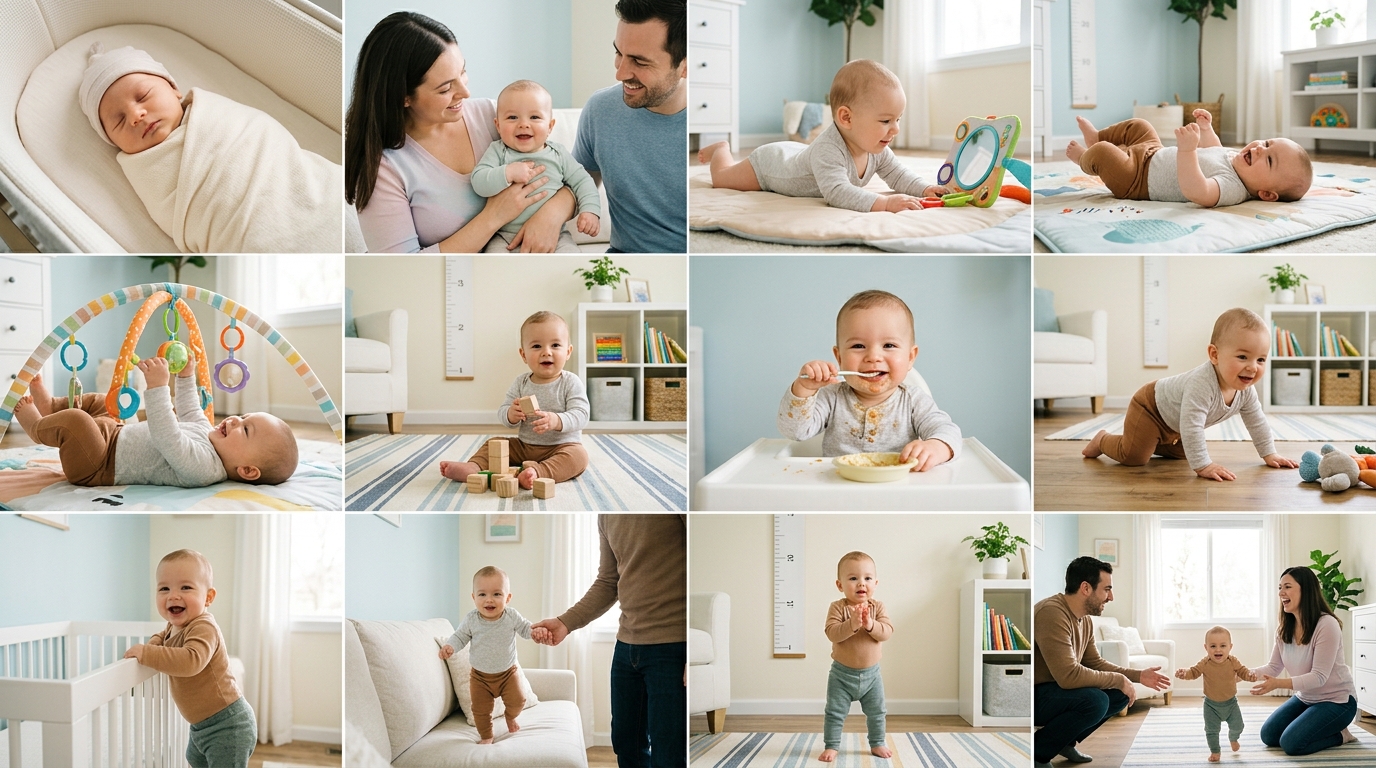
The first year of your baby’s life is a whirlwind of growth and change. It can feel like you go to sleep with a helpless newborn and wake up with a babbling, crawling toddler! While every baby develops at their own unique pace, there is a general timeline for when certain physical and cognitive skills usually appear.
Here is a quick breakdown of the exciting milestones you can look forward to in your baby’s first year:
Months 1-3: The Awakening
In these early months, your baby is mostly adjusting to life outside the womb, but their brain is making millions of connections.
- Social/Emotional: You will likely see their first real, intentional smile (usually around 6-8 weeks).
- Physical: They will start to hold their head up for short periods during “tummy time” and track moving objects with their eyes.
- Communication: Cooing and making soft vowel sounds.
Months 4-6: Exploring the World
Your baby is becoming much more active and curious about their surroundings.
- Physical: They will learn to roll over (usually from tummy to back first). By 6 months, many babies can sit up with some support.
- Fine Motor: Reaching for toys and bringing almost everything straight to their mouth!
- Feeding: This is often the time pediatricians give the green light to start introducing solid food purees.
Months 7-9: On the Move
Get ready to baby-proof your house because your little one is likely on the move!
- Physical: Sitting up completely unassisted. Many babies start crawling, scooting, or army-crawling during this window.
- Cognitive: Developing “object permanence” (they realize you still exist even when you leave the room, which can trigger separation anxiety).
- Fine Motor: Developing the “pincer grasp” (using their thumb and pointer finger to pick up small foods).
Months 10-12: The Transition to Toddlerhood
The final stretch of the first year is filled with major physical leaps.
- Physical: Pulling themselves up to stand using furniture, “cruising” along the edges of the couch, and maybe even taking their first independent steps!
- Communication: Saying their first real words like “Mama” or “Dada” with meaning, and pointing at objects they want.
- Social: Waving goodbye and playing simple games like peek-a-boo.
A Reminder for Parents: Try not to compare your baby’s progress to the baby next door. Some babies walk at 9 months, and others don’t walk until 15 months—both are completely normal! Always consult your pediatrician if you have concerns about your child’s development.