
Medical Disclaimer: This article is for informational purposes only and reviewed against WHO and FOGSI guidelines. Always consult your gynaecologist before starting any exercise programme during pregnancy. Stop any pose that causes pain or discomfort immediately.
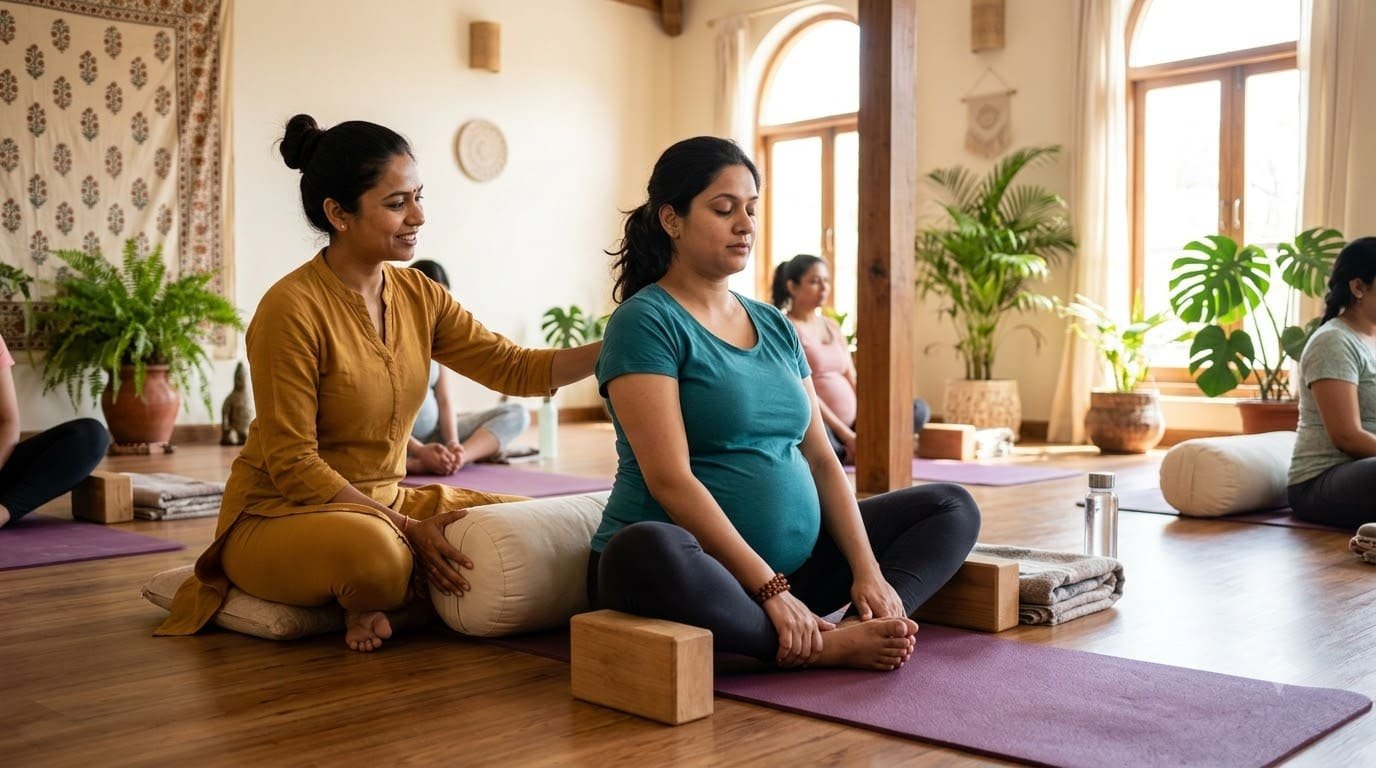
Prenatal yoga guide India is something every pregnant Indian woman searches at some point — usually after her gynaecologist mentions exercise is beneficial, or after a friend who had a smooth delivery credits her daily yoga practice, or simply because the body is changing in ways that make daily life uncomfortable and she’s looking for something that helps.
I started pregnancy yoga at 16 weeks. I had done no exercise in the first trimester — too nauseous, too exhausted. My gynaecologist said at my 16-week visit: “Start something gentle now. Walking or yoga. Your body is ready and you’ll thank yourself in the third trimester.”
She was right. I thanked myself particularly during labour — when the breathing techniques I had practiced for weeks became an involuntary reflex, and when the muscle memory from months of squatting meant the position came naturally when I needed it.
This guide covers prenatal yoga for Indian pregnant women — what the research says, which poses are safe and beneficial, which to avoid, and how to build a simple practice from Week 14 through delivery.
Prenatal Yoga Guide India — What the Research Shows
Prenatal yoga guide India should begin with what the evidence actually shows — because the benefits are real and documented, not aspirational.
According to the World Health Organization’s guidelines on physical activity during pregnancy, regular physical activity during pregnancy is safe and beneficial for most women, improving fitness, reducing excessive weight gain, and supporting mental health. The Federation of Obstetric and Gynaecological Societies of India (FOGSI) recommends yoga as one of the most appropriate forms of exercise during uncomplicated pregnancy.
Research-backed benefits of prenatal yoga: ✅ Shorter active labour duration ✅ Reduced need for pain relief during labour ✅ Higher rates of normal delivery ✅ Reduced risk of preterm birth ✅ Better management of pregnancy-related back pain ✅ Reduced anxiety and depression in pregnancy ✅ Lower rates of pregnancy-induced hypertension in some studies ✅ Better fetal positioning in the final weeks
Who should NOT do prenatal yoga without specific medical clearance:
- Placenta previa (placenta covering the cervix)
- Threatened preterm labour
- Severe pregnancy-induced hypertension/pre-eclampsia
- Multiple pregnancy (twins/triplets) — modified yoga may be appropriate
- History of preterm birth — discuss specifically with gynaecologist
When to Start and General Safety Rules
When to start: From Week 14 (second trimester) for most poses. Some very gentle breathing and meditation can begin from the first trimester.
General safety rules:
- Always inform your gynaecologist before starting
- Never hold the breath — continuous, steady breathing throughout
- Avoid lying flat on the back after Week 20 (the uterus presses on the vena cava, reducing blood return to the heart)
- Avoid deep twists that compress the abdomen
- Avoid poses that require balance without support — balance changes significantly in pregnancy
- Listen to the body — discomfort means modify or stop
- Drink water before, during, and after practice
- Practice in a well-ventilated, cool space — avoid overheating
10 Best Safe Prenatal Yoga Poses India
Pose 1 — Malasana (Garland Pose / Deep Squat)
Why it’s the most important prenatal yoga pose: Malasana is the single most beneficial pose for pregnancy and birth preparation. It opens the hips and pelvis, encourages the baby into optimal head-down position, strengthens the pelvic floor, and trains the body for the squatting position used in labour.
Indian advantage: Indian women who grew up squatting as part of daily life — using Indian-style toilets, working on the floor — have naturally greater hip flexibility that makes malasana accessible. This is a genuine physiological advantage for Indian women in labour.
How to do it: Stand with feet wider than hip-width apart, toes turned outward at 45 degrees. Slowly lower into a deep squat, bringing the hips toward the floor. Bring the palms together at the chest, using the elbows to gently press the knees outward. Hold for 30-60 seconds. Rise slowly.
Modification: If heels don’t reach the floor — place a folded blanket or rolled yoga mat under the heels for support. Use a wall or chair for balance support.
When: From Week 14. Can be done until delivery for most women. Duration: 3-5 repetitions, 30-60 seconds each
Pose 2 — Baddha Konasana (Butterfly Pose)
Why it helps: Baddha Konasana opens the inner thighs and groin, increasing hip flexibility and preparing the pelvis for delivery. It also relieves the pubic symphysis discomfort that many pregnant women experience in the second and third trimesters.
How to do it: Sit on the floor (or on a folded blanket for height and comfort). Bring the soles of the feet together, allowing the knees to fall outward. Hold the feet gently. Sit tall — lengthen the spine. Breathe steadily. For a gentle stretch, lean slightly forward from the hips (not the waist).
Modification: If sitting on the floor is uncomfortable — sit on a firm cushion or folded blanket. Support the knees with cushions if they don’t reach the floor comfortably.
When: From any point in pregnancy. One of the safest and most accessible prenatal poses. Duration: Hold for 1-3 minutes
Pose 3 — Cat-Cow Stretch (Marjaryasana-Bitilasana)
Why it helps: Cat-cow is one of the most recommended prenatal exercises for pregnancy back pain relief. It mobilises the spine, strengthens the back muscles that support the growing weight of the uterus, and encourages the baby into an anterior position (optimal for birth).
How to do it: Come onto hands and knees — wrists under shoulders, knees under hips. Inhale: let the belly drop toward the floor, lift the tailbone and head — cow position. Exhale: round the spine toward the ceiling, tuck the tailbone, drop the head — cat position. Move slowly and continuously with the breath.
Why it’s particularly helpful in India: Back pain is one of the most common pregnancy complaints for Indian women, who spend significant time in household activities that strain the back. 10 minutes of cat-cow daily can provide meaningful relief.
When: From Week 14. Safe until delivery. Duration: 10-15 slow cycles
Pose 4 — Virabhadrasana (Warrior Pose) — Modified
Why it helps: A modified Warrior pose strengthens the legs and hips, improves balance (with support), and builds the stamina needed for labour.
How to do it: Stand beside a wall or chair for support. Step one foot back about 3-4 feet. Front foot faces forward, back foot at 45 degrees. Bend the front knee to approximately 90 degrees (not beyond the ankle). Arms extended or one hand on the support. Hold for 30-60 seconds. Switch sides.
Modification: Always use wall or chair support. Do not hold the pose until fatigue — stop well before that.
When: From Week 14 to Week 32-34 (reduce or discontinue as balance becomes more challenging). Duration: 30-60 seconds each side, 2-3 repetitions
Pose 5 — Pelvic Tilts
Why it helps: Pelvic tilts are one of the most practically useful prenatal exercises — they strengthen the deep abdominal and back muscles that support the spine, reduce lower back pain, and prepare the pelvis for delivery.
How to do it: Stand against a wall, feet hip-width apart, knees slightly bent. Press the lower back gently toward the wall — this is the pelvic tilt. Hold for 5 seconds. Release. Repeat.
Alternative positions: On hands and knees (similar to cat-cow but smaller movement — just the pelvis tilts). Seated on a birthing ball — roll the pelvis forward and backward gently.
When: Safe from the first trimester through delivery. Duration: 10-15 repetitions, 2-3 times daily
Pose 6 — Tadasana (Mountain Pose) with Awareness
Why it helps: Tadasana teaches correct postural alignment that is increasingly important as the weight of the pregnancy shifts the centre of gravity forward. Many pregnant women develop an exaggerated lower back curve (lumbar lordosis) that causes back pain — tadasana corrects this.
How to do it: Stand with feet hip-width apart. Feel the four corners of each foot on the ground. Gently draw the lower belly inward (pelvic floor engagement). Roll the shoulders back and down. Lengthen the crown of the head toward the ceiling. Breathe steadily for 1-2 minutes.
The posture correction: The most common posture error in pregnancy is thrusting the belly forward and letting the lower back collapse. Tadasana teaches the correct neutral spine position.
When: From any point in pregnancy. Duration: 1-3 minutes of mindful standing
Pose 7 — Supported Bridge Pose (Setu Bandhasana)
Why it helps: A supported bridge pose gently opens the chest and hips, relieves back tension, and strengthens the gluteal muscles that support the pelvis.
How to do it: Lie on your back (only until Week 20 — after Week 20, use a significantly raised bolster under the pelvis or avoid this pose). Knees bent, feet flat on the floor, hip-width apart. Press the feet into the floor and gently lift the hips — or support the hips with a bolster or folded blanket for a restorative version.
After Week 20: Use a firm bolster or stack of firm blankets under the hips so you’re not fully flat on the back. The supported restorative version is safe throughout pregnancy.
When: Until Week 20 in unsupported version; supported version until delivery. Duration: 30-60 seconds, 3-5 repetitions
Pose 8 — Pranpranayama (Breathing Practices)
Why it’s essential: Breathing is the most underestimated and most important preparation for labour. The controlled breathing techniques learned in yoga become the primary pain management tool during contractions — and unlike an epidural, they are available at every hospital and at home.
Three key breathing techniques:
Ujjayi breathing (Victorious breath): Breathe in through the nose. Exhale through the nose with a slight constriction at the back of the throat — creating a soft, wave-like sound. This activates the parasympathetic nervous system, reducing the fight-or-flight response that amplifies labour pain.
Diaphragmatic breathing: Place one hand on the chest and one on the belly. Breathe so that the belly hand rises and the chest hand stays relatively still. This is the foundation of all effective labour breathing.
Slow exhale breathing: Inhale for 4 counts, exhale for 8 counts. The extended exhale activates the relaxation response. Practice as a contraction-management technique — breathing through a timer set to 60 seconds.
When: From any point in pregnancy. Daily practice is essential — breathing techniques are skills that need to become automatic through repetition.
Pose 9 — Viparita Karani (Legs Up the Wall)
Why it helps: One of the most restorative poses in pregnancy — it reduces leg swelling and heaviness, relieves varicose vein discomfort, reduces lower back tension, and promotes relaxation. In the third trimester, when leg heaviness and swelling are common, this pose provides immediate relief.
How to do it: Sit beside a wall, sideways. Gently lower down and swing the legs up the wall — adjusting so the back is comfortable on the floor and the legs are supported by the wall. Arms rest by the sides. Breathe steadily. Stay for 5-15 minutes.
After Week 28: Place a folded blanket under the hips to provide a slight tilt — this prevents the vena cava compression of flat lying while still providing the benefits of the pose.
When: Second and third trimester. Particularly beneficial from Week 28 onward. Duration: 5-15 minutes
Pose 10 — Savasana (Relaxation Pose) — Modified
Why it helps: The modified Savasana — the final relaxation at the end of a yoga practice — is where the physical and mental benefits of the practice integrate. Regular relaxation practice in pregnancy reduces anxiety, lowers cortisol (the stress hormone), improves sleep quality, and trains the mind for the calm needed in labour.
How to do it (modified for pregnancy): Lie on the left side (left-side lying is optimal after Week 20 — it improves blood flow to the uterus). Place a pillow between the knees for hip comfort. A bolster or pillow under the belly if needed. Cover with a light blanket. Close the eyes. Allow the body to be completely heavy. Follow the breath without controlling it. Stay for 10-15 minutes.
Left-side position: The left lateral position is specifically recommended during pregnancy because it prevents the uterus from compressing the aorta and vena cava — maintaining optimal blood flow to the baby.
When: Second and third trimester — daily if possible.
Poses to Avoid in Pregnancy
❌ Deep twists compressing the abdomen
❌ Lying flat on back after Week 20
❌ Intense inversions (headstand,
   shoulderstand)
❌ Hot yoga (risk of overheating)
❌ Strong abdominal exercises (navasana,
   intense core work)
❌ Deep backbends (urdhva dhanurasana)
❌ Poses requiring significant balance
   without support
❌ Bikram or heated yoga
Building a Simple Daily Prenatal Yoga Practice
Week 14-24 (15-20 minutes daily):
- Baddha Konasana (3 minutes)
- Cat-Cow (10 cycles)
- Malasana (3-5 repetitions)
- Pelvic tilts (10-15 repetitions)
- Ujjayi breathing (5 minutes)
- Modified Savasana (10 minutes)
Week 24-36 (20-30 minutes daily): Add: Virabhadrasana (supported), Tadasana, Supported Bridge Continue all of the above
Week 36-40 (20-30 minutes daily): Focus on: Malasana, Baddha Konasana, Breathing practice, Viparita Karani, Savasana Reduce: Standing poses as fatigue increases
FAQ — Prenatal Yoga Guide India
Q: Can I start yoga if I have never done it before?
Yes — prenatal yoga is designed for all levels, including beginners. Many experienced yoga practitioners say their prenatal practice was actually their first consistent yoga practice. The poses are modified for pregnancy and are accessible regardless of prior experience. Start with gentle, basic poses and build gradually.
Q: My gynaecologist has said no exercise. Does this include yoga?
If your gynaecologist has specifically recommended no exercise, follow that guidance and discuss what restrictions apply before starting any yoga practice. Placenta previa, threatened preterm labour, and pre-eclampsia are conditions where exercise restrictions are medically important.
Q: Is yoga safe in the first trimester?
Gentle yoga — breathing, meditation, very gentle stretching — is generally safe in the first trimester. Avoid vigorous practice, heat, and anything that puts pressure on the abdomen. Many yoga teachers recommend a more conservative practice in the first trimester due to the higher miscarriage risk in this period. Discuss with your gynaecologist.
Q: Can yoga guarantee a normal delivery?
No — mode of delivery depends on many factors including the baby’s position, the baby’s size, the mother’s pelvis, and how labour progresses. Yoga significantly increases the likelihood of normal delivery by improving fitness, positioning, and mental preparation — but it is not a guarantee. A well-prepared mother who ultimately requires a caesarean for a valid medical reason has not failed — she has given herself and her baby the best preparation possible.
Q: Are there specific yoga centres for pregnant women in India?
Yes — most major Indian cities have prenatal yoga classes. Ask your gynaecologist or midwife for recommendations. Look for instructors with specific prenatal yoga training, not just general yoga instructors. Online prenatal yoga is also an excellent option — several Indian platforms offer specifically Indian-context prenatal yoga.
More from MumPappaHub — Read These Next:
- Normal Delivery Tips India
- Postpartum Weight Loss India
- Postpartum Yoga Poses for New Moms
- Postpartum Exercises to Rebuild Core
- Pregnancy Week by Week Third Trimester
- Pregnancy Diet Chart India
- C-Section Recovery India
- Gestational Diabetes India
- Hospital Bag Checklist India
- Early Signs of Labour India
- Newborn Care Tips
- Pregnancy Calendar Week by Week
About This Article
Written by the MumPappaHub Research Team — including a researcher who started prenatal yoga at 16 weeks on her gynaecologist’s advice. She thanked herself during labour, when the breathing techniques she had practiced for months became involuntary reflex, and when the months of squatting meant malasana came naturally when she needed it most.
Reviewed for accuracy against WHO guidelines on physical activity during pregnancy and FOGSI clinical recommendations on exercise in pregnancy for Indian women. This content is for general informational purposes only. Always consult your gynaecologist before starting any exercise programme during pregnancy.
MumPappaHub — Real talk for real Indian parents. mumpappahub.com
