
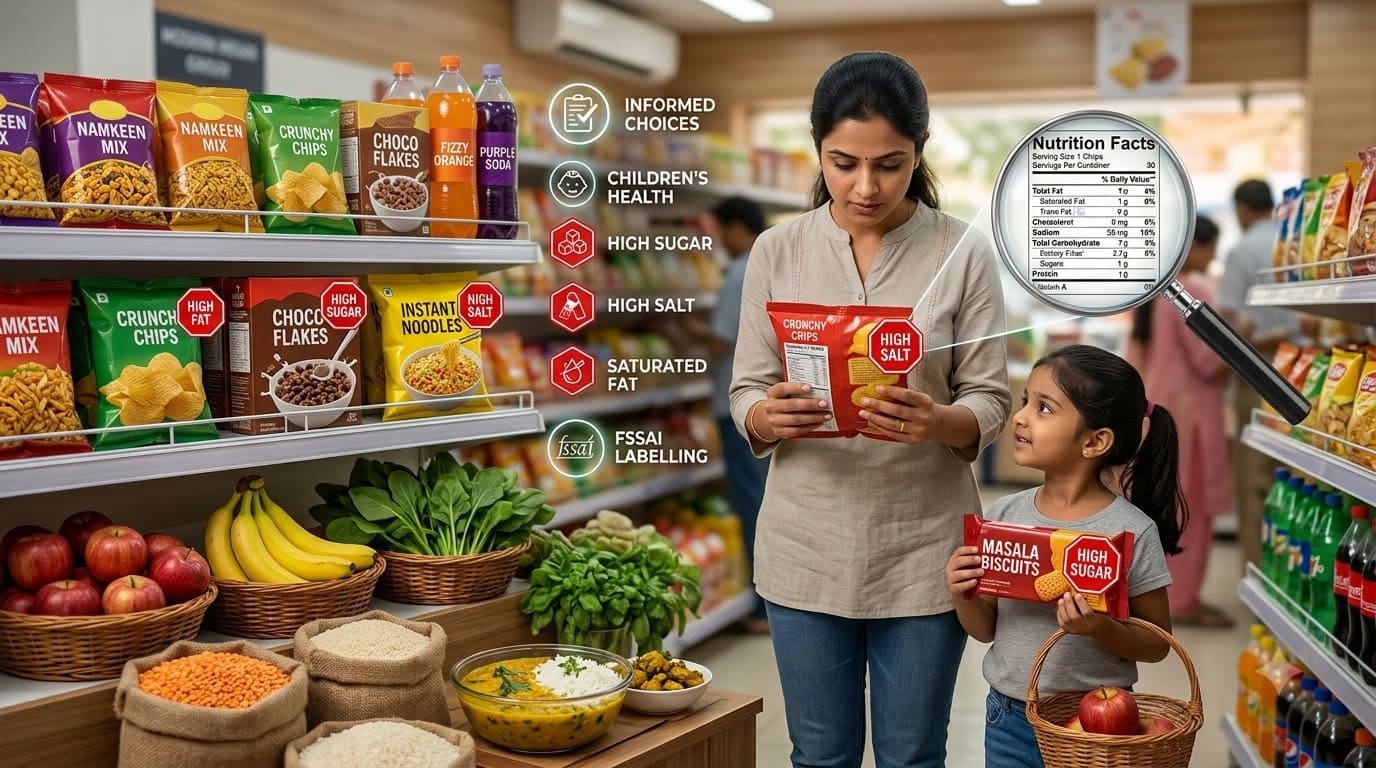
FSSAI warning labels packaged food are officially in the works. If you’ve ever stood in the snack aisle trying to decode a nutrition label in tiny print on the back of a chips packet, this news will feel overdue. India’s food safety regulator, FSSAI, has told the Supreme Court it plans to introduce prominent red warning labels on the front of packaged foods and drinks that are high in sugar, salt, or fat — a move that comes directly out of a court case centred on rising childhood obesity in India.
What FSSAI Has Actually Proposed
According to the filing submitted to the Supreme Court, FSSAI wants to require a red, hexagon-shaped warning symbol on the front of packaging for products that cross specific thresholds for sugar, salt, or saturated fat. The label would carry a direct declaration — something like “HIGH SUGAR,” “HIGH SALT,” “HIGH FAT,” or “HIGHLY SWEETENED BEVERAGE” — placed in a font size larger than what’s currently used for the nutrition table on the back of the pack.
The rollout is proposed in phases rather than all at once. The first phase would cover products that are high in two or more of the three flagged nutrients, giving the food industry time to adjust or reformulate before a second phase expands the requirement to products high in even just one of the three.
A handful of single-ingredient staples — ghee, edible oil, salt, sugar, jaggery, and honey — would reportedly be exempt from the requirement, since these aren’t the “hidden” sugar or salt sources the warning is really aimed at catching.
Why This Is Happening Now
This proposal didn’t come out of nowhere. It follows a pointed Supreme Court hearing on a public interest litigation pushing for mandatory front-of-pack warnings, similar to labelling systems already used in countries like Chile and Israel. The bench had reportedly expressed sharp frustration with FSSAI’s pace on the issue, questioning whether the regulator was genuinely prioritising public health, and warned that judicial orders would follow if the government didn’t act.
The court specifically pointed to the risk to children as a central concern — packaged snacks and sugary beverages make up a growing share of what Indian kids eat and drink daily, particularly in urban households. One projection cited during the case, published in The Lancet, estimated that around 450 million Indians could be classified as obese or overweight by 2050 if current trends continue.
Notably, the Supreme Court also rejected arguments that warning labels would unfairly penalise traditional Indian packaged snacks, suggesting the rules are intended to apply broadly rather than carve out exceptions for local products.
What This Means for Parents, Practically
None of this changes what’s already on your kitchen shelf today — this is a proposal working through a legal and regulatory process, not a rule in effect yet. But it does signal a few things worth knowing as a parent shopping for your family.
The products most likely to eventually carry a red warning are exactly the ones many parents already treat with some caution — packaged chips, sugary breakfast cereals, flavoured milk drinks, sweetened juices, and ready-to-eat snacks marketed toward kids. If and when this rollout happens, spotting these at a glance in the store will get considerably easier than squinting at a nutrition table.
In the meantime, the back-of-pack nutrition information is still the most reliable thing available. Checking sugar, salt, and saturated fat content per serving — not per pack, since these often differ significantly — remains the most useful habit until front-of-pack labels actually arrive on shelves.
For families already trying to make more informed food choices for young children, our guide on toddler nutrition and picky eating and our list of iron-rich foods for babies and toddlers offer some direction on prioritising nutrient-dense options over packaged convenience foods, and our toddler weight gain foods guide covers healthy ways to support growth without leaning on processed snacks.
The Bigger Picture
This proposal sits alongside other recent government efforts aimed at the same underlying problem. The Union Health Ministry has separately floated the idea of “sugar and oil boards” — visual displays in schools, offices, and public institutions meant to nudge people toward healthier choices by making hidden fat and sugar content more visible.
Whether the FSSAI proposal in its current phased form satisfies the Supreme Court, or gets pushed further, remains to be seen — the court has shown little patience for delay on this issue so far. For now, it’s a meaningful signal of direction rather than a done deal, but it’s one worth watching if food labelling on your family’s shelf is something you care about.
More from MumPappaHub — Read These Next:
- Toddler Nutrition & Picky Eating
- Iron-Rich Foods for Babies & Toddlers in India
- Toddler Weight Gain Foods India
- Ultra-Processed Toddler Foods India
- Superfoods for Toddler Brain Development
- How to Handle a Picky Eater
MumPappaHub — Real talk for real parents. mumpappahub.com
