
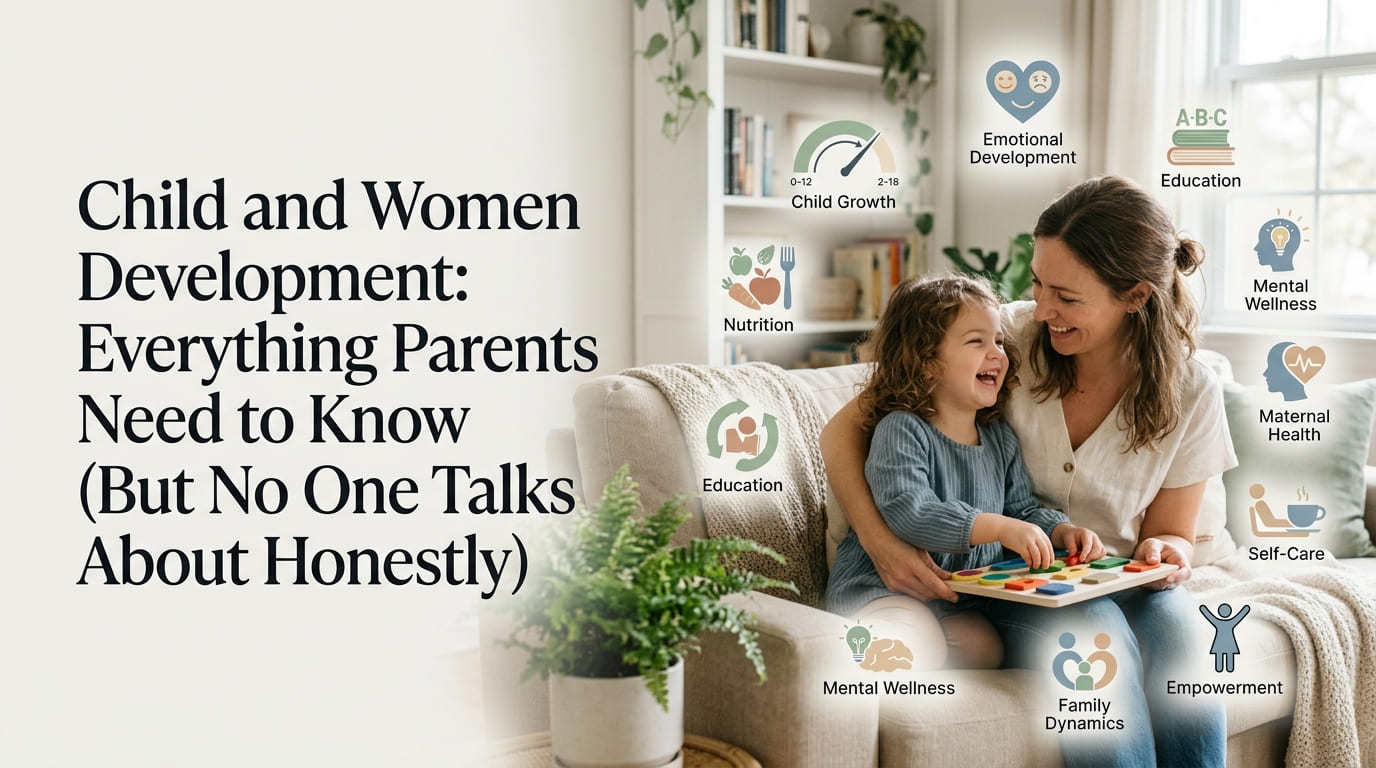
Child and women development are two things nobody prepares you to think about at the same time — but you end up living both, simultaneously, at 3 AM.
Have you ever stood outside your child’s bedroom at midnight, listening to them breathe, and thought — “Am I doing this right?
Or maybe you’re a new mom who googled “why does my baby cry so much” at 3 AM while crying yourself?
If yes — this article is written for you.
Child development and women’s development are two of the most searched topics on Google today. Yet most of what you find online reads like a medical textbook — cold, clinical, and completely disconnected from the messy, beautiful, terrifying reality of raising a child or rebuilding yourself after becoming a mother.
So instead of adding to that pile, let’s talk differently — like humans, not textbooks.
Child Development: It’s a Journey, Not a Race
The First 1000 Days — Why They Matter More Than Anything
From birth to age three, a child’s brain forms over one million new neural connections every single second. That’s not an exaggeration — that’s neuroscience.
This window, often called the “first 1000 days,” is when the foundation for everything — language, emotion, learning, relationships — is quietly being laid.
What shapes those connections? You do.
- Your voice is your baby’s first language lesson
- A gentle touch tells their nervous system whether the world is safe
- Your face teaches them what emotions look like
This doesn’t mean you need to be perfect. It means you need to be present — even imperfectly.
MumPappaHub Tip: Ten minutes of undistracted conversation with your baby before bed — even when they can’t respond — has a measurable impact on language development. Explore more in our Newborn Care Guide.
The 5 Areas of Child Development Every Parent Googles
The most common parenting search? “Is my child developing normally?”
Here’s the honest answer: development is a spectrum, not a schedule. But these five domains give you a meaningful map.
1. Physical Development
Sitting at 6 months. Walking at 12. These are averages, not deadlines.
To put it simply, what actually drives physical development is:
- Adequate nutrition (not perfect nutrition — adequate)
- Quality sleep (yes, even the naps you fight about)
- Free, unstructured outdoor play
The child rolling on grass, climbing trees, or just running in circles is doing developmental work their body desperately needs.
Check out our Age-by-Age Nutrition Guide to know exactly what your child needs at each stage.
2. Cognitive Development
When your toddler asks “why?” for the 47th time today — celebrate it. That question is their brain actively building architecture.
Moreover, here is what supports cognitive growth:
- Open-ended play (blocks, sand, water — messy things)
- Storytelling and reading aloud
- Letting them solve small problems before jumping in to help
On screen time: Under 2 — minimal to none. Ages 2–5 — under 1 hour daily. Ages 5–12 — under 2 hours. But quality matters more than quantity. Watching with them beats passive solo viewing every time.
3. Language Development
Expected milestones (approximate):
- 12 months: 1–3 words
- 18 months: 10–20 words
- 24 months: 50+ words, two-word phrases
- 36 months: Simple sentences
Bilingual children sometimes speak a little later — this is normal and actually a cognitive advantage long-term.
When to see a specialist: If your child has no words by 18 months, doesn’t point or wave by 12 months, or loses skills they previously had — speak to your pediatrician.
4. Social-Emotional Development
This is the most underrated area of child development — and the one that predicts adult happiness more than IQ does.
Emotional intelligence begins at home:
- Name feelings out loud: “You seem really frustrated right now. That makes sense.”
- Let children feel difficult emotions instead of rushing to fix them
- Model how to manage anger, disappointment, and fear yourself
When your child has a meltdown in a grocery store, they’re not manipulating you. In fact, their prefrontal cortex — the part of the brain that manages impulse control — isn’t fully developed until age 25. Therefore, they genuinely cannot always regulate themselves.
That’s why your calm becomes their regulation.
Read more on handling tantrums with compassion in our Toddler Behavior Guide.
5. Moral Development
Children don’t do what you tell them. Instead, they do what they see you do.
Kindness, honesty, empathy — these aren’t lessons delivered in lectures. Rather, they’re absorbed in daily moments: how you treat a waiter, how you talk about other people, whether you say sorry when you’re wrong.
You are their first and most lasting moral education.
Women’s Development: You Are Still You — Even After Becoming a Mother
This section is for the millions of women who search: “How to stop losing myself in motherhood” or “Who am I besides being a mom?”
These are not selfish questions. On the contrary, they are survival questions.
Motherhood Doesn’t Erase Your Identity — But Society Tries To
The moment a woman becomes a mother, the world shrinks her identity into a single role. Her opinions about her own body, career, time, and desires suddenly become negotiable — subject to everyone else’s approval.
But here’s what doesn’t change when you become a mother:
- Your ambitions
- Your need for friendship, rest, and creativity
- Your right to be a full human being
Women’s development means:
- Reclaiming time for yourself — without justifying it
- Learning to set boundaries that actually hold
- Building or rebuilding a career on your own terms
- Knowing that a fulfilled mother raises more emotionally secure children
This isn’t theory. In fact, study after study confirms it: maternal wellbeing is one of the strongest predictors of child wellbeing.
Explore our Working Mom Resource Hub for practical tools to balance work, home, and self.
Postpartum Depression: The Conversation We’re Still Afraid to Have
Approximately 1 in 5 new mothers experiences postpartum depression (PPD). In India, estimates suggest the number may be even higher — simply because it often goes unrecognized and unreported.
What PPD looks like — beyond sadness:
- Feeling numb or disconnected from your baby
- Constant anxiety or racing thoughts
- Irritability or rage you don’t recognize in yourself
- Physical symptoms: exhaustion beyond normal new-parent tired, headaches, appetite changes
- Feeling like your family would be better off without you (this is a medical emergency — please reach out immediately)
What PPD is not: weakness, a character flaw, or a sign that you don’t love your baby.
In fact, PPD is a hormonal and neurological condition. Furthermore, it’s completely treatable. Therefore, you deserve treatment — and you should seek it without guilt.
If you’re experiencing any of these symptoms, please visit our Mental Wellness Support Page or speak to a healthcare provider today.
The Power of Women Supporting Women
One of the most protective factors against postpartum depression, burnout, and maternal isolation? Community.
Not Instagram community. Real community — women who say “me too,” women who bring food without being asked, and women who watch the baby so you can sleep for three hours.
If you don’t have that village yet, build one. Online spaces count too, and MumPappaHub exists exactly for this reason.
Parenting Together: Both Parents Matter
The Science of Involved Fatherhood
In many households, parenting is still treated as the mother’s primary responsibility. However, research tells a different story about what children actually need.
When fathers are actively involved:
- Children show stronger problem-solving skills
- Girls develop higher self-esteem and professional ambition
- Boys become more emotionally intelligent partners and parents
- Mothers experience significantly less burnout
Simply put, active fatherhood isn’t babysitting your own child. It’s parenting — full stop.
Dads — we see you. Visit our Father’s Guide to Parenting for real talk, not just tips.
The Division of Labor Problem — And Why It Matters for Child Development
Here’s something that rarely gets said in parenting articles: unequal distribution of household labor is a child development issue.
When children grow up watching one parent carry all the mental and physical load of running a home, they internalize that as normal. As a result, daughters learn to over-function while sons learn to under-contribute.
Equal partnership at home isn’t just fair — it’s formative.
Nutrition for Kids: What Parents Actually Need to Know
Dealing With a Fussy Eater
“My child will only eat plain pasta.” Sound familiar?
Picky eating is one of the top-searched parenting topics globally — and one of the biggest sources of daily stress for parents.
Evidence-based strategies that actually work:
- Exposure without pressure — It can take 10–15 exposures to a new food before a child accepts it. Keep offering, never forcing.
- Eat together as a family — Children accept more variety when they see adults eating the same foods.
- Make food fun — Not every meal needs to be educational, but a little creativity goes a long way.
- Divide responsibility — You decide what’s on the table. They decide how much they eat. This division, popularized by dietitian Ellyn Satter, removes the power struggle.
Download our free Children’s Meal Planner by Age — from baby-led weaning to school-age lunchboxes.
Immunity and Gut Health — What’s Actually Worth Your Attention
With every cold season comes a wave of “immunity booster” products marketed at parents. Here’s the truth:
What actually builds immunity:
- Diverse, whole-food diet (especially vegetables, legumes, fruits)
- Adequate sleep — this is non-negotiable
- Time outdoors and physical activity
- A reduction in unnecessary antibiotics
There’s no supplement that replaces these four. Therefore, before spending on anything marketed as an “immunity booster,” talk to your pediatrician first.
Mental Health in Children: The Signs Parents Miss
Childhood Anxiety Is Rising — Here’s What It Looks Like
Anxiety in children doesn’t always look like worry. Often, it looks like:
- Repeated stomachaches or headaches with no medical explanation
- Refusal to go to school or attend social events
- Clingy behavior that seems regressive for their age
- Perfectionism and intense fear of making mistakes
- Sleep difficulties or frequent nightmares
If these patterns are consistent and interfering with daily life, this is worth a conversation with a child psychologist or counselor.
Furthermore, getting your child support early is not overreacting — it’s simply good parenting.
Your Mental Health Is Your Child’s Mental Health
This is not a metaphor — it’s biology, backed by decades of research.
When a caregiver is chronically stressed, children’s stress hormone (cortisol) levels rise — even when parents try to hide it. As a result, children absorb the emotional state of their caregivers without even realizing it.
That’s why your self-care is genuinely your child’s care too.
A 30-minute walk, a meal eaten without interruption, a friendship maintained — none of these are luxuries. In fact, they’re part of the parenting job description.
Education Today: What Kids Actually Need to Succeed
Beyond Marks and Grades
The most future-proof skills are not taught in most school curricula. They are:
- Critical thinking — questioning, analyzing, reasoning
- Creativity — generating ideas, solving problems in new ways
- Communication — speaking and listening with confidence
- Collaboration — working effectively with diverse people
- Emotional resilience — getting back up after failure
Your child’s report card is one data point. However, their curiosity, kindness, and ability to handle difficulty are what will truly carry them through a lifetime.
Raising Girls: The Difference Between “Strong” and “Free”
Parents often say they want to raise strong girls. However, strength can still be conditional — strong within certain limits, strong in ways that are still socially acceptable.
What girls actually need, instead, is freedom:
- Freedom to be ambitious without apology
- The freedom to be sensitive without shame
- Equally important, the freedom to choose any career, relationship style, or life path
- And finally, freedom to fail and try again
The most powerful thing you can do for your daughter? Treat her and your son by the same rules, same expectations, same freedoms.
That’s not just feminist parenting. More importantly, that’s simply good parenting.
Community: You Were Never Meant to Do This Alone
Modern parenting is uniquely isolating. Nuclear families, long work hours, phones instead of neighbors — the village that used to raise children has largely dissolved. However, the need for community hasn’t disappeared with it.
Whether it’s an online forum, a local mother’s group, or just one friend who gets it — connection is not optional. In fact, it’s protective. For you and for your child.
MumPappaHub was built for exactly this reason: a place where parents can find real information, real stories, and real support — without judgment.
Frequently Asked Questions (FAQ)
Q1. What are the most important stages of child development?
Child development happens across five key areas: physical, cognitive, language, social-emotional, and moral development. The most critical window is the first 1,000 days (birth to age 3), when the brain forms millions of neural connections every second. However, development continues actively through adolescence and even into early adulthood, so ongoing attention matters at every stage.
Q2. What are normal milestones for a 1-year-old baby?
By 12 months, most children can:
A) Pull themselves up to stand and may take first steps
B) Say 1–3 meaningful words like “mama” or “dada”
C) Wave bye-bye, point at objects, and clap hands
D) Understand simple instructions like “come here”
Remember — these are averages, not deadlines. If you have concerns, always consult your pediatrician.
Q3. How much screen time is safe for children?
According to WHO guidelines:
A) Under 2 years: No screen time (except video calls with family)
B) 2–5 years: Maximum 1 hour per day of high-quality content
C) 5–12 years: Maximum 2 hours per day
Quality matters more than quantity. Watching together and discussing what they see is far better than solo, passive viewing.
Q4. What is postpartum depression and how is it different from “baby blues”?
Baby blues are mild mood swings, tearfulness, and anxiety that typically appear within 2–3 days of birth and resolve on their own within 2 weeks.
Postpartum depression (PPD) is more intense, lasts longer (weeks to months), and requires professional support. Signs include persistent sadness, feeling disconnected from your baby, extreme exhaustion, and in severe cases, thoughts of self-harm. PPD affects approximately 1 in 5 new mothers and is completely treatable with the right help.
Visit our Mental Wellness Support Page if you need guidance.
Q5. How can I help my child develop emotional intelligence?
Emotional intelligence starts at home. Here’s how to nurture it daily:
A) Name emotions — “You look really frustrated right now. That’s okay.”
B) Validate feelings — Don’t rush to fix or dismiss what they feel
C) Model regulation — Let them see how you handle anger and disappointment
D) Create safe space — Make it clear no emotion is “bad” or “too much”
Children with strong emotional intelligence tend to have better relationships, academic performance, and mental health in adulthood.
Q6. My child is a fussy eater. What should I do?
Picky eating is extremely common and usually not a medical concern. Strategies that work:
A) Offer new foods 10–15 times without pressure — repeated exposure is key
B) Eat the same foods yourself at family meals
C) Never use food as a reward or punishment
D) Let your child have some control — offer two healthy choices instead of one
If, on the other hand, your child is losing weight, has very limited accepted foods (under 20), or shows extreme anxiety around eating, speak to a pediatric dietitian as soon as possible.
Q7. At what age should children start school?
Most children are ready for formal schooling between ages 5–6. However, “readiness” isn’t just academic — it includes:
A) Ability to follow simple instructions
B) Basic self-care (using the toilet, eating independently)
C) Ability to separate from parents without extreme distress
D) Some ability to interact with other children
Check our School Readiness Checklist to assess where your child stands.
Q8. How can mothers maintain their identity after having a baby?
This is one of the most important — and most ignored — questions in parenting. Some practical steps:
A) Schedule non-negotiable “you” time — even 20–30 minutes daily counts
B) Maintain at least one hobby or interest from before motherhood
C) Stay connected with friends outside of parenting circles
D) Talk about it — with your partner, a therapist, or a trusted communitydren
E) Remember: A fulfilled mother is a more present, patient parent
Your identity doesn’t disappear with motherhood. It expands — but only if you protect it.
Q9. How can fathers be more involved in child development?
Involved fatherhood goes beyond occasional babysitting. Here’s where fathers make the biggest impact:
A) Daily routines — bedtime, bath time, morning prep
B) Emotional presence — asking how their child feels, not just what they did at school
C) Equal household contribution — children learn gender roles by watching parents
D) Being the “safe space” — not just the fun parent or the disciplinarian
Research shows that children with involved fathers have better cognitive development, higher self-esteem, and stronger social skills.
Read our full Father’s Guide to Parenting for practical steps.
Q10. What are the signs that my child may need professional mental health support?
Consider speaking to a child psychologist if your child shows:
A) Persistent sadness, withdrawal, or loss of interest in things they loved
B) Frequent unexplained physical complaints (headaches, stomachaches)
C) Intense fear or worry that interferes with daily life
D) Behavioral regression (bedwetting after being trained, baby talk)
E) Talk of not wanting to be alive or hurting themselves (seek help immediately)
Getting help early is always the right decision. In fact, there is no “waiting to see if it passes” when it comes to your child’s mental health — because early support always leads to better outcomes.
Final Thought: You Are Enough
Development — whether your child’s or your own — is not a destination with an arrival point. Instead, it’s a practice. It’s daily, imperfect, and made up of thousands of small moments that don’t feel significant until, one day, they are.
You will get it wrong sometimes. After all, every parent does. The goal was never perfection.
The goal is connection. Presence. Repair when things break. And above all, the willingness to keep showing up.
If you read this far — you are already doing that.
Related Articles on MumPappaHub:
- Child Safety at Home: The Ultimate Room-by-Room Proofing Guide (Ultimate Edition)
- Sleep Solutions: The 4-Month Sleep Regression: Signs, Causes, and Survival Tips
- Child Development: The Ultimate Guide to Understanding and Supporting Your Little One’s Milestones
- Newborn Care: 10 Essential Newborn Care Tips Every First-Time Parent Needs to Know
- Nutrition: 5 Superfoods to Boost Your Toddler’s Brain Development
- Pregnancy Guidance: The First Trimester Survival Guide: 7 Things Nobody Tells You About Early Pregnancy
- Maternity Health: 10 Natural Ways to Manage Morning Sickness: A 2026 Guide for Expecting Mothers
MumPappaHub — Real talk for real parents. Visit us at mumpappahub.com

1 Comment