
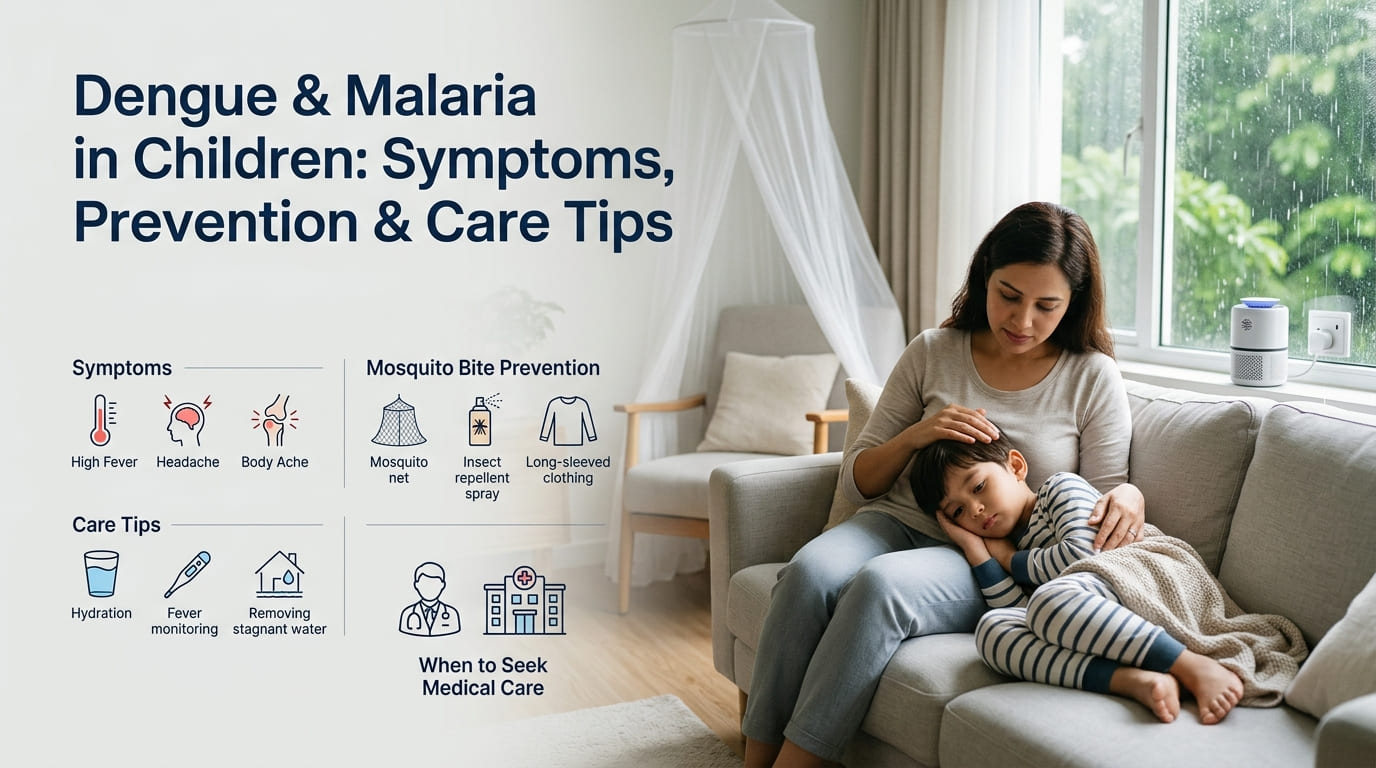
Medical Disclaimer: This article is for informational purposes only and does not replace professional medical advice. If your child shows any symptoms of dengue or malaria, seek medical attention immediately. Always consult your paediatrician for diagnosis and treatment.
Dengue and malaria in children can look like an ordinary fever at first — that’s exactly what happened the monsoon my daughter was three, when she spiked a fever on a Wednesday evening.
Nothing unusual at first — she’d had fevers before. I gave her paracetamol, put her to bed, assumed it would pass by morning. By Thursday afternoon it was higher. By Friday she had a rash spreading across her torso and her eyes looked puffy in a way that made my stomach drop.
Dengue. Confirmed at the hospital that evening.
She recovered fully — we caught it in time, she had good care, and three weeks later she was back to running circles around me in the garden. But those five days in between were the most frightening of my parenting life. And the thing I kept thinking, lying on the hospital floor next to her cot, was — why didn’t I know what to look for sooner?
So this is that article. The one I wish I’d read before that Wednesday evening.
Why Dengue and Malaria Peak During Monsoon
The mosquito lifecycle explains everything
Both dengue and malaria spread through mosquito bites — but different types of mosquitoes, active at different times of day, breeding in different conditions.
Dengue spreads through the Aedes aegypti mosquito — a daytime biter that breeds in clean, stagnant water. Flower pots, water tanks, coolers, tyres, anything that holds water and sits undisturbed. Monsoon creates these conditions everywhere, simultaneously, across entire cities.
Malaria spreads through the Anopheles mosquito — a night biter that breeds in larger bodies of stagnant or slow-moving water. Ponds, puddles, waterlogged fields, blocked drains. Heavy rain creates all of these.
When mosquito populations explode in July and August, cases of both diseases follow within one to two weeks — the time it takes for the mosquito to bite an infected person, allow the pathogen to develop inside it, and then transmit it to the next person it bites.
Why children are hit harder
Children’s immune systems respond to these infections differently than adults. Dengue in particular can progress more rapidly in young children — the warning signs appear faster and the window between “unwell” and “seriously unwell” is shorter.
Furthermore, children cannot reliably tell you what they’re feeling. A headache behind the eyes — one of the classic dengue symptoms — a toddler cannot describe. Muscle pain they might show as irritability or reluctance to move. Joint pain in a child who can’t yet articulate it might look like a child who simply doesn’t want to walk.
This is why knowing what to look for — as a parent — matters so much more than waiting for your child to tell you something is wrong.
Dengue in Children — The Complete Picture
What dengue actually is
Dengue is a viral infection caused by the dengue virus — four different strains of it, which is part of why you can get dengue more than once and why a second infection is often more severe than the first. There is no specific antiviral treatment. The body has to fight it out while medical care manages symptoms and prevents complications.
In most cases, dengue is unpleasant but manageable. However, in some children — particularly young ones — it progresses to severe dengue, which involves plasma leaking from blood vessels and can be life-threatening without prompt treatment.
The difference between mild dengue and severe dengue often comes down to how quickly parents and doctors recognise the warning signs.
Dengue symptoms in children — what to actually watch for
The fever phase — days 1 to 3
Dengue fever arrives suddenly and hits hard. One hour your child seems fine, the next they have a temperature of 39 or 40 degrees Celsius. Unlike many childhood fevers that fluctuate, dengue fever tends to be high and persistent.
Alongside the fever, watch for:
Severe headache — in children who can’t describe it, this shows as holding the head, unusual irritability, or squinting against normal light levels.
Pain behind the eyes — classic dengue symptom. Children rub their eyes or seem to find light uncomfortable.
Muscle and joint pain — dengue earns its old name “breakbone fever” because of how much the body aches. A child in dengue will not want to be moved, may cry when lifted, may refuse to walk.
Nausea and vomiting — common in the first few days.
No runny nose, no cough — this matters. Dengue looks like a severe flu in many ways but typically comes without the upper respiratory symptoms. A high fever with body pain but no cold symptoms should immediately make you think dengue during monsoon season.
The critical phase — days 4 to 6
This is the phase most parents don’t know about — and it’s the most dangerous one.
Around days four to five, the fever often drops. Parents feel relieved. The child seems to be improving. But this is actually when the risk of severe dengue is highest.
During this phase, watch for these warning signs and go to hospital immediately if any appear:
Severe abdominal pain — persistent, not just discomfort.
Vomiting that won’t stop — three or more times in twenty-four hours.
Bleeding — from the nose, gums, or in vomit. Any bleeding during a dengue illness is a red flag.
Rapid breathing.
Fatigue so extreme the child can barely stay awake or respond normally.
The rash — a characteristic dengue rash appears in many cases. It looks like small red spots or patches, sometimes with islands of clear skin within it. It typically appears on the torso and spreads to the limbs. It’s not always present but when it is, it’s fairly distinctive.
Blood in urine or stool — dark urine or black tarry stools indicate internal bleeding. Emergency.
The recovery phase — days 7 to 10
If managed well, most children begin recovering around day seven. The fever breaks properly, appetite returns, energy slowly comes back. However, full recovery — back to normal energy levels — often takes two to three weeks. Don’t rush it.
Malaria in Children — What Parents Need to Know
How malaria is different from dengue
Malaria is caused by a parasite — Plasmodium — not a virus. This distinction matters because malaria is treatable with specific antimalarial medications, and early treatment is significantly more effective than delayed treatment.
India sees millions of malaria cases every year. Children under five are among the most vulnerable groups, particularly to the more severe forms caused by Plasmodium falciparum.
Malaria symptoms in children
The classic malaria pattern is cyclical fever — fever that spikes, then breaks with sweating, then returns again on a regular cycle. In Plasmodium vivax, this cycle tends to be every 48 hours. In Plasmodium falciparum, the pattern can be less regular.
Watch for:
High fever that comes and goes in a pattern — this cycling is the hallmark of malaria. If your child’s fever seems to follow a rhythm, think malaria.
Chills and shivering before the fever spike — children may shake visibly before the temperature rises.
Sweating as the fever breaks — drenching sweats that then leave the child feeling temporarily better.
Headache, body pain, and fatigue — similar to dengue but without the characteristic rash or eye pain.
Vomiting and loss of appetite.
Severe malaria — know these signs
Falciparum malaria can progress to severe disease quickly in young children. Signs of severe malaria that need immediate emergency care:
Seizures during fever.
Extreme pallor — the child looks very pale, almost grey.
Difficulty breathing.
Loss of consciousness or extreme drowsiness that can’t be explained by normal sleep.
Jaundice — yellowing of the skin or whites of the eyes.
Dark, cola-coloured urine — indicates kidney involvement.
Inability to stand or sit — extreme weakness.
If any of these appear — go to the nearest emergency department immediately. Don’t wait for the next morning. Don’t wait to call relatives first. Go now.
How to Tell Dengue from Malaria — And Why It Matters
Parents often ask how to tell the difference between the two. The honest answer is — you often can’t, and you shouldn’t try to. Both require a blood test for accurate diagnosis. Both need medical assessment.
However, some patterns can help:
Dengue tends to arrive more suddenly, with more severe body pain, the characteristic rash, and eye pain. The fever is typically high and continuous in the early days.
Malaria tends to have a more cyclical fever pattern — fever, then apparent recovery, then fever again. Chills before the fever spike are more characteristic of malaria.
Both can cause high fever, headache, vomiting, and weakness. Both can become severe. Both need a doctor — not home management alone.
The only way to know for certain is a blood test. In India, rapid diagnostic tests for both dengue and malaria are widely available and produce results quickly. If your child has had a fever for more than two days during monsoon season, a blood test is worth doing regardless of which disease you suspect.
What to Do at Home While Seeking Medical Care
If you suspect dengue or malaria, you’re going to the doctor. But while you’re getting there, or while awaiting test results, here’s what helps and what to avoid.
What helps
Paracetamol for fever — give the correct dose for your child’s weight. Paracetamol is safe for fever management in both dengue and malaria.
Fluids, fluids, fluids — keeping a child with dengue well-hydrated is one of the most important things you can do. Offer water, coconut water, oral rehydration solution, diluted juice — anything they’ll drink, frequently. Dehydration in dengue worsens outcomes significantly.
Rest — keep your child calm and still. Movement is painful in dengue and exhausting in malaria.
Monitor closely — check temperature every few hours. Watch for the warning signs described above. Write down when symptoms appeared, how the fever has behaved, what you’ve given and when. This information helps the doctor enormously.
What to avoid — this is critical
Never give ibuprofen or aspirin for fever in suspected dengue. This is not a caution — it’s an absolute rule. Both ibuprofen and aspirin affect blood clotting. Dengue already affects platelet counts and can cause bleeding. Giving these medications in dengue can worsen bleeding significantly and has caused serious harm. Paracetamol only.
Don’t give antimalarial medication without a diagnosis. Antimalarials have side effects and treating for malaria when the child has dengue won’t help and might harm.
Don’t delay seeking care waiting for the fever to come down. High fever in a child during monsoon season deserves medical assessment, not watchful waiting at home.
For our full guide on managing fever in children and when to go to hospital, our baby fever guide and toddler fever guide cover both ages in detail.
Prevention — What Actually Works
Eliminate mosquito breeding grounds at home
This is the single most impactful thing you can do for your family. Aedes aegypti — the dengue mosquito — breeds in small amounts of clean standing water. You probably have more of these in and around your home than you think.
Check and empty or cover every week during monsoon: flower pot saucers, cooler water tanks, overhead tanks and their surrounds, tyres, buckets, birdbaths, any container that collects rainwater. A mosquito can complete its breeding cycle in as little as seven days. Weekly inspection and emptying breaks that cycle.
For malaria mosquitoes, the targets are larger — waterlogged areas, stagnant drains, puddles. These are harder to control individually but worth addressing where you can.
Mosquito repellent for children
DEET-free repellents formulated for children are available and appropriate for babies over six months. Apply to exposed skin — not on the face, not on hands that go in the mouth.
For babies under six months, repellents are not recommended — use physical barriers instead. Mosquito nets over the pram, keeping the baby indoors during peak mosquito hours (dawn and dusk for dengue mosquitoes, evening and night for malaria mosquitoes), and covering with light clothing.
For older children — long sleeves and trousers in light, breathable fabric during dawn and dusk significantly reduce biting. Mosquitoes are opportunistic — covered skin simply doesn’t get bitten.
Mosquito nets
Mosquito nets over sleeping areas remain one of the most effective and safest protections, particularly for young children. Use them consistently, check regularly for holes, and ensure they’re properly tucked in.
Dengue vaccine
A dengue vaccine — Dengvaxia — exists but carries specific recommendations and restrictions. In India, speak to your paediatrician about whether it’s appropriate for your child based on current guidelines and your child’s specific circumstances.
There is currently no widely available malaria vaccine in India, though research continues.
After Recovery — What Parents Need to Know
Recovery from dengue, in particular, takes longer than most parents expect. Even after the fever breaks and the child seems much better, complete recovery of energy and appetite often takes two to three weeks.
During recovery — keep activity light, maintain good nutrition and hydration, and follow up with your paediatrician as advised. Platelet counts in dengue take time to normalise. Don’t rush back to school or normal activity before the doctor gives clearance.
Watch for relapse — a return of fever after apparent recovery needs medical reassessment promptly.
For support on nutrition during and after illness, our superfoods for toddler brain development article covers foods that support immune recovery.
FAQ — Dengue and Malaria in Children
About Symptoms and Diagnosis
Q: How do I know if my child has dengue or just a regular fever?
Key differences — dengue fever arrives suddenly and is high, usually above 39°C. It comes with severe body pain, headache, and often pain behind the eyes. There is typically no runny nose or cough. During monsoon season, any high fever in a child that doesn’t improve in forty-eight hours warrants a blood test to rule out dengue and malaria.
Q: What does a dengue rash look like in children?
The dengue rash typically appears around days three to five of illness. It consists of small red spots or flat red patches, often with areas of normal skin in between — sometimes described as “islands of white in a sea of red.” It usually starts on the torso and spreads outward. Not every dengue case develops a rash, but when it appears alongside fever and body pain, it’s a strong indicator.
Q: Can my child get dengue more than once?
Yes — and a second infection with a different dengue strain is often more severe than the first. This is one reason prevention matters so much even after a child has had dengue once.
About Treatment and Care
Q: Can I manage dengue at home without hospitalisation?
Mild dengue in older children — with good fluid intake, paracetamol for fever, close monitoring, and no warning signs — can sometimes be managed at home under a doctor’s guidance. However, children under five, children who develop any warning signs, and any child who cannot maintain adequate hydration need hospital care. Never manage suspected dengue in a young child without medical assessment.
Q: Why can’t I give ibuprofen for dengue fever?
Dengue affects platelet function and can cause bleeding. Ibuprofen and aspirin both further impair platelet function and can significantly worsen bleeding risk. Paracetamol is the only safe fever medication in dengue. This applies to suspected dengue even before diagnosis is confirmed.
Q: How long does malaria treatment take?
Treatment duration depends on the type of malaria and the medication used — typically three to seven days of antimalarial medication. Symptoms usually begin improving within twenty-four to forty-eight hours of starting the right treatment. Complete the full course even if the child seems better — stopping early risks relapse and contributes to drug resistance.
About Prevention
Q: At what age can I use mosquito repellent on my child?
DEET-free repellents formulated for children are generally considered safe from six months of age. For babies under six months, use physical barriers — nets, clothing, keeping indoors during peak mosquito hours — rather than repellents. Always apply repellent to your own hands first and then onto the child’s skin, avoiding face and hands.
Q: Does the dengue vaccine protect my child completely?
The dengue vaccine reduces the risk and severity of dengue but does not eliminate it entirely. Current recommendations in India involve specific criteria for who should receive it — speak to your paediatrician rather than seeking it independently.
Q: My child had dengue last year. Are they at higher risk this monsoon?
Yes — a second dengue infection with a different strain carries higher risk of severe dengue than a first infection. Maintain vigilant mosquito prevention and act quickly if fever appears during monsoon season.
📚 More from MumPappaHub — Read These Next:
- Baby Fever Guide: When to Worry
- Toddler Fever Guide
- Monsoon Baby Care Tips
- How to Protect Your Child from Waterborne Diseases
- Baby Cold and Cough Home Remedies
- Child Development Milestones
- Baby First Year Milestones
- Superfoods for Toddler Brain Development
- Newborn Care Tips
- Child Safety Proofing Guide
- Baby Blues vs Postpartum Depression
- Postpartum Recovery Guide
About This Article: Written by the MumPappaHub editorial team. Reviewed for accuracy against current paediatric and public health guidelines on dengue and malaria in children. This content is for general informational purposes only and does not constitute medical advice. Always seek immediate medical care if you suspect your child has dengue or malaria.
MumPappaHub — Real talk for real parents. mumpappahub.com

1 Comment