
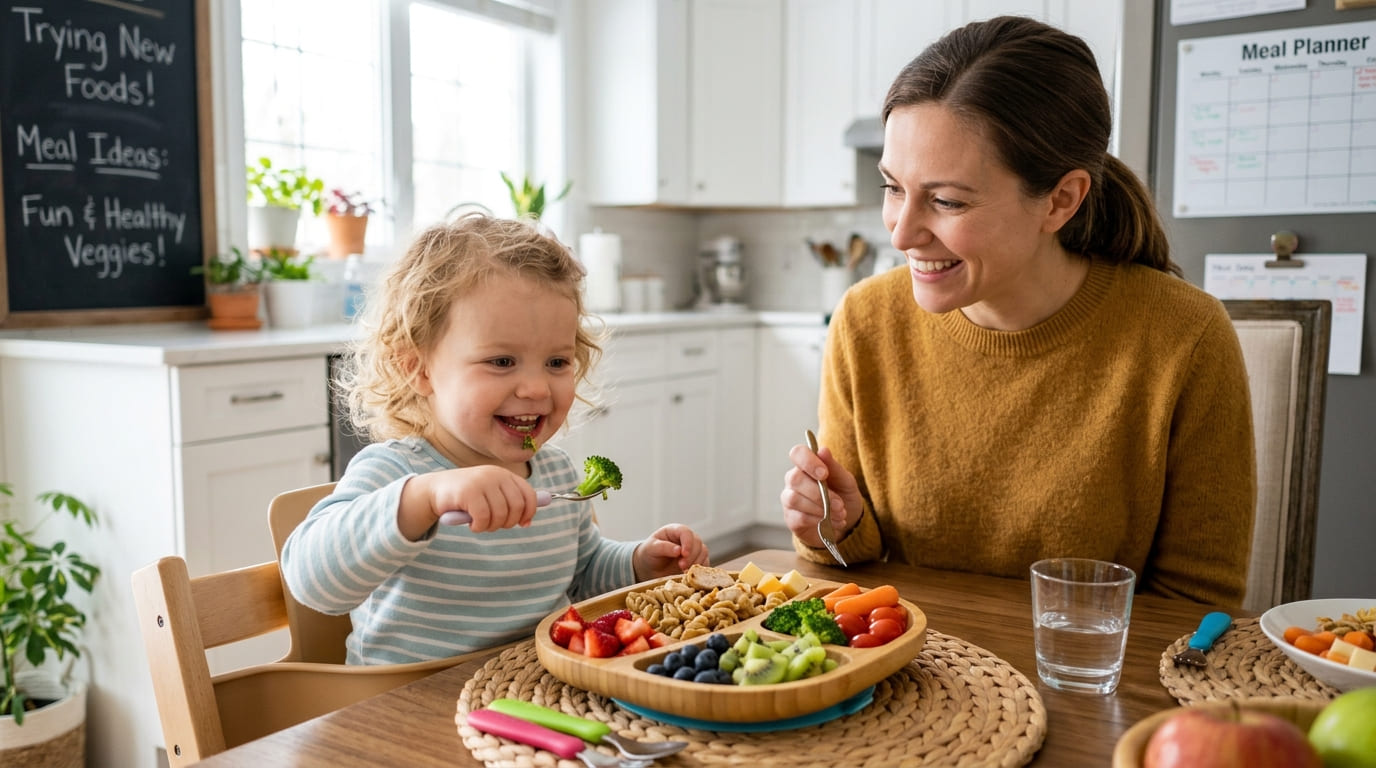
If you are the parent of a toddler, there is a very high probability that you have experienced this exact, deeply frustrating scenario: You spend forty-five minutes cooking a highly nutritious, beautifully balanced meal. You place the colorful plate in front of your two-year-old. They look at it, their face contorts in pure disgust, and they push the plate away, screaming, “NO! I only want crackers!”
You are left staring at the cold broccoli, wondering how your baby—who happily slurped down spinach purees just six months ago—has suddenly transformed into a tiny food critic who apparently plans to survive entirely on air, fruit snacks, and plain pasta.
If mealtime in your home has devolved into a daily battleground of bribery, airplane noises, and eventual tears, take a deep breath. You are absolutely not alone. Picky eating (often clinically referred to as “fussy eating”) is an incredibly common developmental phase that peaks between the ages of two and four.
However, just because it is normal does not mean you have to suffer through it. In this comprehensive, expert-backed guide, we will dive into the fascinating biology of why toddlers suddenly stop eating, explore the golden “Division of Responsibility” rule, and provide you with 10 actionable, proven strategies to reverse picky eating, reduce mealtime anxiety, and build lifelong healthy habits.
The Science: Why Did My Good Eater Suddenly Become Picky?
Before you can fix the problem, you have to understand the root cause. Parents often blame themselves when a toddler becomes picky, assuming they did something wrong during the weaning process. The truth is, picky eating is driven by a combination of biology, evolution, and psychology.
1. The Growth Rate Plateau
During their first year of life, a baby’s growth is explosive. They typically triple their birth weight in just twelve months. This rapid growth requires a massive amount of calories, which is why infants seem to have a bottomless appetite. However, right around the 12-to-15-month mark, their physical growth rate dramatically slows down. Because they are not growing as rapidly, their biological caloric needs drop. Simply put: they are eating less because their body is telling them they don’t need as much food.
2. Evolutionary “Neophobia”
Neophobia is the extreme fear of new things, specifically new foods. From an evolutionary biology standpoint, this is actually a survival mechanism. When early humans were wandering the forests, toddlers who just started walking could easily pick up and eat poisonous berries or toxic plants. Neophobia kicks in around age two to prevent them from putting unfamiliar, potentially dangerous things into their mouths. Their brain is literally hardwired to reject the green, bumpy broccoli because it looks “unsafe.”
3. The Need for Autonomy and Control
Psychologically, the toddler years are entirely about establishing independence. A toddler has very little control over their day—you decide when they wake up, what they wear, and where they go. But there are three things a parent absolutely cannot force a child to do: sleep, use the potty, and swallow food. Refusing to eat is one of the only ways a toddler can exercise absolute power and control over their environment.
The Golden Rule: The Division of Responsibility
If you only take one piece of advice from this entire guide, let it be this. Created by internationally recognized feeding therapist Ellyn Satter, the “Division of Responsibility in Feeding” (sDOR) is the absolute gold standard for raising healthy eaters.
The concept is simple. To end mealtime power struggles, you must strictly divide the jobs.
The Parent’s Job:
- To decide WHAT food is offered (You plan the menu).
- To decide WHEN food is offered (You set the schedule for meals and snacks).
- To decide WHERE food is offered (You decide they must eat at the table, not walking around the living room).
The Child’s Job:
- To decide WHETHER they are going to eat the food you provided.
- To decide HOW MUCH of it they are going to eat.
When you try to do your child’s job (by forcing them to take “just one more bite”), or when you let your child do your job (by acting as a short-order cook and making them a separate meal of chicken nuggets because they rejected the family dinner), the entire system collapses into anxiety and frustration. Trust your child’s body to know when it is full.
10 Proven Strategies to Reverse Picky Eating
Now that you understand the psychology and have established the Division of Responsibility, here are 10 highly actionable strategies to encourage your toddler to explore new foods.
1. Always Include a “Safe Food”
Never serve a plate entirely consisting of new or historically rejected foods. If you serve salmon and asparagus to a toddler who has never seen salmon before, their brain will register the entire plate as a threat, and they won’t eat anything.
- The Strategy: Always ensure there is at least one “Safe Food” on the plate that you know they like and can fill up on. This could be a slice of bread, a pile of strawberries, or a serving of plain rice. Knowing the safe food is there lowers their defensive walls, making them far more likely to eventually poke at the salmon.
2. Stop the “Clean Plate Club” and Eliminate Bribery
We all grew up hearing, “You cannot leave the table until your plate is clean,” or “If you eat your peas, you can have a cookie.”
- Why it fails: Forcing a child to clean their plate teaches them to ignore their body’s natural fullness cues, which can lead to binge eating disorders later in life. Furthermore, bribing them with dessert elevates the cookie to a “premium reward” and downgrades the peas to a “punishment you have to endure.”
- The Strategy: Serve a very small, un-intimidating portion of food. Let them ask for seconds if they are hungry. Offer dessert completely neutrally alongside the meal, not as a reward.
3. Practice “Food Chaining”
Food chaining is a brilliant clinical technique used by occupational therapists. It involves taking a food your child currently loves and making tiny, microscopic changes to it until they eventually accept a completely new food.
- The Strategy: Let’s say your toddler only eats McDonald’s chicken nuggets.
- Step 1: Buy a different brand of frozen chicken nuggets.
- Step 2: Serve the new brand of nuggets, but cut them into different shapes.
- Step 3: Serve homemade breaded chicken tenders.
- Step 4: Serve un-breaded, baked chicken breast cut into tender-shapes.
- Step 5: Serve regular baked chicken. By moving at a glacial pace, the child accepts the changes without triggering their neophobia.
4. Deconstruct “Mixed” Meals
Toddlers despise unexpected textures. A casserole, a hearty stew, or a mixed salad is a terrifying prospect for a picky eater because they don’t know what they are going to get in each bite. A soft piece of pasta mixed with a crunchy piece of celery can cause them to spit the whole bite out.
- The Strategy: Deconstruct the meal. If you are having tacos for dinner, do not serve them a fully assembled taco. Give them a plate with a small pile of plain meat, a small pile of shredded cheese, a few plain tomatoes, and a dry tortilla. Let them see and control exactly what they are eating.
5. Change the Language Around Food
How you talk about food drastically impacts how your child views it. Stop labeling foods as “Good,” “Bad,” “Healthy,” or “Junk.”
- The Strategy: Talk about what the food does for their body.
- Instead of: “Eat your carrots, they are healthy.”
- Say: “Carrots have special vitamins that make your eyes sharp like an eagle so you can read your books in the dark!”
- Instead of: “Pasta is bad for you.”
- Say: “Pasta gives your muscles fast energy so you can run really fast at the playground today!”
6. Embrace the “No-Pressure” Exposure
Did you know that a child may need to be exposed to a new food up to 15 to 20 times before they actually decide to taste it? Most parents give up after the third rejection.
- The Strategy: Keep putting a single floret of broccoli on their plate every time you make it. Do not ask them to eat it. Do not even point it out. Exposure does not just mean eating. Looking at it, smelling it, poking it with a fork, or even touching it to their lips and spitting it out into a napkin all count as successful exposures.
7. Get Them Involved in the Kitchen
Children are exponentially more likely to eat a meal if they feel like they had a hand in creating it. Cooking gives them a sense of ownership.
- The Strategy: Bring a learning tower or a sturdy chair into the kitchen. Give them age-appropriate tasks. A two-year-old can wash the bell peppers in the sink, tear the lettuce leaves for the salad, or use a dull butter knife to cut a banana. The sensory experience of handling the raw ingredients makes the final cooked product far less intimidating.
8. Serve Meals Family-Style
Plating the food for your toddler and placing it in front of them can sometimes feel aggressive to a sensitive child.
- The Strategy: Put all the components of the dinner in large serving bowls in the center of the table. Give your toddler an empty plate and let them serve themselves (with your physical help to hold the heavy spoons). When a child is allowed to choose what goes on their plate, they are far more likely to eat it.
9. Make the Food Visually Fun
We eat with our eyes first, and toddlers are highly visual creatures. A plate of brown meat and mushy green beans is not inspiring.
- The Strategy: Buy a set of cheap, plastic cookie cutters. A sandwich cut into the shape of a dinosaur is instantly 100% more appetizing. Arrange a few slices of bell pepper and cucumber to look like a smiley face. Use colorful silicone cupcake liners to separate different foods on their plate.
10. Heavy Work Before Meals (Sensory Input)
Sometimes, a toddler cannot sit still and focus on eating because their nervous system is dysregulated. They need “proprioceptive input” (heavy work) to calm their brain down before sitting at the table.
- The Strategy: 10 minutes before dinner is served, have your toddler do some heavy physical work. Have them push a heavy laundry basket across the living room, do 10 frog jumps, or give them a deep-pressure “bear hug.” This grounds their nervous system, making it much easier for them to sit calmly in their high chair. (Note for Mom: Chasing and lifting an active toddler requires a strong physical foundation. If you are still experiencing back pain, make sure you are practicing safe postpartum exercises to rebuild your core to prevent injuries during playtime!)
FOR THE MOMS: While you are focusing on your toddler’s nutrition, don’t forget your own physical health! Check out our guide on 5 Safe Postpartum Exercises to Rebuild Your Core to heal your body and regain your energy.
When Is It More Than Just Picky Eating? (Medical Red Flags)
While standard picky eating is a normal developmental phase, there is a distinct difference between a fussy toddler and a child with a true medical or sensory feeding disorder, such as ARFID (Avoidant/Restrictive Food Intake Disorder).
Consult your pediatrician or a licensed pediatric feeding therapist if you observe any of the following red flags:
- Dropping Entire Food Groups: They refuse to eat any fruits, any vegetables, or any proteins, severely limiting their nutritional intake.
- A Shrinking List of Accepted Foods: Their list of “Safe Foods” drops below 15 items, and if they suddenly reject a safe food, they never go back to it.
- Brand Specificity: They will only eat one specific brand of chicken nuggets, and if the packaging changes or you buy a different brand, they will completely starve themselves rather than eat it.
- Severe Physical Reactions: They gag, vomit, or have full-blown panic attacks simply by being in the same room as a new food.
- Difficulty Swallowing: They constantly choke, pocket food in their cheeks for hours, or lack the jaw strength to chew solid foods.
Conclusion: Play the Long Game
Reversing picky eating is not a sprint; it is an ultra-marathon. You will not implement these strategies on Monday and have a child begging for kale salad by Friday. It requires weeks, and often months, of calm, zero-pressure consistency.
Remind yourself daily that your job is simply to provide the food. Release the anxiety of whether or not they swallow it. Keep family mealtimes positive, keep offering a wide variety of colors and textures, and trust that you are laying the fundamental groundwork for a healthy, lifelong relationship with food.

12 Comments