
Introduction
In today’s digital age, the lure of the tablet or television is strong. We’ve all been there—the baby is crying, you’re exhausted, and a quick cartoon feels like a lifesaver. But have you ever noticed how your toddler acts after the screen goes off? Often, they are cranky, overstimulated, and struggling to reconnect.
This isn’t an article shaming parents for using screens; it’s an invitation to rediscover the magic of Screen-Free Play. Play is the “work” of childhood, and when we remove digital distractions, we unlock a world of creativity, emotional regulation, and deep developmental growth. In this guide, we’ll explore how to turn your everyday home into an engaging, developmental playground that your toddler will absolutely love.
1. Why Screen-Free Play is Your Toddler’s Best Friend
When a child watches a screen, they are a passive observer. When they play with physical objects, they are an active scientist. Screen-free play allows for:
- Deep Focus (Flow State): When toddlers engage with real-world objects, they learn to sustain their attention—a skill that is drastically reduced by fast-paced digital media.
- Creative Problem Solving: A screen tells a child exactly what to see and hear. A pile of wooden blocks, however, forces the child to decide: “Is this a tower, a bridge, or a garage for my cars?”
- Emotional Regulation: Physical play allows children to externalize their feelings. Pounding dough or sorting objects helps them process the “big feelings” they encounter daily.
If you are finding that your toddler is experiencing frequent emotional outbursts, you might find our Toddler Tantrum Management guide helpful for understanding the “why” behind the meltdowns.
2. The “Everyday Object” Philosophy: Play Doesn’t Need a Battery
The most expensive, battery-operated toy in the store usually keeps a child’s attention for 10 minutes. A cardboard box? That can keep them busy for hours. Here’s why “low-tech” is actually “high-impact”:
The Power of “Open-Ended” Toys
Open-ended toys are items that can be used in multiple ways. They grow with the child.
- Wooden Blocks: Today they are buildings, tomorrow they are food, the next day they are a fence for animals.
- Play Silks or Scarves: These are magic capes, blankets for dolls, rivers on the floor, or ghosts in a game of peek-a-boo.
- Kitchen Utensils: A muffin tin and some silicone spoons are perfect for sorting activities.
3. Room-by-Room: Setting Up “Invitations to Play”
You don’t need a dedicated playroom. You just need an “invitation.” An invitation to play is simply setting up a small, neat area that sparks curiosity.
The Kitchen Floor (While You Cook)
While you’re preparing meals, give your toddler a “kitchen cupboard” access point. Give them plastic containers, lids, and a wooden spoon.
- Developmental Goal: Motor skills, cause-and-effect learning, and language (talking about textures and sounds).
The Living Room “Den”
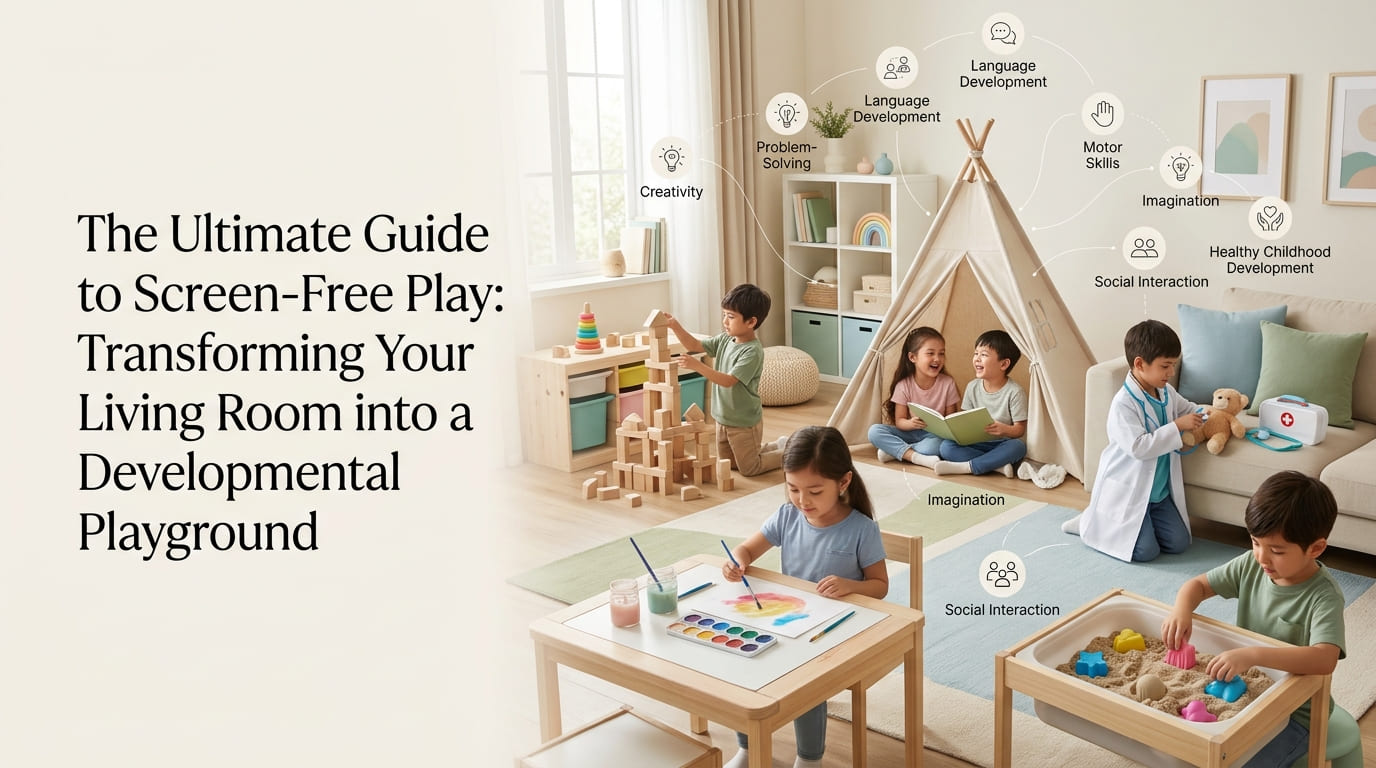
Drape a sheet over two chairs. Add some cushions and a flashlight. This creates a cozy, safe space where your child can read, hide, or just “be.”
- Developmental Goal: Emotional safety, imaginative play, and spatial awareness.
The Bathroom (Tub Play)
Even if it’s not bath time, let them play in an empty tub with shaving cream (if safe/non-toxic) or a bucket of water and a paintbrush to “paint” the tiles.
- Developmental Goal: Sensory exploration and tactile awareness.
4. Nurturing the “Whole Child” Through Activity
As your child engages in these play sessions, remember that they are building their physical and cognitive foundation. If you are ever curious about how these activities correlate to their growth phases, keep our Child Development Milestones Guide bookmarked. It helps to understand which skills they are practicing while they play!
5. Frequently Asked Questions (FAQs)
You aren’t doing anything wrong! Toddlers have short attention spans. The key is “toy rotation.” Keep most of your toys in a closet and only bring out 3–4 types at a time. The novelty makes them feel like new toys every time.
Both are important. “Floor time” where you play alongside them is vital for bonding, but “independent play” is how they build confidence. Start by sitting nearby while they play, then slowly pull away as they get absorbed in their activity.
Don’t go “cold turkey” if it’s too hard. Start by replacing one screen session with a “new” activity—perhaps a walk outside or a craft session—so the shift feels like an upgrade, not a punishment.
6. The Human Touch: Your Role as the Play Partner
The most important “activity” you can provide is your presence. You don’t need to entertain them every second; in fact, it’s better if you don’t. Being a “play partner” means observing, narrating, and supporting.
When they build a tower, don’t say, “Good job.” Say, “You used so many blue blocks! That tower is reaching all the way to the ceiling!” This is called narrative play, and it builds language skills faster than any app ever could.
7. Conclusion: Play is the Foundation
Screen-free play is about slowing down. It’s about giving our children the space to be bored, to be creative, and to be children. It builds a foundation of health and happiness that lasts far longer than any digital reward.
Remember, a well-fed brain plays better! Ensure your toddler is getting the right nutrients for these active sessions by reading our 5 Superfoods for Brain Development article.
Start small. Tomorrow, don’t turn on the TV. Instead, throw a sheet over the sofa, give your toddler a box of crayons, and just sit back and watch the magic happen.
1 Comment