
Medical Disclaimer: This article is for informational purposes only. If your toddler’s tantrums are extremely frequent, very intense, or accompanied by self-harm, consult your paediatrician.
Toddler tantrums tips India is what I searched frantically one afternoon when my two-year-old threw himself on the floor of a Big Bazaar because I wouldn’t buy him a chocolate. Not a quiet floor sit. A full-body, back-arching, screaming meltdown in aisle seven with approximately forty people watching.
My mother-in-law, who was with me, handled it perfectly — she crouched down, spoke softly, and within three minutes he was calm. I was still standing there, red-faced and completely undone, wondering how she had done that.
“He needed to feel heard,” she said. “That’s all.”
That afternoon was the beginning of my actual education in toddler behaviour. What I learned changed how I parent — and most of it came from understanding what was actually happening in my son’s brain, not from tips about distraction or reward charts.
This guide covers toddler tantrums tips India properly — the brain science, the India-specific triggers and contexts, and 12 strategies that genuinely work in Indian households.
Why Toddler Tantrums Tips India Must Start With Brain Science
Toddler tantrums tips India work best when parents understand what is actually happening during a tantrum — because this understanding changes everything about the response.
A toddler’s prefrontal cortex — the part of the brain responsible for impulse control, emotional regulation, and rational decision-making — is not fully developed until the mid-twenties. At age two, it is barely online.
What IS fully developed at age two: the limbic system — the emotional brain. A toddler has the full intensity of adult emotions with none of the regulatory capacity that comes with a developed prefrontal cortex.
According to the World Health Organization’s guidelines on early childhood development, emotional regulation is a developmental skill that emerges gradually through the toddler and preschool years — it cannot be demanded or punished into existence before the neurological infrastructure exists to support it.
The Indian Academy of Pediatrics recognises that tantrums in children aged 1–4 years are developmentally normal, peak around age 2–3, and are not a sign of bad parenting or a difficult child.
A tantrum is not defiance. It is a developmental overflow — too much emotion for an immature regulatory system. Once this is understood, the response changes from “stop this behaviour” to “help this child through this experience.”
When Do Tantrums Peak — And When Do They End?
Tantrums typically begin around 12–18 months as mobility and independence increase but language hasn’t yet caught up. They peak at 2–3 years. They reduce significantly by 4 years as language develops and emotional regulation improves.
The single strongest predictor of tantrum frequency: the gap between what the child wants to express and what their language allows them to say. A toddler who cannot yet say “I’m frustrated that you’re not listening to me” expresses that frustration through their body — which is what a tantrum is.
This is why toddler language development is so directly connected to tantrum reduction. Our toddler language development guide covers how to support language at each age — which is one of the most effective long-term tantrum prevention strategies.
The India-Specific Tantrum Context
Some tantrum triggers are universal. Others are specifically common in Indian household and cultural contexts:
Joint family dynamics: Multiple adults with different rules and boundaries create confusion for toddlers. Nani says yes to chocolate, mummy says no. Dada allows jumping on the sofa, papa doesn’t. Inconsistency between caregivers is one of the most reliable tantrum accelerants.
Festival and visit disruptions: Indian festivals, family visits, and weddings frequently disrupt sleep schedules, meal times, and routines. An overtired toddler at Diwali celebrations at 11 PM is not being naughty — they are neurologically overwhelmed.
The “free range” grandparent problem: Many Indian grandparents give toddlers significant latitude — and then parents try to enforce limits. The resulting confusion produces real emotional distress in the toddler, expressed as tantrums.
Public expectations: Indian cultural expectations around child behaviour in public — “achcha bachcha” — can create parental anxiety that transfers directly to the toddler. A parent who is tense and embarrassed during a public tantrum makes the tantrum longer, not shorter.
Diet and screen time patterns: Many Indian toddlers have irregular meal times, high sugar intake from mithai and packaged snacks, and significant screen time. All three are reliable tantrum triggers: blood sugar drops cause dysregulation, and screen removal is one of the most consistent tantrum triggers across all cultures.
12 Proven Toddler Tantrums Tips India
1. Stay Calm — Your Nervous System Regulates Theirs
The most important thing during a tantrum is the parent’s own state. A dysregulated parent cannot regulate a dysregulated child.
This is not just good advice — it’s neuroscience. The toddler’s nervous system co-regulates with the adult’s through a process called neurological synchrony. When the adult is calm, the child’s nervous system has something to synchronise with. When the adult escalates, the child’s nervous system escalates further.
In practice: Take one slow breath before responding. Lower your voice rather than raising it. Get physically lower — crouch, kneel, sit on the floor. Your body language communicates safety or threat before a word is spoken.
2. Don’t Try to Reason During the Tantrum
During a tantrum, the prefrontal cortex — the rational brain — is effectively offline. Explaining, reasoning, threatening, or negotiating during an active meltdown does nothing except extend it.
The sequence is: First calm, then talk. When the tantrum is active — the child is screaming, crying, hitting the floor — this is not the time for “listen to me” or “if you don’t stop, you won’t get X.” Those words are not being processed.
Wait for the storm to pass. Then talk.
3. Name the Emotion — Don’t Dismiss It
My mother-in-law’s “he needed to feel heard” was exactly right.
When a child’s emotion is named and acknowledged, it reduces. When it is dismissed or contradicted, it intensifies.
What not to say: “Stop crying.” “You’re being silly.” “There’s nothing to cry about.” “Bas karo.”
What to say instead: “You’re really angry right now.” “You wanted that so much and it’s so hard when we can’t have it.” “I can see you’re really upset.”
This feels counterintuitive — aren’t you reinforcing the behaviour by giving it attention? Research consistently shows the opposite. Acknowledged emotion resolves faster than dismissed emotion. The child feels understood and can begin to come down.
4. Get Down to Their Level — Literally
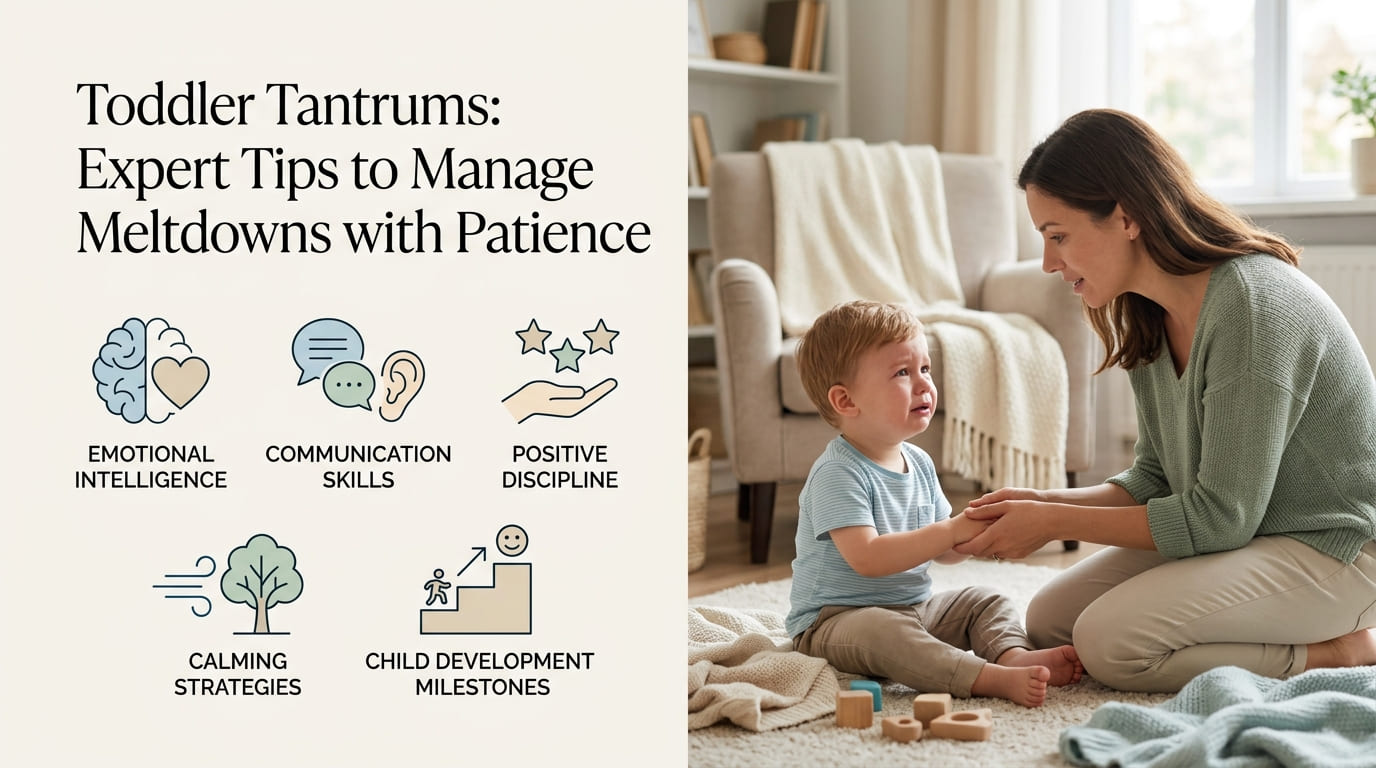
Standing over a screaming toddler is threatening, not comforting. Getting down — crouching, kneeling, sitting on the floor — is one of the simplest and most effective changes you can make.
It signals: I’m with you. Not above you. Not against you. With you.
5. Offer Comfort Without Giving In
These are two different things and they are frequently confused.
Comfort = “I see you’re upset. I’m here.” — This is always appropriate.
Giving in = “Fine, you can have the chocolate.” — This reinforces that tantrums produce the desired outcome.
A toddler who is held, spoken to gently, and whose emotion is acknowledged — while the limit is maintained — learns that emotions are safe but limits are real. A toddler who is held and then gets what they wanted learns that tantrums work.
You can be warm AND hold the boundary simultaneously.
6. Prevention — Know the HALT Triggers
Most toddler tantrums have a trigger that could have been predicted and prevented. The HALT framework:
H — Hungry: A toddler whose blood sugar has dropped is a tantrum waiting to happen. Regular snacks — not just three meals — prevent this.
A — Anxious/Angry: A child who has been stressed, overwhelmed, or frustrated earlier in the day has less regulatory capacity for challenges later.
L — Lonely/Lacking connection: A toddler who hasn’t had quality connection time with a parent is more dysregulated. Ten minutes of undivided attention — phones away, playing together — builds a reserve that helps with later challenges.
T — Tired: The most common tantrum trigger. An overtired toddler has the worst regulatory capacity. Protecting nap time and bedtime protects tantrum frequency.
Indian festival note: Diwali, Eid, Holi, Christmas — any late-night celebration = overtired toddler = guaranteed meltdown the next day. Anticipate this rather than being surprised by it.
7. Give Choices Within Limits
Many tantrums are about control — the toddler’s desperate need for some autonomy in a world where adults control everything.
Offering genuine choices within acceptable boundaries gives the toddler legitimate control:
“Do you want to wear the red kurta or the blue one?” “Should we leave in five minutes or ten minutes?” “Do you want to sit in the front of the trolley or the back?”
The parent has set the limit (you’re getting dressed, we’re leaving, you’re coming with me). The child has genuine choice within that limit. Power struggles reduce significantly.
8. Consistency Between Caregivers
In joint family households, tantrum frequency is directly related to consistency across caregivers. A toddler who gets a different answer from nani, dadi, mummy, and papa about the same request is a toddler who is perpetually confused and perpetually testing.
The adult conversation that prevents this: agree on the key rules privately and present a consistent front to the toddler. Not every adult needs to have the same rules — but on the major boundaries (screen time, sweets, hitting, bedtime), consistency makes a significant difference.
9. After the Storm — Reconnect
Once the tantrum has resolved and the child is calm, reconnect before anything else.
A hug. A quiet moment together. “That was really hard. I love you.”
This repair after emotional rupture is important — it teaches the child that difficult emotions don’t damage the relationship, and it restores the connection that the conflict temporarily disrupted.
Don’t immediately debrief or lecture. Reconnect first. Debrief — if at all — later, much later, when everyone is fully calm and engaged.
10. The Public Tantrum — Specific Strategy
Public tantrums are some of the most difficult because parental anxiety about the watching audience makes them worse.
The most important thing: Stop caring about the audience. Every parent present has been in this situation. The strangers watching have no power over your life. Your child’s regulation is more important than other people’s comfort.
Practical steps: If possible, move to a quieter space — outside, to the car, away from the main area. Get down to child’s level. Acknowledge the emotion. Wait for the storm to pass. Then, calmly continue with the plan (leave the store, go home, whatever was happening).
Do not give in because people are watching. This is the most reliable way to create more public tantrums.
11. Screen Removal — The Specific Protocol
Screen removal is the single most reliable tantrum trigger in children aged 2–5. The dopamine withdrawal is real and neurological.
The strategies that reduce screen-removal tantrums:
Five-minute warning: “Two more minutes, then the tablet goes off.” This allows the child to prepare.
Timer the child can see: A visual timer — many are available — makes the limit concrete and removes the negotiation. “When the timer goes off, the screen goes off” is different from “a few more minutes.”
What comes next: Have the alternative ready before the screen goes off. “Screen is done, now we’re going to make atta dough” — the transition to something engaging prevents the vacuum.
Consistency: A child who knows the screen always goes off at the same time adjusts to that routine. Inconsistency — sometimes ten minutes, sometimes an hour — creates constant uncertainty and constant testing.
12. When to Seek Help
Tantrums are developmentally normal until age 4–5. These patterns warrant a paediatrician conversation:
Tantrums more than 5 times daily consistently after age 3. Tantrums lasting more than 25 minutes regularly. Self-harm during tantrums — head banging, biting self, hitting self. Tantrums that are getting worse rather than better after age 3. Tantrums accompanied by breath-holding that causes the child to faint. Significant regression in language or other developmental skills alongside tantrums. Your instinct that something is not typical.
FAQ — Toddler Tantrums Tips India
Q: My toddler hits me during tantrums. What do I do?
Calmly and firmly say “Hitting hurts. I won’t let you hit me” and step back or hold the hands gently. Don’t hit back, don’t shout, don’t lecture during the tantrum. After calm is restored: “When you’re angry, you can say ‘I’m angry’ or stomp your feet — hitting is not okay.” Repeat this consistently every time. It takes many repetitions but the message lands.
Q: My son is 3.5 and still has massive tantrums. Is this normal?
Yes — tantrums at 3.5 are still within normal range, particularly for children who are temperamentally intense or whose language is still developing. By 4–4.5, most children have significantly improved emotional regulation. If the frequency and intensity aren’t reducing at all by age 4, mention it to your paediatrician.
Q: My toddler only tantrums with me, not with grandparents. Why?
This is extremely common and it’s actually a sign of secure attachment, not bad behaviour. Children save their worst behaviour for the people they feel safest with — the people they know will still love them through it. It’s uncomfortable but it means your child trusts you most.
Q: My mother-in-law says I should just ignore the tantrum completely. Is this right?
Ignoring the tantrum in the sense of not giving in to demands — yes. Ignoring the child during the tantrum — no. A child left alone during a meltdown feels abandoned at the moment of their highest distress, which increases the intensity and duration. Being present, calm, and not giving in is the effective combination.
Q: Should I give sweets or screen time to stop the tantrum quickly?
No — this is the most reliable way to create more tantrums. The child learns that tantrums produce sweets or screens. Use comfort and calm presence to help the child through the emotion, while maintaining the limit that triggered the tantrum.
Q: How do I handle tantrums in public in India where everyone stares?
Remember: every Indian parent in that mall or market has been in this situation. Get down to your child’s level, acknowledge the emotion quietly, hold your boundary, and wait. Most tantrums in public resolve within 5–10 minutes if the parent stays calm and doesn’t give in. The people watching have no power over your life or your child’s development.
More from MumPappaHub — Read These Next:
- Positive Parenting Tips India
- Screen Time Guidelines Children India
- Toddler Language Development
- Screen-Free Childhood Challenge
- Sensory Play for Toddlers India
- Child Development Milestones
- Baby Sleep Schedule Month by Month India
- Baby First Year Milestones
- 4 Month Sleep Regression
- Newborn Sleep Tips
- Baby Blues vs Postpartum Depression
- Baby Fever Guide
About This Article
Written by the MumPappaHub editorial team — including a mother whose two-year-old threw a full-body meltdown in Big Bazaar aisle seven while forty people watched. Her mother-in-law resolved it in three minutes. The lesson — “he needed to feel heard” — became the foundation of this entire article.
Reviewed for accuracy against WHO early childhood development guidelines and Indian Academy of Pediatrics guidance on toddler behaviour and emotional development. This content is for general informational purposes and does not constitute medical advice. Consult your paediatrician if you have concerns about your child’s behaviour.
MumPappaHub — Real talk for real parents. mumpappahub.com

12 Comments