
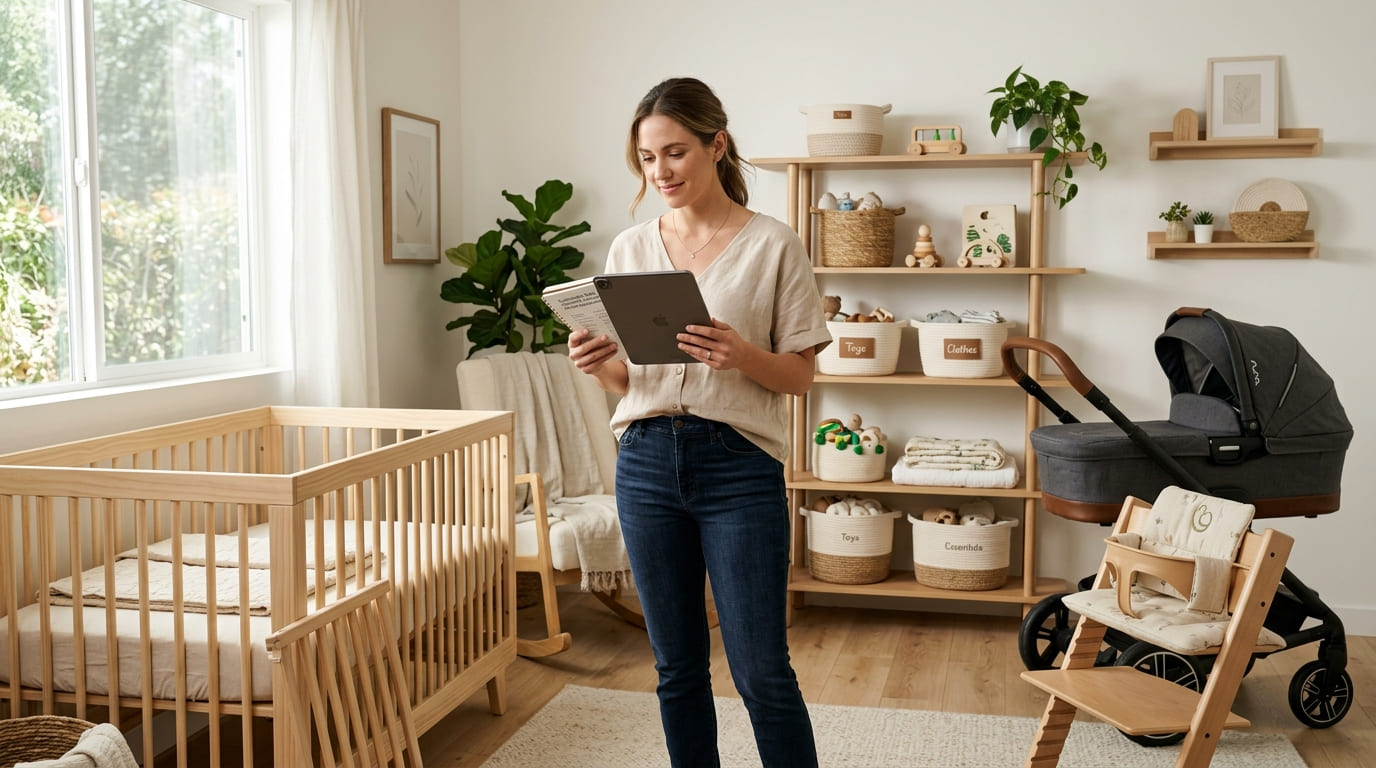
Every new parent has been there. You spend weeks researching the perfect baby gear, buy everything on the list, and six months later — half of it is collecting dust in the corner. The bouncer your baby loved at two months? Completely ignored by month four. That expensive swing? Outgrown before you even paid off the credit card.
Here is what no one tells you before the baby arrives: most baby products have an incredibly short useful life. And in 2026, the most switched-on parents around the world are refusing to play that game anymore.
The new approach is simple — choose baby products that grow with your child.
What Does “Grows With Your Child” Actually Mean?
A product that grows with your child is one that adapts across multiple stages of development — not just the newborn phase. It adjusts, converts, or transforms so that it remains useful from infancy through toddlerhood and sometimes beyond.
Think of it this way: instead of buying a newborn rocker, then a high chair, then a booster seat separately, you invest once in a product that serves all three purposes at different settings.
This approach saves real money. It reduces clutter at home. And it is far better for the environment.
5 Baby Products Worth Investing In — Because They Last
1. Convertible Crib (Newborn to Age 5)
A standard crib is used for roughly 18 to 24 months. A convertible crib, on the other hand, starts as a full-size crib with side rails, converts into a toddler bed, and in many models, eventually becomes a full junior bed.
What to look for: solid wood construction, non-toxic paint finish, and mattress height adjustability. The mattress should sit high for newborns and drop lower as your baby learns to pull up and stand.
This is one product where spending a little more upfront genuinely pays off over time.
2. Adjustable High Chair (6 Months to 6 Years)
A basic high chair works for about one year. An adjustable high chair with a removable tray, reclining seat, and height settings that sync with your dining table? That chair stays useful for years.
By age three, many of these chairs become a regular dining chair that fits right at the family table — no tray needed. Some models even convert into a small desk and stool combination, perfect for colouring and early learning activities.
Look for: easy-to-clean seat padding, a five-point safety harness, and sturdy, non-tip legs. Avoid high chairs with too many fabric folds — they trap food and become unhygienic quickly.
3. Modular Stroller System (Newborn to Toddler)
A travel system stroller that begins as a flat-recline pram for newborns and adjusts to an upright toddler seat is one of the smartest purchases a parent can make. Many systems also attach directly to a car seat, eliminating the need to wake a sleeping baby during transfers.
Key features to prioritise: lightweight aluminium frame, puncture-resistant wheels, one-hand fold mechanism, and a reversible seat so your baby can face you as a newborn and face the world as a curious toddler.
In India, brands like R for Rabbit and Chicco offer reliable modular stroller options at a range of price points. Globally, Joie and Graco are consistently well-reviewed for durability and value.
4. Open-Ended Toy Sets (Age 6 Months to 6 Years and Beyond)
Here is a category where the difference between a growth-oriented product and a throwaway one is crystal clear.
A battery-operated toy that sings the alphabet has exactly one function. Once your child masters that function — usually within a few weeks — the toy loses its appeal entirely.
Contrast that with a set of wooden stacking rings or a simple set of building blocks. A six-month-old mouths them and develops sensory awareness. A one-year-old stacks and knocks them down, building motor skills. A three-year-old uses them to build towers, sort by colour, and create imaginary worlds.
The same toy. Three completely different developmental stages. Zero batteries required.
Look for: non-toxic paint or natural wood finishes, smooth edges, and age-appropriate sizing to avoid choking risks for younger babies.
5. Baby Carrier with Ergonomic Adjustment (Newborn to Toddler)
A well-designed ergonomic baby carrier supports your newborn in the fetal position and adjusts as your baby grows to support an older toddler on your back or hip. The best carriers grow from 3.5 kg newborns up to 20 kg toddlers.
The ergonomic aspect is critical — for the baby, the carrier should support a natural M-position with knees higher than the bottom. For the parent, padded shoulder straps and a waist belt distribute weight properly and prevent back strain.
Brands like Ergobaby, LÍLLÉbaby, and Indian brand Snugkins are widely trusted across global parent communities for both safety and longevity.
3 Questions to Ask Before Every Baby Purchase
Before adding anything to your cart, run it through these three questions quickly:
Will this still be useful in 18 months? If the honest answer is no, either skip it or borrow it from another parent.
Does it meet certified safety standards? In India, check for BIS certification. Internationally, look for EN 71 or ASTM markings. No certification, no purchase — regardless of how attractive the price looks.
Does it make daily life simpler or more complicated? The best baby product is one that frees up your time and energy. If a product creates more tasks than it solves, it is not worth the shelf space.
A Note on Sustainability
Choosing products that grow with your child is not just a financial decision — it is an environmental one. The global baby product industry generates an enormous amount of waste every year from products discarded after just a few months of use.
When you invest in multi-functional, long-lasting baby gear, you directly reduce that waste. And when your child eventually outgrows even these products, passing them on to another family through resale or donation extends their life even further.
Conscious parenting in 2026 is not about buying the most premium products. It is about buying the right ones — fewer, better, and built to last.
Frequently Asked Questions
A convertible crib, an ergonomic baby carrier, and a modular stroller system are the three products where spending a little more upfront genuinely saves money over time. These items are used daily across multiple stages of your baby’s development, so quality and durability matter more here than anywhere else.
Yes — especially if you are planning more than one child. A good convertible crib serves as a newborn crib, toddler bed, and junior bed across 4 to 5 years. Compared to buying separate beds at each stage, the savings are significant. Just ensure it carries BIS certification (India) or EN 716 certification (international markets).
Most standard baby products — bouncers, newborn rockers, basic high chairs — are outgrown between 4 and 12 months. This is exactly why multi-functional, adjustable products make more sense. Products designed to grow with your child typically remain useful from birth up to age 3, 4, or even 6 depending on the category.
Always check for safety certification before anything else — price, brand, or design. In India, look for BIS (Bureau of Indian Standards) marking. For internationally sourced products, check for EN 71 (Europe) or ASTM (USA) certification. A certified affordable product is always a better choice than an uncertified premium one.
Related Reading
Looking for affordable baby essentials? Check out our detailed guide:
Budget-Friendly Baby Products in 2026: Smart Choices for Indian and Global Parents
Final Thought
Your baby does not need a house full of gear. They need safe, well-designed products that meet them where they are developmentally and grow alongside them. Start with the five categories above, apply the three-question filter to every purchase, and you will find that parenting feels a little lighter — financially, physically, and mentally.
Enjoyed this guide? Share it with a parent who is about to start their baby shopping journey. Explore more practical parenting advice at MumPappaHub.

3 Comments