
Medical Disclaimer: This article is for informational purposes only. Milestones are ranges, not deadlines. Always consult your paediatrician if you have concerns about your baby’s development.
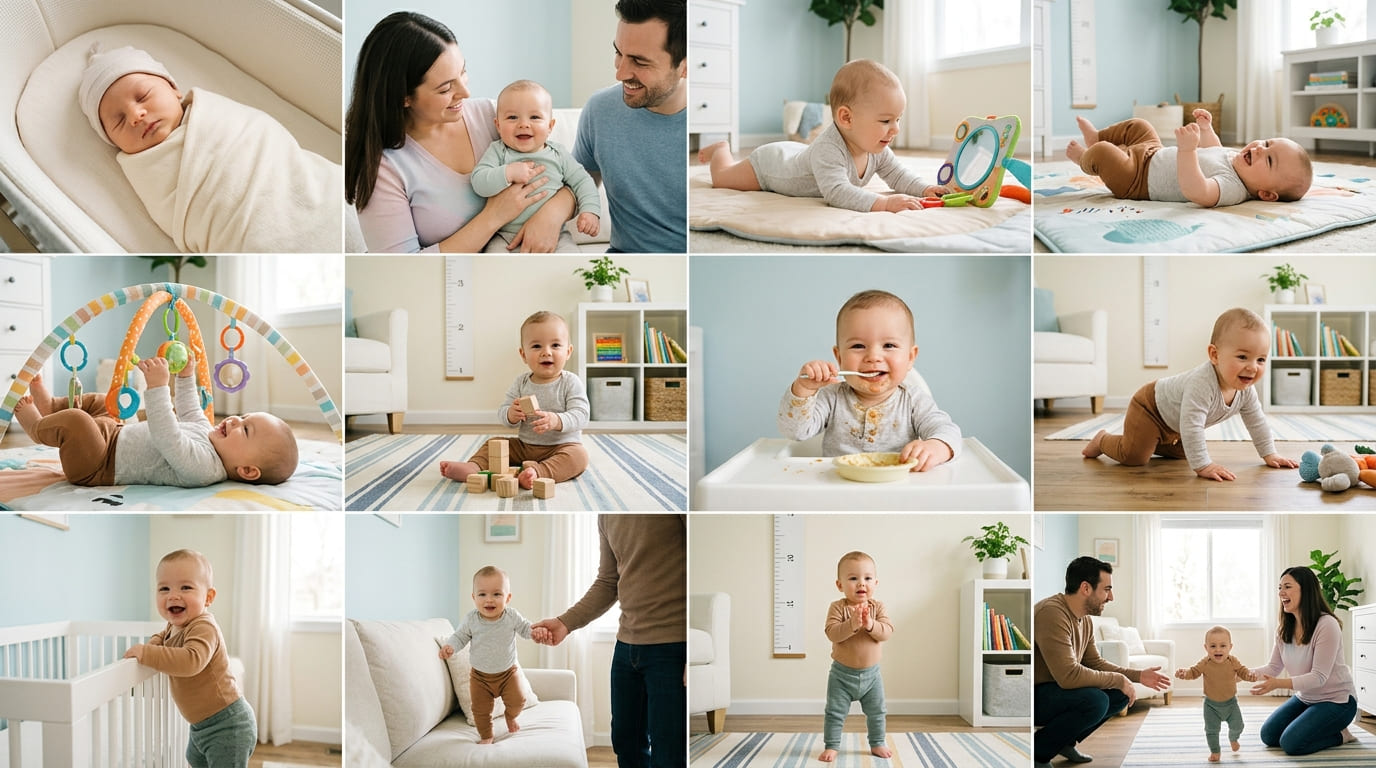
Baby first year milestones charts make it sound simple — crawl by nine months, stand by eleven, walk by twelve. My daughter was eleven months old when I read one of those charts and it said she should be pulling to stand by now.
She wasn’t. She was sitting very contentedly in the middle of the floor, examining a plastic spoon with the focused intensity of a scientist who has just discovered something remarkable about plastic spoons.
I closed the chart. I opened it again. I Googled “11 month old not pulling to stand.” I read four different forums with four different answers. I spent twenty minutes spiralling. My daughter, completely unaware of any of this, kept examining the spoon.
She pulled to stand at twelve months. Walked at fourteen. She’s fine. She’s brilliant, actually, at the things she cares about.
This is the guide I wish I’d had then — the one that explains what’s actually happening each month, what the ranges really mean, and how to watch your baby without losing your mind in the process.
Before the months — what milestone charts actually mean
Here is the thing that milestone charts don’t tell you upfront: the ranges they list are not the average. They’re the range within which most babies — not all babies — achieve a particular skill. A baby who walks at nine months and a baby who walks at fifteen months are both developing completely normally.
According to the World Health Organization’s Multicentre Growth Reference Study, the window for typical motor milestone achievement is significantly wider than most parents expect. Walking, for example, normally occurs anywhere between 9 and 18 months. That’s a nine-month window. Most milestone charts show one number.
The Indian Academy of Pediatrics is consistent in its guidance that developmental surveillance — watching for the overall pattern and trajectory of development — matters more than whether a specific skill arrived by a specific date.
So: use the months below as a map, not a schedule. Your baby is reading the terrain, not the map.
Month 1 — Everything is new and overwhelming, for both of you
Your baby has spent nine months in a warm, dark, continuously nourishing environment with constant sound and sensation. Now they’re here, in a world of variable temperature, intermittent feeding, and an overwhelming amount of visual information.
The first month is mostly adjustment.
What you’ll notice:
Your baby can see — but only clearly at about 20 to 30 centimetres. Which is almost exactly the distance from your face to theirs during feeding. This is not a coincidence. They are designed to see you at the distance you hold them. Faces — especially your face — are the most interesting thing in their visual world right now.
They startle easily. The Moro reflex — arms flinging wide in response to sudden movement or sound — is active and strong. It looks dramatic. It’s normal.
They hold their head for a second or two during tummy time before it drops. The neck muscles are working on it.
What you’ll notice about yourself:
Sleep deprivation hits differently than you imagined. You are also adjusting — to a completely new identity, a completely changed body, a completely different life. Both of you are figuring out something new.
For support on the newborn period — what to actually expect and how to survive it — our newborn care tips guide covers the practical side honestly.
🛒 Helpful for this stage:
Month 2 — The smile that changes everything
Around six to eight weeks, the social smile appears.
Not the reflex smile of the first weeks — this is a real one. Eye contact, face lighting up, smile that reaches the eyes. Responding to you. The first evidence that your baby knows you are you and is genuinely pleased about it.
I’m telling you this in advance so you’re watching for it. It arrives around the same time as the hardest weeks of new parenthood, and it matters more than you might expect.
🛒 Helpful for this stage:
What else is happening:
Cooing begins — those soft, round vowel sounds. Your baby is discovering that their mouth can make things. This is language, at its very earliest stage.
Head control is improving. During tummy time, they’re lifting the head more consistently and holding it a little longer.
They’re tracking — following a moving object or face with their eyes. Moving something slowly in front of them and watching them follow it is one of the more remarkable things about this month.
Month 3 — Personality starts arriving
By three months, your baby has opinions. About who holds them. About which position they prefer. About how they feel about the car seat (often: not great).
What’s developing:
Hands become fascinating. Your baby is discovering that these things attached to their arms are theirs to control. They’ll stare at their hands with the same concentrated attention they’ll later give to toys.
Tummy time is getting easier. The head is lifting to 45 degrees or more. Forearms are pushing up from the mat. The neck and shoulder muscles are building the foundation for everything that comes next.
Sounds are multiplying. Laughing begins — usually a soft, surprised-sounding giggle that you will subsequently spend enormous amounts of time trying to reproduce.
Month 4 — Rolling and the sleep regression
Month four contains one of the most celebrated milestones and one of the most dreaded developments, often arriving together.
The rolling:
Rolling from tummy to back usually comes first — the baby lifts the head, the weight shifts, and gravity does the rest. It often happens before the baby intends it to. The look of mild surprise on their face the first time is genuinely delightful.
The sleep regression:
Also around this time — and it is not a coincidence — many babies who were sleeping in reasonably predictable stretches suddenly start waking more frequently, taking shorter naps, and generally disrupting sleep patterns that felt like they were finally becoming manageable.
This happens because the brain is reorganising. Sleep architecture is maturing from the predominantly deep newborn sleep into something closer to the adult cycle, with more frequent transitions between sleep stages. Each transition is an opportunity to wake.
It’s temporary. It feels permanent. It isn’t. Our 4 month sleep regression guide explains what’s happening and what actually helps.
🛒 Helpful for this stage:
Month 5 — Reaching, grabbing, mouthing
Five months is when babies become interactive in a way that feels more like a conversation.
What’s happening:
Reaching for objects with intention. Not waving arms in the general direction of a toy — actually reaching toward a specific thing. The coordination required for this is significant.
Everything goes in the mouth. Everything. This is not random — mouthing is how babies at this age gather information about an object. The mouth has more sensory receptors per centimetre than the hands. It’s a learning strategy.
Sitting with support is becoming possible. Propped in a high chair or with pillows around them, many five-month-olds can hold themselves upright for increasing periods.
Stranger awareness often begins — the recognition that some faces are familiar and some are not, and the first signs of preference for familiar people.
Month 6 — Solids, sitting, the big transition
Six months is a genuine turning point.
Sitting independently:
Many babies sit without support for brief periods this month. It comes suddenly — one day they topple immediately, the next day they sit for thirty seconds, the next week they sit indefinitely. The core muscles have crossed a threshold.
This matters for more than sitting. Independent sitting is also the developmental readiness indicator for starting solid foods.
Starting solids:
The WHO and Indian Academy of Pediatrics both recommend exclusive breastfeeding or formula feeding until six months, with solids introduced alongside milk from this point. Signs of readiness: sitting with minimal support, head control, loss of the tongue-thrust reflex that pushes food back out of the mouth.
First foods should be single-ingredient purees or soft finger foods — introduced one at a time with a few days between new foods to monitor for reactions. Our starting baby solid foods guide has a complete week-one plan.
🛒 Helpful for this stage:
Month 7 — On the move (or preparing to be)
Movement is coming. The form it takes varies enormously — some babies crawl classically, some bottom-shuffle, some commando-crawl flat on their belly, some skip crawling altogether and go straight to walking. All of these are legitimate.
What’s developing:
Object permanence begins this month — the understanding that things continue to exist even when they can’t be seen. Before this, out of sight was genuinely out of mind. Now, when you leave the room, the baby understands you still exist somewhere. This is why separation anxiety often increases around this time — it requires knowing you’re gone to be upset about it.
Babbling begins. Real babbling — consonant-vowel combinations. “Ba-ba-ba.” “Da-da-da.” “Ma-ma-ma.” These aren’t words yet — the baby is practicing sounds — but they’re the building blocks of language.
Hand transfer — passing an object from one hand to the other — develops this month. It requires more bilateral coordination than it sounds.
Month 8 — Separation anxiety peaks (briefly)
Eight months is often the peak of separation anxiety. Understanding that you exist when you leave + not yet understanding that you will come back = significant distress when you go.
This is not a regression. This is a cognitive advancement expressing itself emotionally. The baby now understands enough about permanence to be upset by absence, but not yet enough to trust return.
What else is happening:
The pincer grasp is developing — the ability to pick up small objects between thumb and forefinger. Developmentally significant because it requires precise finger coordination. Practically significant because every small thing on the floor is now of interest.
Standing with support is often possible by this month. Holding onto furniture or your fingers, many babies can bear weight through their legs.
Peek-a-boo becomes genuinely funny to your baby around this time rather than simply confusing. This is object permanence in play form — you disappear and reappear, and now that they understand you still exist when hidden, the reappearance is genuinely surprising and delightful.
🛒 Helpful for this stage:
Month 9 — Pulling to stand, cruising, communicating
Month nine is where the physical and social development really accelerate.
Gross motor:
Pulling to stand from the floor — grabbing furniture, your trousers, anything in reach, and hauling themselves upright. Once standing, cruising along furniture begins — walking sideways while holding on.
Communication:
The babbling is becoming more varied and more clearly communicative. Your baby is using specific sounds in specific contexts. They may understand several words — their name, “no,” common object names — even without being able to say them yet.
Pointing appears — first receptive (responding when you point) then expressive (pointing to communicate what they want). Pointing is a significant communication milestone. It demonstrates understanding that another person can follow their attention to a shared object.
If you’re seeing signs of language delay or are concerned about communication development, our toddler language development guide covers what’s typical and when to seek assessment.
Month 10 — Getting faster, getting more opinionated
By ten months, most babies are mobile enough to be genuinely difficult to contain. Whatever form of locomotion they’ve chosen, they’ve gotten fast at it.
What’s happening:
Standing alone — briefly, often accidentally. The baby pulls to stand, lets go to reach for something, and stands unsupported for a second before sitting back down.
Imitation is more sophisticated. Your baby watches what you do with objects and tries to replicate it. Brushing hair, talking on a phone, sweeping — they’re watching and trying.
The first words are forming. Not necessarily clearly spoken yet, but specific sounds used consistently for specific meanings. “Ba” for bottle. “Da” for dog. The mapping of sound to meaning has begun.
Emotional communication is more complex. Frustration is expressed more clearly. So is joy. So is affection — at ten months, most babies actively seek physical closeness when distressed, which is both sweet and somewhat exhausting at 3 AM.
Month 11 — The final month before the first birthday
Eleven months is often a month of consolidation — skills that were emerging become established, and the baby is preparing for the leap to independent walking and first proper words.
What’s developing:
Object permanence is now robust. Your baby will look for a hidden toy, understand that it was put away rather than destroyed, and wait for it with genuine patience.
Waving bye-bye is usually established. It seems simple. It requires understanding social convention, intentional gesture, and connecting an action to a social context.
Feeding independence is increasing. Many eleven-month-olds can drink from a sippy cup and are beginning to use a spoon with variable success.
Month 12 — The first birthday
A baby who weighed somewhere between 2.5 and 4 kg twelve months ago is now, most likely, three times that weight. They can probably stand. They may be taking first steps, or they may be a few weeks away from it. They have, in all likelihood, at least one or two clear words.
The first birthday is as much about you as about them. You have kept a person alive and thriving for a year. You have done this while running on inadequate sleep, navigating a completely changed identity, and figuring out something entirely new with essentially no prior experience.
That’s worth celebrating.
What to expect around the first birthday:
Walking: anywhere from nine to eighteen months is normal. If your baby is not yet walking at twelve months, this is not a concern. If they are not walking by eighteen months, speak to your paediatrician.
Words: one to three clear words with consistent meaning is typical around twelve months. Some babies have more, some have fewer. The trajectory matters more than the number.
Understanding: your baby understands significantly more than they can say. Simple instructions (“bring me the ball,” “wave bye-bye”), object names, and emotional context are all comprehended.
For a complete guide to what comes next — when babies start walking, talking, and the developmental milestones of the toddler years — our when do babies start walking guide and child development milestones guide cover the next stages in detail.
🛒 Helpful for this stage:
When to talk to your paediatrician
Most variation in milestone timing is completely normal. Some things, however, do warrant a conversation — not because they’re definitely a problem, but because early assessment and support is always better than late.
| Milestone | Talk to your doctor if… |
|---|---|
| Smiling | No social smile by 3 months |
| Eye contact | Not making eye contact by 3 months |
| Rolling | Not rolling either direction by 6 months |
| Sitting | Not sitting with support by 9 months |
| Babbling | No babbling by 9 months |
| Pointing | No pointing or waving by 12 months |
| Words | No single clear words by 12 months |
| Walking | Not walking by 18 months |
| Any skill | Baby loses a skill they previously had — always talk to your doctor |
The last one matters most. Regression — losing a skill that was established — always deserves prompt assessment. New skill delays often resolve on their own. Lost skills need to be looked at.
For more on speech and language development specifically, our speech delay in toddlers guide covers the signs, causes, and when to seek help.
Supporting your own wellbeing through the first year
This guide is about your baby’s milestones. But you have milestones too — and they matter just as much.
The first year is emotionally complicated in ways nobody quite prepares you for. The love is real and enormous. So is the exhaustion, the identity shift, the grief for aspects of the life that existed before, and occasionally the feeling that you have absolutely no idea what you’re doing.
All of that is normal. All of it coexists with genuine joy and competence.
If the emotional weight of this year is feeling like more than normal adjustment — please speak to your doctor or midwife. Postnatal depression and anxiety affect more parents than the numbers suggest, because many don’t mention it. Our baby blues vs postpartum depression guide explains what’s typical and what deserves proper support.
FAQ — Baby’s First Year Milestones
About milestone timing
Q: My baby isn’t reaching milestones on time. Should I be worried?
Milestone charts show ranges — often wider ranges than they appear to show. A baby who achieves something at the later end of the range is developing normally. The question to ask is not “is my baby on the chart” but “is my baby making overall progress.” Across the first year, a baby should be acquiring new skills consistently, even if the timing of each is later than average. If skills are being lost rather than delayed — speak to your paediatrician.
Q: My baby skipped crawling and went straight to walking. Is this okay?
Yes. Crawling is not a required milestone — it’s one common path to walking, but not the only one. Bottom-shufflers, tummy-crawlers, and babies who pull to stand and walk without ever crawling on hands and knees are all developing normally. Some research suggests crawling supports bilateral coordination and visual development, so floor time is always worthwhile — but skipping the classic crawl is not a red flag.
Q: My first baby walked at nine months. My second isn’t walking at thirteen months. What’s wrong?
Probably nothing. Siblings often develop at quite different rates — including in the same family, with the same parenting. Thirteen months is well within the normal range for walking. If walking hasn’t appeared by eighteen months, that’s when a paediatrician should assess.
About supporting development
Q: How much tummy time does my baby need?
From birth, short supervised tummy time sessions — even two to three minutes several times a day — support neck and shoulder development. By three months, aim for thirty minutes total throughout the day. Tummy time is the foundation of rolling, sitting, crawling, and walking. Most babies dislike it initially and tolerate it better as they get stronger.
Q: Do I need to buy educational toys to support development?
No. The most developmentally valuable things for a baby in the first year cost nothing — your face, your voice, conversation, narrating what you’re doing, floor time, physical contact. Simple household objects — wooden spoons, containers, scarves — are often more engaging than purpose-made toys because they’re novel and have multiple possibilities.
Q: How do I know if my baby is happy and developing well?
A baby who is alert when awake, gaining weight appropriately, making eye contact, responding to voices, and showing interest in people and objects around them is developing well — regardless of whether specific milestones have arrived exactly on schedule.
About the emotional side
Q: I feel sad that my baby is growing so fast. Is this normal?
Completely. The grief of the growing-up process — the bittersweet quality of each stage passing — is one of the less-discussed aspects of parenthood. Every milestone is also a goodbye to the stage before it. Feeling both proud and sad simultaneously is not contradictory. It’s accurate.
Q: I keep comparing my baby to others and feeling anxious. How do I stop?
The comparison reflex is very human and very unhelpful. Other babies’ milestones tell you nothing about your baby because development is not a competition — it’s an individual trajectory. If comparison is causing significant anxiety, limiting the specific sources (certain apps, certain parent groups) often helps more than willpower alone.
More from MumPappaHub — Read These Next:
- Newborn Care Tips: The Complete Guide
- Newborn Sleep Tips
- 4 Month Sleep Regression: What’s Happening & What Helps
- Starting Baby on Solid Foods
- When Do Babies Start Walking?
- Toddler Language Development
- Child Development Milestones
- Speech Delay in Toddlers: Signs & When to Worry
- Baby Blues vs Postpartum Depression
- Baby Fever Guide
- Baby Sleep Training Guide
- Potty Training Guide
About This Article
Written by the MumPappaHub editorial team — including a mother who spent twenty minutes Googling “11 month old not pulling to stand” while her daughter serenely examined a plastic spoon. The daughter is fine. The spoon survived.
Reviewed for accuracy against current WHO child development guidelines and Indian Academy of Pediatrics recommendations. This content is for general informational purposes and does not constitute medical advice. Always consult your paediatrician with specific concerns about your baby’s development.
MumPappaHub — Real talk for real parents. mumpappahub.com

22 Comments